


On a jagged mountain top, with sweeping views of the Jordan Valley, the past and present converge. Around two dozen dust-covered archaeological workers are busy digging up mud and sifting through buckets of dirt.
Beneath their feet lie the remnants of ancient kingdoms, while the lush green landscape before them is dotted with Palestinian villages and Israeli settlements on one of the most geopolitically contested strips of land on Earth.
This is Alexandrion, named after Hasmonean King Alexander Jannaeus, who reigned here from 103-76 BCE and likely used the site as a desert stronghold commanding the Jordan Valley. Later, it is believed to have been restored by Herod the Great, who ruled from 37-4 BCE, as another of his signature fortresses, akin to Masada and Herodium farther south.
The site is also known as Sartaba, where, according to Jewish tradition, beacon fires once signaled the arrival of the new moon – Rosh Hodesh – to communities across the valley and toward Jerusalem.
Evidence of this layered past is scattered across the steep mountainside. Collapsed heart-shaped columns, shards of pottery, and fragments of fresco and stucco lie exposed, while other relics such as coins, walls, and water systems remain buried beneath centuries of sand.
‘De facto annexation’
While such dramatic ancient archaeological sites are located across this region, which Israelis call by its biblical name, Judea and Samaria, Alexandrion/Sartaba is now one of a handful of places where active excavations are taking place – for the first time in 40 years.
However, the renewed excavation here is not unfolding in isolation from modern events. It comes amid a sweeping Israeli government initiative to expand archaeological activity across the West Bank – territory Palestinians seek for a future state; territory which much of the international community considers “occupied.”

The renewed digging coincides with policies by Israel’s right-wing government aimed at tightening control over the territory and expanding Jewish settlement. Palestinians have described these measures as “de facto annexation.”
Much of the West Bank remains under Israeli military control, with limited Palestinian self-rule in areas administered by the Palestinian Authority.
Saving the past
At Sartaba, archaeologist Dvir Raviv of Bar-Ilan University leads the excavation, which is funded by Israel’s Heritage Ministry and supported by the archaeology department of the Civil Administration – the Israeli military body overseeing civilian affairs in the West Bank. The project is now in its second season. The team includes both Israeli and Palestinian workers and volunteers.
“Last season, we had to walk 40 minutes every morning just to get here,” Raviv told The Jerusalem Report during the magazine’s recent visit to the site.
Standing on the very tip of the mountain, he explained that due to its geographical location, excavations at the site “are very complicated.”
This year, access has improved after the Civil Administration paved a narrow road to the foot of the mountain, reducing the final climb to just a few minutes.
‘Occupied land’
The last excavation here took place between 1981 and 1984. Archaeologists uncovered a storeroom, a ritual bath (mikveh), and an elaborate water system on the eastern slope.
Then work stopped.
Part of the reason was logistical. The terrain is unforgiving. But geopolitics intervened as well. In 1987, the First Intifada erupted, drawing global attention to the Palestinian struggle for statehood in the West Bank and Gaza.
Suddenly, it was no longer appropriate for archaeologists working with renowned Israeli academic institutions to excavate in the area, which many of their counterparts around the world viewed as illegally occupied by Israel.
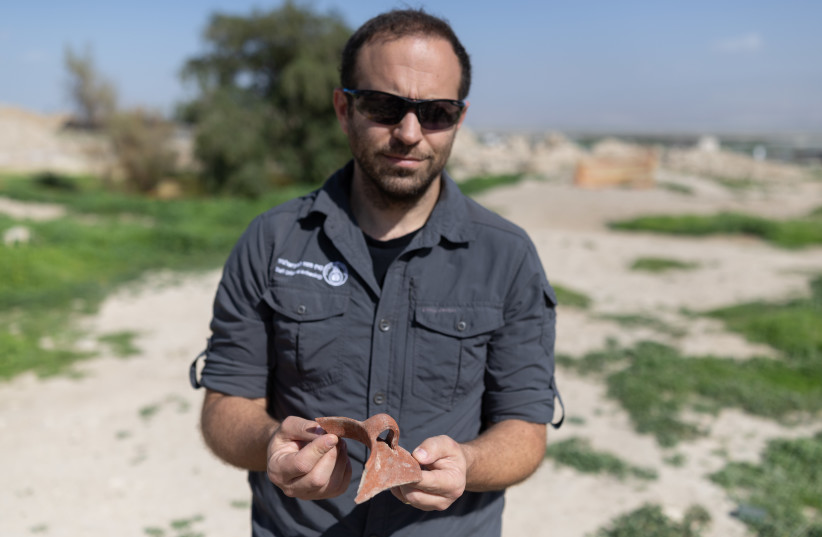
Raviv acknowledges the criticism but focuses on the historical potential of the site. Spanning five to seven dunams (5,000–7,000 square meters), with the remains of a tower already visible, he expects that the excavation could continue for at least a decade.
Protecting history
Alongside architectural remains, the team has found evidence of vandalism and looting – scars of years when the site lay largely unmonitored.
“This is a place that was ruined and destroyed. We are now here saving it from looters and thieves,” said Eyal Freiman, archaeologist and deputy head of the Civil Administration’s Staff Office for the archaeology department.
According to Freiman, surveys conducted after Israel captured the West Bank in the 1967 Six Day War identified roughly 5,000 archaeological sites across the territory.
Excavations took place sporadically during the 1970s and 1980s but slowed dramatically in the 1990s after the Oslo Accords divided the West Bank into Areas A, B, and C, assigning varying degrees of Israeli and Palestinian control.
Freiman estimates that 3,000 sites lie in Area C, under full Israeli control; about 1,000 are in Area B, under Israeli security control and Palestinian civil administration; and another 1,000 are located in Area A, administered by the Palestinian Authority.
Five years ago, he said, a government decision was made to develop – and, more importantly, protect – some of those places, although funding was initially limited.
That changed in July 2023, when a multi-year plan allocated additional millions of shekels to combat antiquities theft and expand development of archaeological and tourism sites in the West Bank.

The initiative was spearheaded by Heritage Minister Amichai Eliyahu, a member of the Otzmah Yehudit party, alongside Finance Minister Bezalel Smotrich and Tourism Minister Haim Katz.
“We are investing in this out of the understanding that we are not just a lone olive leaf but an olive growing on earlier branches. We are not alone in the world but are deeply rooted in the soil,” Eliyahu told the Report. “One who has no roots is a single olive, detached, new, a leaf blown in the wind. But one who has roots can flourish, and his growth can develop,” he elaborated.
The minister said that close to NIS 300 million has now been invested in the project, with the overarching goal of proving Israel’s connection to the land via archaeology.
“The struggle is ideological. It is not about money,” Eliyahu said. “They [Palestinians] want to destroy us. If we forget for a moment why we are here and what our right is here, what happened on October 7 will happen again.
“But if we remember our path, it will also be better for them,” he continued. “There are Arabs here who understand that we returned after 2,000 years of exile. Some even preserved our names and parts of our history in the names of their villages.
“That they now deny the historical role they played in preserving the land’s heritage is because they lost their way, not because we lost ours,” the minister said.
Delicate divide
With increased funding, Freiman and his unit have expanded enforcement – monitoring not only looting but also construction projects that might threaten antiquities.
The delicate divide between the geopolitics and conflicts of today and the secrets of the past is fully on display a few miles south of Alexandrion/Sartaba, just north of the Palestinian city of Jericho.
Archelais, also known as Khirbet el-Beiyudat, was once a fortified administrative center active during the Hasmonean and Herodian periods. Today, it sits beside the main highway through the Jordan Valley.
The site is enclosed by fencing and surveillance cameras. Palestinian homes in the nearby town of Al-Auja stand just beyond.
Close to the fence, Freiman pointed out areas that had been destroyed, he said, by looters looking for antiquities or flattened by bulldozers and tractors clearing the way for more buildings in the Palestinian village.

“It’s a race to save the archaeological remains at this site,” he stated.
He explained that modern construction methods, which require deeper foundations, increasingly threaten subsurface remains.
Alex Melamed, an archaeologist overseeing work at Archelais, said that previous excavations uncovered the foundations of a Byzantine church with a mosaic floor, as well as a tower from the Second Temple, Herodian period.
It is believed that Herod’s son Archelaus built and resided at the site, which functioned as a commercial hub for the area.
“What’s amazing here is that in the future, visitors will be able to come and see a church next to a synagogue, and see all the layers and stages of what happened here,” Melamed marveled.
Freiman said he believes that heritage preservation should transcend politics.
“Not all the sites are Jewish, but they do tell the story of the region, and all the layers of this area show us how it all fits together,” he explained, adding that everything of significance in the Bible happened here, and this area is important to other groups as well.
“When Jesus walked from Nazareth to Jerusalem, it wasn’t via Tel Aviv, it was through the Jordan Valley, right through here,” said Freiman, gesturing to the area around him.
The Jewish narrative
Critics argue that the renewed archaeological impetus is inseparable from settlement expansion and Israeli efforts to consolidate long-term control over the territory.
Several sites slated for development lie adjacent to Jewish settlements or outposts. A planned community near Mount Ebal, in northern Samaria, is situated roughly one kilometer from a site identified by some as Joshua bin Nun’s Altar.
Near Sebastia – a location with layers of Israelite, Hellenistic, Roman, and Byzantine history – renewed excavation efforts coincide with the recent approval of the Homesh settlement nearby.
While the new farming communities are boosting the archaeological developments, the settlements are also benefiting from the presence of ancient sites. The hundreds of hilltop farms that are springing up throughout the West Bank were initially uncoordinated with the authorities; now they are being more well planned in order to avoid damage to antiquities and ancient sites.
Freiman agrees that it is strategic and pointed out that if Palestinians took control of such sites, they would likely prevent Jews from visiting altogether and might even work to erase or minimize the Jewish connection to them.
“We have seen a lot of destruction of the Jewish period of history in Palestinian areas,” he said.
“Archaeology is always connected to nationality, as it strengthens the narrative of the Jewish people,” he explained. “The fact that the minister and the government are pushing this plan, protecting these sites, is also strengthening the Jewish presence in Israel.”
On the summit of Alexandrion/Sartaba, the debate feels both distant and immediate. Each layer of earth removed reveals traces of ancient sovereignty – Hasmonean, Herodian, Byzantine – while the contemporary struggle over sovereignty continues all around it.
In this area, the past is never only the past. It is argument, evidence, and aspiration – unearthed one bucket of soil at a time.■