
It is said that children are our future. However, circumstances put many kids around the world at a considerable disadvantage, whether due to natural disasters or wars or other trauma-inducing situations.
But here to help those children is Ran Cohen Harounoff.
While already successful and notable for his work as a songwriter and popular children’s author behind The Treehouse Kids, created with his brother Yaya of the Israeli rock band Hadag Nahash, Cohen Harounoff is making an even bigger impact with his organization Early Starters International.
Whether it is a war zone in Ukraine, communities in Jamaica recovering from a hurricane, Venezuelan refugees in the US, or Israelis affected by the Oct. 7 massacre, Early Starters is committed to providing safe spaces and helping improve resilience on every level. This isn’t just a Band-Aid on an immediate emergency or helping with reconstruction – this organization is committed to helping on a systemic level, to truly help tackle problems and ensure a better future.
In Jerusalem sat down with Cohen Harounoff to talk about his work.

What is Early Starters International?
We are an international humanitarian educational organization and have been working since 2017. We work with children in crisis zones, like wars or earthquakes or hurricanes, and people living in long-term crises, such as refugees, diseases, poverty, and so on.
We’re now working in five places around the world, ranging from disaster zones to battlefields. We started in Ukraine at the beginning of the war with Russia, I think four days after it started. We work with refugees in Moldova in partnership with the Moldovan Welfare Ministry, and now we also work with children in Moldova itself.
In Ukraine, we opened safe spaces at first for the immediate emergency. Then we opened ones for displaced children and the children of adults who are fighting in the war. We’re also working with the Education Ministry there on having a systemic change in the kindergarten, which will help the kids who stayed behind have better education and give something better for the families who will eventually return.
We operate in the United States in different places, but mainly in New York. There, we work mostly with immigrants who were refugees, such as New Yorkers who came from Central America and Venezuela. But we’re also working with the general population. We helped out after the hurricane in North Carolina alongside the local JCC.
We have three phases of our work: the immediate emergency; the recovery period; and then the systemic approach, which is when we try to work with the country where the disasters have occurred.
I’ll give an example. One country we worked with was Ethiopia during an outbreak of a disease called trachoma, which impacts the eyes of children and can cause blindness. We worked in Ethiopia’s Tigray region to try and stem the spread of the disease. In the end, we helped 50,000 children and families, and we know we were successful.
When children have the disease, they have very visible signs of infection. Thanks to our work, we didn’t see those signs.

Where does your main funding come from?
Amazing Jewish families in the United States. One of our main funders is Dr. Evelyn Lipper, an amazing pediatrician.
We also work with the New York-Presbyterian Hospital. They provided some funding and helped us train staff in New York.
What sort of work do you do in Israel?
On Oct. 7, 2023, it took us half an hour to understand what we had to do. On October 8, we sent trucks to the hotels where the evacuees were. Within a few weeks, we were at 17 hotels and 17 safe spaces. So this is the main work we do in Israel. We open safe spaces for young children and their families.
When the children and their families started going back to their cities, we opened permanent safe spaces in communities along the Gaza border and in the North. We have safe spaces in Ashdod, Ofakim, and Netivot in the South. In the North, we have safe spaces in Majdal Shams, Tiberias, and Shlomi. We were working with the children from Shlomi when the war started, so we had a good connection with the town; and when we told them that we wanted to open a permanent place, they were really happy.
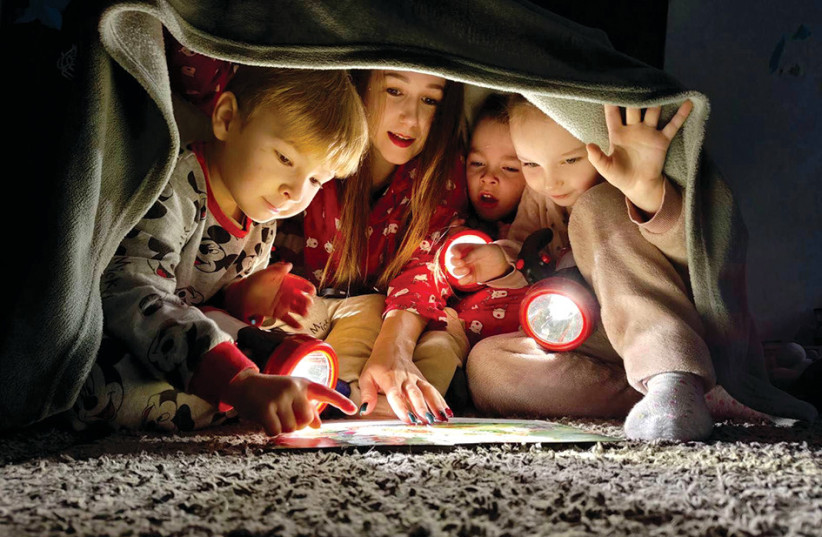
Our space there is especially different because we designed it after a year of working on how to design a space based on the idea that the environment can help children cope with post-trauma. The design was intended to give the children a sense of security, optimism, and hope. This includes taking care in selecting the colors on the walls, the textures, the sound, and even the smells.
What other projects do you have?
We have a project called Daddy Time. This is a project for reservist soldiers and their young children. A soldier comes with one of his children, and we help them on their connection with each other.
The activities can vary. In some cases, we’ll have them read a book together, or children will make dinners for their parents.
We also have the parents sit with one of our counselors to talk about their days and how it impacts their home lives.
It’s really beautiful, and it is so necessary. I heard one of the soldiers say he saw horrible things during combat, and he really is afraid that he will bring what he saw back home. Because of this, he spends all his time at work and not at home, and he was afraid of being with his child.
We had several fathers after our meetings realize that they were suffering from PTSD and went to therapy. We aren’t therapists, and we aren’t trying to be. We’re trying to help these parents connect with their children and come back home.
What sort of work have you done in Jamaica?
We went to Jamaica after a hurricane, and we connected with UNICEF and the education minister in advance. But once we got there, we saw the need to help out with children and parents, as well as children and teachers. But the big problem was systemic.
First, we worked to train teachers. We ended up training over a thousand teachers on what we call trauma-informed education. These were things we learned from the war in Ukraine and Oct. 7 – how to train educators in the aftermath of major catastrophes.
Now we’re thinking about broadening our work, building a strategy for the three next years on the recovery and rebuilding of Jamaica after that horrible hurricane, and bringing ideas that we developed in Ukraine and in Israel, on the future kindergarten of Jamaica, and working on the resilience of the staff and the children themselves.
And, of course, we’re working on building a systematic change in Jamaica’s early childhood education, though we’re still waiting for funding for that.