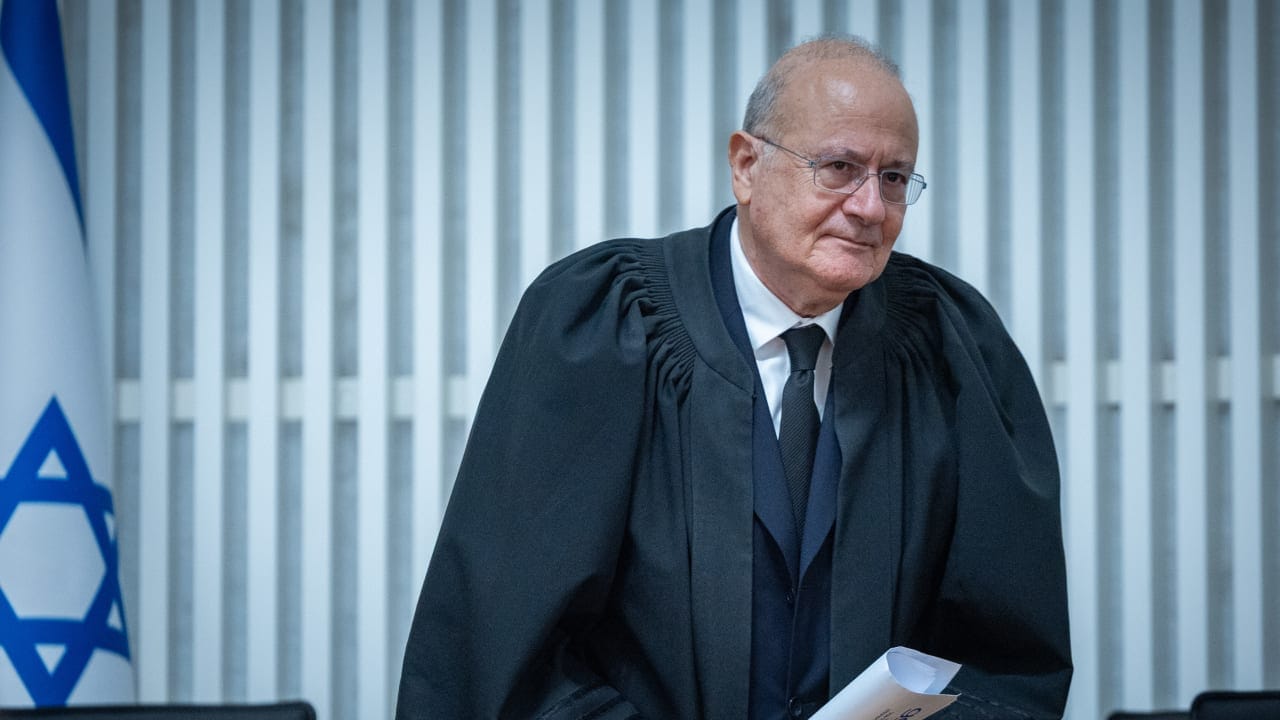
The parties in Yashar chairman Gadi Eisenkot’s bloc have agreed to nominate retired Supreme Court justice Yosef Elron to become state comptroller, Yashar reported Thursday.
Israel has been without a state comptroller since July, when Matanyahu Englman completed his seven-year term. In June, the Knesset voted to appoint his successor. The High Court of Justice invalidated the vote over concerns regarding its integrity and secrecy.
In that vote, Elron competed against attorney Michael Rabello, who had served as Prime Minister Benjamin Netanyahu’s personal lawyer.
During the vote, Likud was said to have instructed its MKs to document themselves casting their votes for Rabello as a way of placing pressure on them.
By law, the process for electing the state comptroller must be conducted through a secret ballot to protect the integrity of the vote and prevent political pressure from influencing the appointment.

Although the High Court ruled that a new vote must be held swiftly, the outgoing coalition did not hold one ahead of the October 27 election.
Rabello withdrew his candidacy for state comptroller in November amid the controversy.
On Thursday, Eisenkot backed his nomination of Elron for the position of state comptroller.
“During this complex period, the State of Israel needs strong, independent, and statesmanlike governing institutions,” he said.
Netanyahu had deliberately created a reality in which the country is left without a state comptroller, he added.
Doing so was “part of a systematic campaign to weaken the gatekeepers and dismantle the country’s institutions – another profound and dangerous failure that we are required to correct,” Eisenkot said.
“Appointing a state comptroller of considerable stature is an urgent necessity to ensure institutional continuity and strengthen public trust,” he said.
“Uncompromising adherence to proper procedures and to oversight and checks-and-balances mechanisms is the foundation of the country’s resilience and the proper functioning of all government institutions,” he added.
Eisenkot-led bloc holds parliamentary majority
Eisenkot’s bloc has a parliamentary majority following the October 27 election and has been seeking to advance legislation while negotiations to establish a new government continue.
Rabello was elected after a disputed two-round Knesset vote. In the first round, Elron received 60 votes, while Rabello received 57, leaving both candidates short of the required 61-vote majority.
A second round was then held. Opposition MKs said coalition MKs had been asked to photograph or film their ballots behind the curtain, even though the state comptroller must be elected by secret ballot.
Vote halted, restarted
The vote was halted and restarted. Rabello then defeated Elron 61-57.
A series of petitions to the High Court of Justice followed, including those filed by Yesh Atid and the Movement for Quality Government in Israel. The petitioners argued that documenting votes had turned the secret ballot into a loyalty test and could have prevented MKs from voting freely.
In its ruling, the High Court said a “fundamental defect occurred in the secrecy of the ballot,” requiring the annulment of the vote and a new election.
The State Comptroller’s Office is considered a key independent watchdog, overseeing the country’s public administration, integrity, and quality of services.
The comptroller has broad access to documents and information, as well as the authority to publish reports and audit government ministries and other public bodies.
Sarah Ben-Nun contributed to this report.