
Protecting Israel’s skies during the Israel-Iran War was a multilayered team game, usually with different land-based and air-based defense units each picking up on one target at a time of the 550 ballistic missiles and 1,000 drones that Tehran launched.
In that melee of aerial threats over June 13-24, there was one rare incident where a single Apache helicopter managed to down six drones in only a couple minutes, including a video-game-high-score-style “drone bonus” happening in real life – two drones being hit at exactly the same time.
The two helicopter pilots involved, Maj. (res.) G. and Maj. (res.) S. recently spoke to The Jerusalem Post about their unique experience.
Modestly, the pilots pointed out that they are the last line of defense and not the first line, which could be Iron Dome, fighter jets, David’s Sling, or even now the Iron Beam laser.
But once a drone beats those other layers of defense, S. told the Post, for the helicopter pilots “It’s complicated. We have a short time to shoot down threats. If we don’t shoot them down, they will strike Israel.”
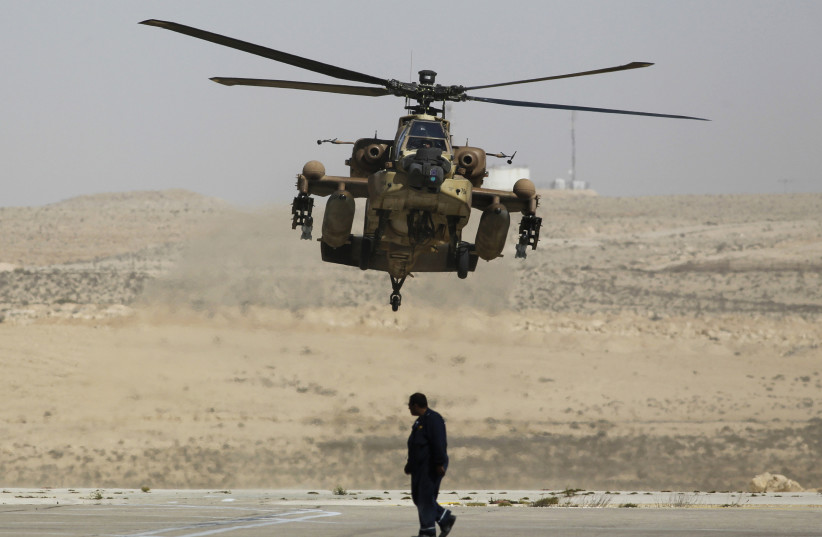
G. told the Post that in those couple of minutes where they shot down drone after drone in rapid succession, including two at the same exact moment, he was mostly ultra-focused on the task at hand, but “after the first drone, I thought, wow – it was a very good feeling to save Israelis.”
Our task is “hugely important. The Apache helicopters are the last line of defense. The helicopters are the goalkeepers,” added G.
“You need to understand the significance, have a sharp focus as you act, and for the outcome to be very precise. If we are a half meter off, we did nothing. We have to hit it the first time,” said S.
This air-to-air conflict was especially challenging for S. and G. during the Iran war, as they had mostly been used to provide close air support for IDF forces in Gaza, or sometimes aimed at assisting with ground forces in Lebanon and Syria.
“We are more experienced at providing air support on land,” especially in Gaza, said S.
S. continued, “The situations where we are providing air support to our ground forces are often similar, though some are more or less complex and tense.
“We have much greater experience” in Gaza, but there is always a challenge there, too, since if “we don’t shoot precisely, we could hit our soldiers,” noted S.
Sometimes there is more time and room to look over the battle space in Gaza for aiming more exactly against Hamas forces than there is to shoot down an Iranian drone in midair, “but not always. Sometimes, if we don’t decide and fire fast, the enemy [Hamas] could already have hit our soldiers.”
Prior to the October 7 invasion, there was more of a debate about how important Apache and other helicopters were to the future of the IDF’s security goals, with some considering eventually having the helicopters fade out of the mix, without replacing them.
However, IDF helicopters were some of the only effective air support for ground forces early on, on October 7 (when aircraft were moving too fast and too high to get close enough to make a difference and distinguish invaders from Israelis); and in other contexts, including shooting down drones, they have shown their ongoing value.
Helicopters’ capability to hover and fire a variety of weapons to shoot down smaller and slower threats at close range, as well as to adapt given that they are manned by human pilots, gives them some advantages over fancier aircraft and over Israeli defensive drones against certain threats.
The latest trend may include purchasing a new squadron of helicopters from the US at a price tag of around $50 million or more per chopper.
Details of purchase deal for new helicopter squadron under negotiation
Those details are still under negotiation, but there may be progress in the coming months.
S. DESCRIBED the transition from regular life to joining the reservist call-up for the Israel-Iran War. “I said goodbye to my kids, but then my wife was under lots of pressure from the sirens from Iranian missiles. It was very hard in Tel Aviv for the family” with me gone, he said.
Upon arriving at his base, S stated, “We had a one-hour pre-operation briefing, we ignited our helicopters, and three hours later we were up in the air defending the country.”
He said they received information from hundreds of sensors and intelligence platforms which identified the drone threats and their incoming trajectory. “Then it’s money time to down the drones.”
Of course, the Iran war was just the latest spike in their reserve duties.
Their reserve duty first went into overdrive during and after October 7 for a period of time, said G.
Eventually, things calmed down and they had a time period of returning to their normal lives.
But then, G. said, they were called up for extended reserve duty during the September 2024 to November 2024 spike in fighting with Hezbollah in Lebanon.
After that, they had calmer lives again until the Iran war.
Both S. and G. described major challenges for their families during their reserve duty, with G. noting that in one instance his wife gave birth to a baby a month after he was called up for service, and he was barely around to help out.
S. said that their mandatory and officer-career-track service had lasted 12 years, with the last seven years flying as reservists.
However, the heavier service flying as a reservist over the last approximately two years since October 7, 2023, he said, have heavily “impacted the family and the kids.”
Despite those sacrifices, S. said, “We always come when called up, and when it gets hard we try to reimagine the mission goal with a fresh mindset and focus on the cohesion of working together with hundreds of air force personnel,” including support personnel taking care of the helicopter’s maintenance needs.
G. has been in the IDF for 19 years, mostly flying Apache helicopters, though he also spent four years flying older Cobra-style attack helicopters
“We have been at war for two years, and we are still continuing. It’s a great privilege to be part of the efforts to defend the nation of Israel and my family more directly,” concluded G.