
To question, explore, imagine, dream, doubt, create, disassemble, and reconfigure: these are the core skills taught in the Faculty of Arts at Kibbutzim College of Education, Technology and the Arts (Seminar HaKibbutzim).
Founded in 1939, it was created as part of the Kibbutz Movement’s initiative to train teachers, preschool and up.
This year’s Faculty of Art graduation exhibition, titled Sof. Hatchala (End. Beginning), featured 21 students from the Faculty of Design, six from the Scenography Department, and 25 from the Faculty of Art. Their works span a wide range of media, characteristic of the school’s multidisciplinary approach.
“We teach multidisciplinary design, or as we prefer to call it, a total design,” Dori Oryan, head of the Faculty’s School of Design, told the Jerusalem Post Magazine.
He explained further to me: “The basic idea is that design is not about how you make it, but why you make it. The school is trying to teach students how to design to change the world. We believe that design is the tool to make the world better.”
While talking with students – young artists – I felt this spirit; therefore, referring to the exhibition’s title, at the end of the Jewish year 5786, I decided to dedicate this monthly column, “Three Artists, Three Questions,” exclusively to three new artists I selected from the exhibition. This is their beginning.
In diverse visual languages, they address issues of personal and collective identity shaped by life in Israel.
These three young artists answered my three questions:
What inspires you?
What do you call art?
What, in your opinion, makes your artwork different from that of other artists?
Aviya Edri
Born in 1998, Aviya Edri grew up and lives in Merkaz Shapira, a religious village in southern Israel. She is an artist, an art educator for children and young people, and an aspiring singer (she’s working on releasing her first single).
Raised in a religious family, she shared, “At 19, I chose an independent path and began working as an instructor of Western sports and therapeutic horseback riding.” The world of horses, along with denim and the leather associated with it, has become a significant part of her visual language over the years.
In 2022, she began her studies at the Faculty of Fine Arts at Kibbutzim College in Tel Aviv. Her art practice focuses primarily on textiles and sculpture, but also incorporates sound, singing, and clothing. She looks for connections among material, body, voice, and memory, and explores identity, tradition, independence, and the intersections of different worlds.
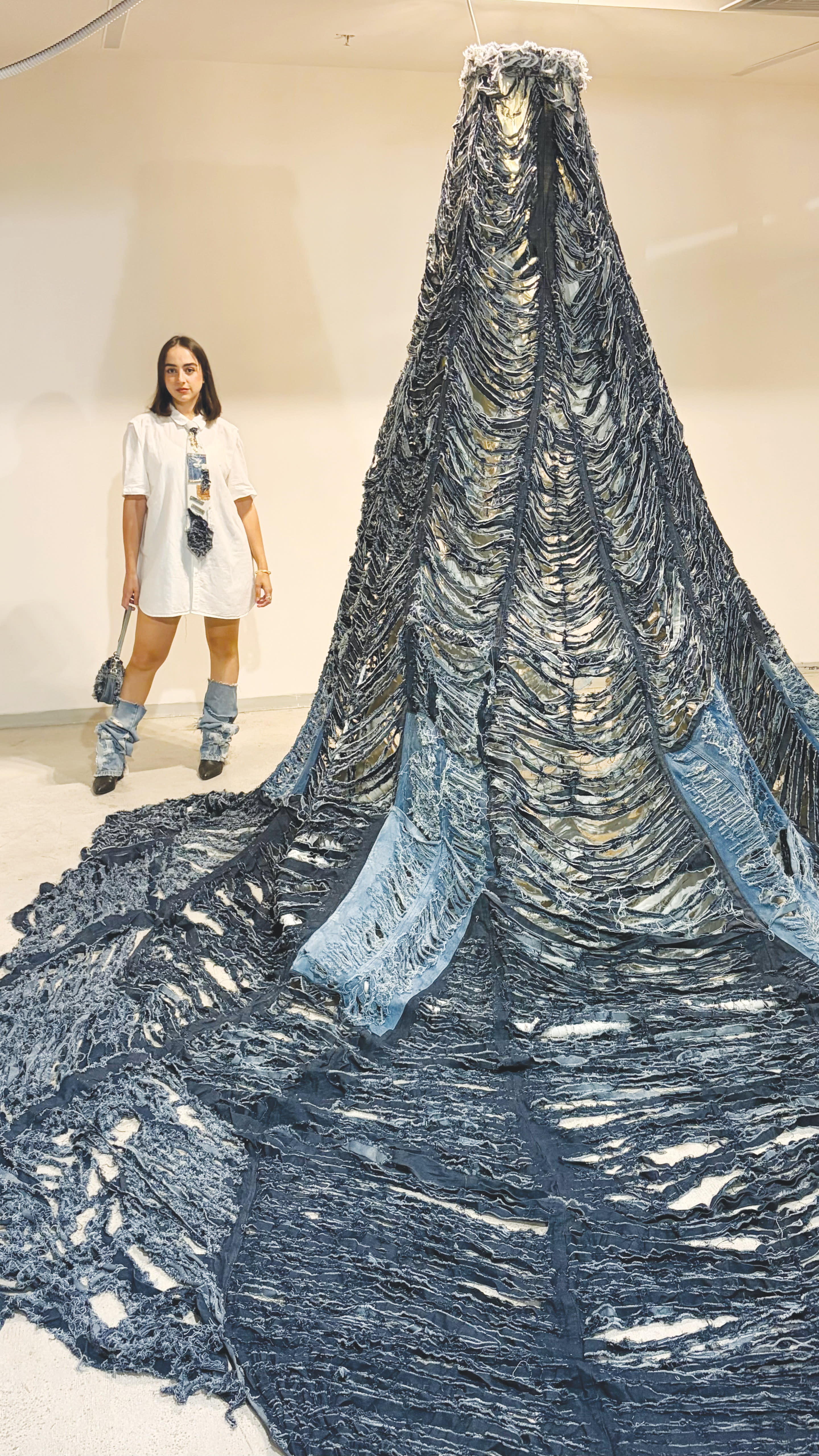
In V’hithalachti (And I Walked), her graduating piece, which I found truly captivating, Edri tells her personal story: “I explore identity and the intersection of worlds: my past and the life I chose to build for myself. Traditions and the religious home I grew up in intersect with independence, freedom, and the life I created for myself.”
She added, “Through the materials and techniques I work with, I strive to connect these two sides without having to choose between them. I unfolded denim and transformed it into a large veil, while simultaneously weaving my own voice into the work.”
Inspiration: Much of my inspiration comes from everyday life and the worlds I inhabit. The world of horses is a significant part of my artistic language. Through it, denim, leather, Western riding culture and aesthetics, nature, and a connection to the body and movement entered my life.
There is something free, wild, and effortless about the world of horses, and these qualities strongly influence how I create.
At the same time, I am deeply influenced by the religious and spiritual world in which I grew up. These two worlds continue to live within me, and their meeting is a significant source of inspiration for my work. I do not feel that I must choose between them; instead, I am interested in the places where they meet.
Music and voice are also an important part of my world. I am drawn to the possibility of turning my own voice into a material within a work, rather than using it merely as an accompaniment.
Meaning of art: For me, art is a way of expressing things that cannot always be explained in words. It allows me to take experiences, memories, and thoughts and express them through material, voice, body, and space.
Art exists not only in the final result, but also in the way a familiar material is transformed into something else. Through this process, I can take something rooted in my own life and give it a new meaning.
Edri’s art: I think the uniqueness of my work lies in the personal language and in its ability to move between different fields and become part of everyday life. I do not want art to remain only within the exhibition space; I want it to move, change, and continue to exist in everyday life.
Much of my work begins with life itself and with the places where I encounter beauty, materials, and ideas. For example, I began designing shirts based on my artistic language, combining screen prints that I create myself with stitching and the application of fabric pieces. This allows people to wear my art in their everyday lives.
Music has also become part of my practice. My voice is incorporated into my works. For example, in V’hithalachti, I worked with approximately 40 meters of denim. I dismantled the fabric, cut it, exposed its fibers, processed it into strips, and reassembled it through both hand sewing and machine stitching.
This process resulted in a veil 2.5 meters long and 2 meters in diameter. Alongside the textile work, I incorporated an original sound piece composed of layers of my own voice, recorded separately and brought together to create a single harmony.
On Instagram: @aviyaedri1
Shahar Berliner
Born in 1997 in Jerusalem, Shahar Berliner is now based in Tel Aviv. She is a designer and artist, currently completing her degree in Multidisciplinary Design (Total Design) at Kibbutzim College.
Her work ranges from graphic design and art to experimental and material-based work.
“Through form, material, color, or typography, I can express something that I might not be able to put into words with the same intensity,” she shared with me.
Berliner often engages with personal and social themes inspired by the reality around her.
Her diploma, Bilingual Lab, which on the surface looks like just a calligraphy project, engages viewers with the relationship between Hebrew and Arabic. “The two languages we hear in Israel,” Berliner told me when we met. “I learned Arabic at school and later on used it during my army service,” she added.
Regarding Bilingual Lab, she explained: “It’s a typographic research project that explores the encounter between Hebrew and Arabic and the possibilities of combining the two languages. My research is structured around five categories, each with a double meaning – a typographic interpretation alongside a social one.
“For each category, I chose a word from the social field and explored it through a series of visual experiments. These experiments led to transformation videos between Hebrew and Arabic, each using the specific typographic characteristic of its category.”
The aim of the project, said Berliner, “is not to create a new typeface that combines the two languages, but rather to explore the relationship between them and the possibilities that emerge from their encounter. It was important for me to include a social dimension in the research, because I believe it is impossible to explore the relationship between Hebrew and Arabic without also addressing the social and cultural meanings they carry.”
Inspiration: My sources of inspiration change and develop along with me. I am deeply influenced by the place I live in – by the social and security situation, the tensions, and the questions that arise from Israeli reality.
During the first two years of the war, for example, many of my works dealt with the hostages, a subject that deeply affected me and was constantly on my mind. Creating became my way of processing the feelings and thoughts it brought up, while also giving space to the struggle of their return.
I am also very drawn to basic visual elements such as shapes, colors, and letters. I have always loved aesthetics, order, and structure, and they strongly influence the way I think and create.
But my greatest source of inspiration is my father, Arie Berliner. He was a graphic designer and passed away about a month before I began studying design.
From a very young age, he gave me my love for this world – for color, form, letters, curiosity, and attention to the smallest details. In a way, choosing design is also my way of continuing something he started and maintaining my connection with him through my work.
Meaning of art: To me, art is a way to express both emotion and a point of view. It allows me to speak about the things that occupy my thoughts, interest me, or feel deeply important to me, without necessarily expressing them directly in words. I see art not only as something aesthetic, but also as a way of looking at the world – a way to interpret it, question it, and respond to it.
Berliner’s art: I think what makes my work different is not necessarily one specific visual style, but how I arrive at the final result. I often begin a project with a certain idea, but I try not to hold on to it too tightly.
Through research, experimentation, and the process of making, I allow myself to change direction, take apart my starting point, and sometimes discover that what truly interests me lies somewhere completely different.
I am particularly interested in the relationship between content and form, and in the ability of visual language to add another layer of meaning to an idea. In each project, I look for the visual language and materials that best fit the idea, rather than following one consistent style.
The freedom to move between design and art, and between digital and physical work, is an important part of my identity as a creator.
On Instagram: @shaharb_design
Lenny Abergel
Born in 2001 in Paris, Lenny Abergel moved to Israel with her family at age 10 and has been living in Tel Aviv ever since.
Abergel graduated from the Multidisciplinary Design program at Kibbutzim College. Her work moves between graphic and product design, illustration, motion, and new technologies.
“I am interested in taking ideas, stories, and images and giving them a new interpretation,” she said.
Abergel moves between the two- and three-dimensional and the physical worlds. “It is important to me that design is not only something you look at, but something that sparks curiosity and creates an experience.”
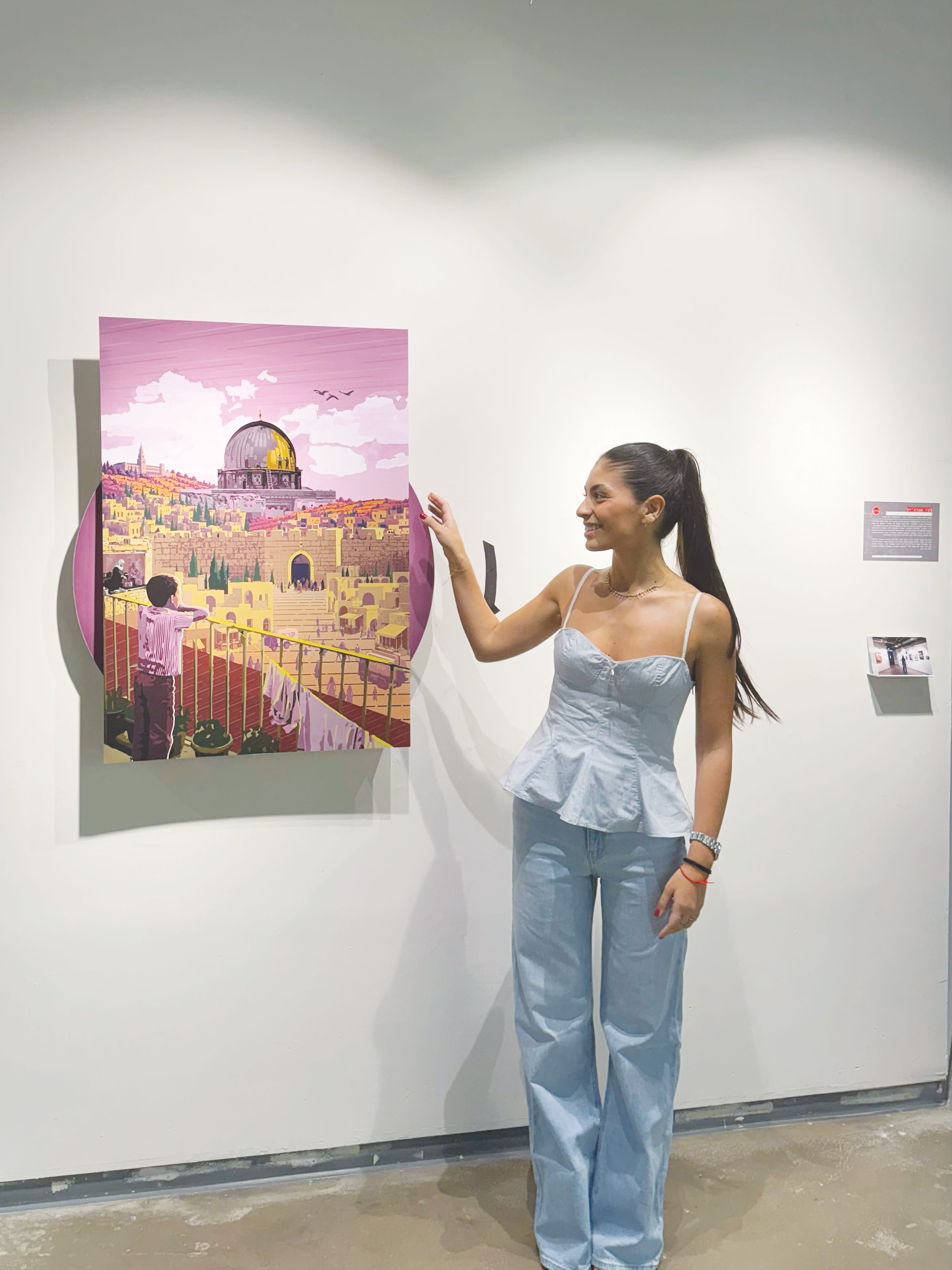
In her graduation project, So Grandpa Told, which caught my attention at the exhibition, Abergel explores well-known images of Jerusalem with an intriguing twist, using modern artistic language to tell the story of her grandfather’s childhood memories of the city.
“Rather than simply documenting them, I wanted to bring them to life and allow the viewer to experience them. Each story took a different form, through posters that come to life with AR, interactive scrolling, or a physical wheel activated by the viewer. Finding the right way to tell each story and connecting graphic language with contemporary tools are central to the way I create,” she noted.
Inspiration: My inspiration comes first from the things I see around me. I pay attention to color combinations, typography, materials, shapes, and the way things are presented in a space. Sometimes a small detail or an unexpected combination can become the starting point for a project.
Growing up in Paris was a source of inspiration in itself. I remember going to Galeries Lafayette and Printemps to see their changing window displays, always waiting to discover the new theme and how they would build an entire world around it. Andy Warhol was also an inspiration for me, and I have always been drawn to work that feels contemporary, graphic, and bold.
During my studies, I discovered the Stenberg brothers, and I created a homage inspired by their style. It opened up a new way for me to think about composition and graphic language. I realized how much can be achieved with a limited color palette, and how typography and abstraction can create drama and tell a story.
I also find inspiration in people and their stories. Conversations with my grandfather about his childhood in Musrara [Morasha], Jerusalem, in the 1950s, inspired my graduation project, So Grandpa Told. I found magic in his small, everyday stories and found myself imagining what those places and moments looked like. That made me want to give his memories a shape of my own.
Meaning of art: For me, art is when something creates a reaction in me: curiosity, emotion, a thought, or simply the desire to stop and look again. I don’t think it has to be beautiful or immediately understood, but it is important to me that there is an idea, intention, or point of view behind it.
Art can take many forms, and there is no single right way for it to look or be created.
It is the ability to take an idea, an experience, or a personal point of view and express it in a way that allows someone else to connect with it and make something of their own. Sometimes leaving something open to interpretation is part of what makes it interesting.
Abergel’s art: What characterizes my work is the desire to tell a story and find a new way to communicate it each time. I combine images from different sources – my own illustrations and typography – looking for a balance between aesthetics and the idea behind the work. I want my work to draw you in, but also reveal another layer the longer you look.
A significant part of my process is taking images, breaking them apart, and putting them back together until they become something different and take on my own visual language.
In recent years, AI has also become part of my process, another tool that can help and open up new possibilities. Ultimately, however, it cannot replace the designer’s eye and intuition.
www.lennyabergel.com/ ■