When the Eilat International Chamber Music Festival opens tomorrow, it will mark more than the return of classical music to Israel’s southernmost city.
After over a two-year-long hiatus (the last festival took place in February 2023), the festival’s return stands as both a cultural and emotional defining moment, a symbol of resilience and the power of art to rejuvenate the spirit.
More than a hundred musicians, hailing from 15 countries, will converge on the Red Sea for four days of concerts, spanning Mozart and Vivaldi to flamenco, swing, and jazz.
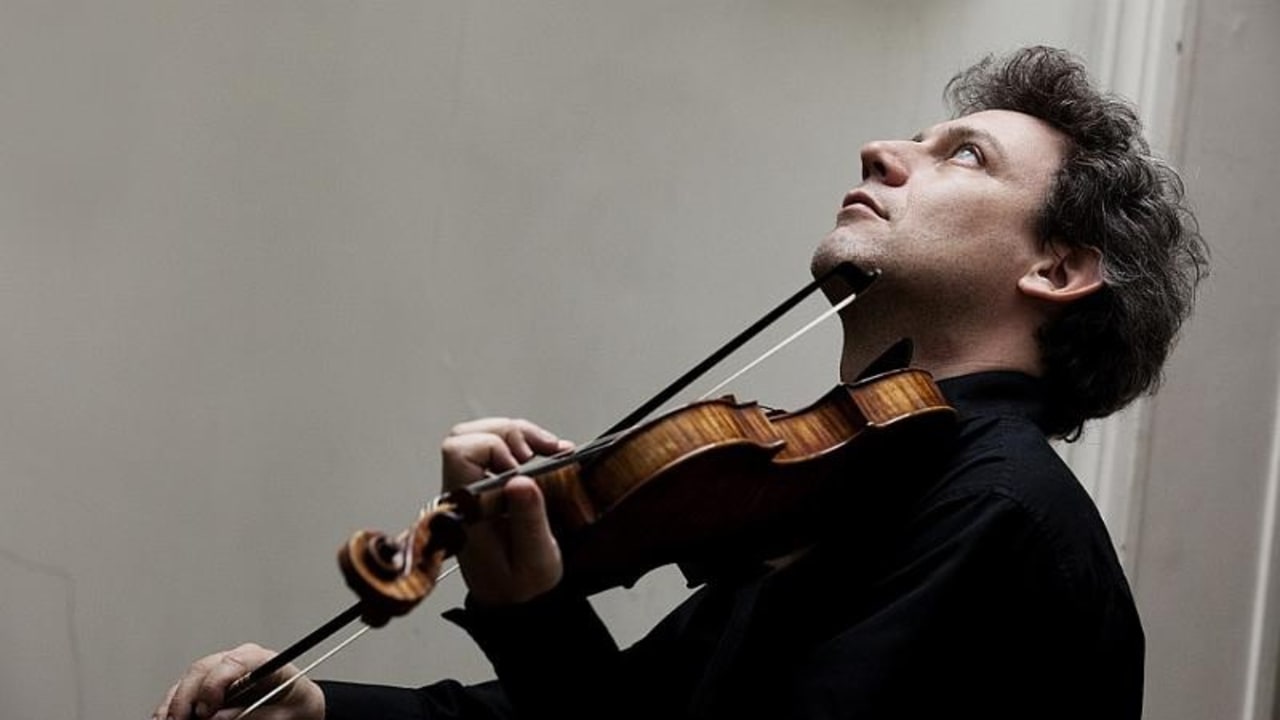
Among them is French violinist and visionary David Grimal, one of Europe’s most original musical minds.
His upcoming appearance in Eilat, where he will helm the Israel Camerata Jerusalem and the State Choir of Georgia, marks both a personal and artistic homecoming.
“I’m very happy to be back at this festival, where I’ve lived wonderful moments in the past,” he says. “We’ll give everything we have, to emanate a positive vibration, to play for hope.”
The festival’s artistic director, Leonid Rosenberg, characterizes this year’s edition as a “celebration of hope, resilience, and renewal.”
In that sense, Grimal seems an ideal guest, a musician whose career has long been predicated on the belief that music can model a better society.
Listening as a moral act
Over the past two decades, Grimal has become a distinctive voice in European music, admired not only for his virtuosity but also for his philosophical approach to performance.
A graduate of the Paris Conservatoire and a frequent soloist with leading ensembles such as the Orchestre de Paris, the Chamber Orchestra of Europe, and the Staatskapelle Dresden, he could easily have pursued a conventional solo trajectory.
Instead, he founded Les Dissonances, an orchestra that renders major symphonic works entirely without a conductor.
“The ideas at the center of Les Dissonances are ideas of humanism, sharing knowledge, responsibility, and, I would dare to say, love,” he explains. “Love for music and love for the players. You cannot play otherwise.”
In this model, leadership is shared rather than imposed. Every musician listens and leads simultaneously, fostering a collective intelligence that can only materialize through deep trust.
“People need strong leaders, with a stick in their hand,” says Grimal. “But I believe leadership can be strong without being authoritarian. Les Dissonances demonstrated that the community is the solution, not the problem.”
The ensemble’s concerts, often characterized as electrifying, offered audiences not only exceptional musical experiences but also a living metaphor for democratic cooperation.
Over time, Les Dissonances extended its mission beyond concert halls, performing in prisons, shelters, and disadvantaged neighborhoods.
“It was important for me that music should not remain confined to the elite,” he has said in previous interviews.
“Music belongs to everyone who is willing to listen.”
After two decades, Les Dissonances concluded its final concert in Paris on October 7, 2024, the one-year mark of a day that had irrevocably altered everything.
“It was very sad to stop after 20 years,” Grimal recalls. “Even though I’m happy to explore new avenues, it was a heavy thing to carry. Still, the lessons remain.”
The coincidence of dates lent the moment a quiet gravitas: as the ensemble came to its close, the world beyond the concert hall was still searching for its own sense of balance.
For Grimal, the echo between the two felt inescapable, a reminder that endings, however painful, can also pave the way to renewal. Because for all his optimism about human connection, he had also grown increasingly uneasy about the climate in his home country.
In recent months, Grimal relocated with his wife and two children to Romania, her homeland. “It’s a friendly place, full of hope.” He refrains from elaborating further, preferring not to dwell on politics.
“France is going through a difficult period,” he says carefully. “It’s a mix of many things: tensions, violence, and loss of societal values. I want my children to grow up in a place where there is still kindness.”
The move also signifies a kind of personal reset, a new beginning after two decades of pioneering an ensemble that redefined musical hierarchy.
“I have learned so many things,” he says quietly. “I don’t even know yet how much I have learned. But I feel grateful and ready to contribute differently now.”
A familiar stage
This is far from Grimal’s first engagement with Israeli audiences. Over the years, he has appeared here as both violinist and conductor, most recently with the Israel Camerata Jerusalem in programs that included Barber, Mozart, and Bartók.
In 2024 he performed at the Weizmann Institute alongside pianist Itamar Golan, presenting works by Bach, Dvorák, Janácek, Pärt, and Beethoven.
His return to Eilat, therefore, feels less like a debut and more like the continuation of a vital dialogue that began long ago.
“I’ve had the joy of performing in Israel several times,” he says. “Each time, I feel a very special connection with the audience, an energy that is generous, open, and deeply engaged. It’s always a joy to come back.”
In Eilat, Grimal’s philosophy will once again be subjected to a real-time test. The upcoming concerts will unfold without a conductor, a daring experiment even by his standards.
“We’ll see if it’s possible,” he laughs. “There’s little time for preparation, but the mandate is to share the music as I always have – through listening and trust.”
Grimal has performed with the Israel Camerata Jerusalem before, but never with the Georgian State Choir, and never in this particular combination.
“We know each other now,” he says of the Camerata. “I did a tour with them about a year and a half ago. This time, I will also play, not conduct, and the challenge will be to secure that natural balance between freedom and unity.”
The program echoes both the festival’s message and Grimal’s artistic ideals. On November 19, he will guide the Israel Camerata Jerusalem and the State Choir of Georgia in Mozart’s Requiem, a work that articulates collective mourning and transcendence.
The following evening he will execute Bach’s Violin Concerto in A minor and navigate the same forces through Vivaldi’s Gloria, a luminous expression of renewal and joy.
“I think we are all longing for better times,” Grimal says. “We’ll play for that, to convey something positive, a moment of peace.”
For the Eilat International Chamber Music Festival, returning after a necessary postponement due to the war, these moments take on a special significance.
Since its founding in 2005, the festival has cemented its status as one of Israel’s leading cultural events, treasured for its top-tier performances and deliberate blending of classical, jazz, and world music.
This year’s program features 15 concerts across four days, hosted for the first time in partnership with the Astral Hotels chain.
In addition to Grimal’s appearance, the festival will showcase the East-West Chamber Orchestra from Germany, jazz pianist Omri Mor, flamenco and swing performances, and an international youth competition for violin, cello, and piano.
The event will be framed by emotionally resonant segments, including a concert dedicated to the memory of the fallen and another honoring pianist Alon Ohel, who returned from captivity after two years.
Artistic director Rosenberg underscores that the influx of so many international musicians to Israel “now, of all times,” is in itself a significant gesture of solidarity.
He adds, “More than one hundred musicians from 15 countries opted to come here, to share with us the universal language of music, the language of hope and compassion.”
Grimal’s presence and artistic philosophy integrate seamlessly into that narrative.
His art, fundamentally grounded in listening and cooperation, offers a quiet form of resistance to cynicism and cultural fragmentation.
“Music is about listening before you do anything else,” he asserts. “It’s about respect, cooperation, working together.”
He pauses before offering a final thought: “I hope the world will survive through harmony between people, not by being conducted by a few who hold all the keys.”
For an artist who has spent his life challenging hierarchy, this is a fitting credo. On stage in Eilat, David Grimal affirms his enduring conviction that musical harmony is a powerful path toward renewal, offering a truer vision for human connection.
November 19-22
For a full program, tickets, and reservations, go to: www.eilatfestival.co.il