
Talk about going out of the frying pan into the fire. Israel’s preeminent purveyor of genre-crossing melodic singer-songwriting, Idan Raichel, is leaving the turmoil of protests, uncertainty, and frayed nerves in his homeland to take the BDS movement head on with a series of performances throughout the US.
Although not as aggressively problematic as Europe, where Israeli artists have canceled shows or been canceled due to possible security threats, the US noisy minority can also make it very uncomfortable for Israeli performers.
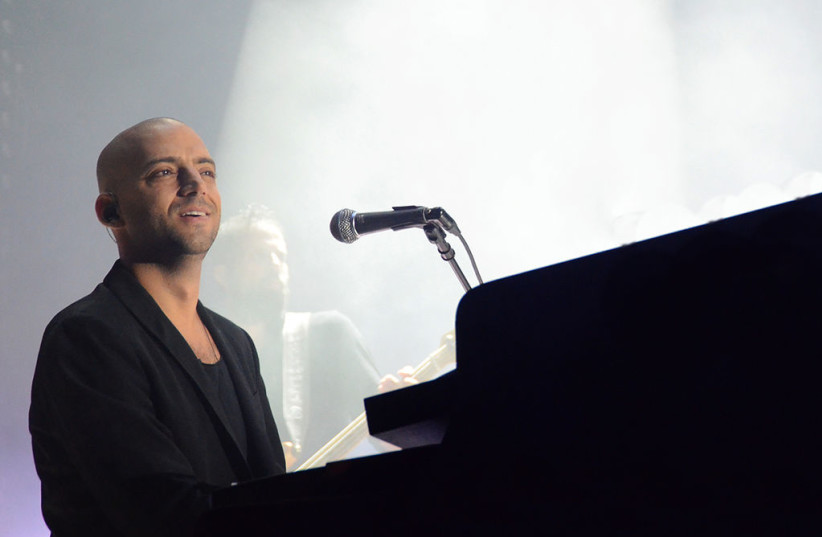
For Raichel, 48, the specter of demonstrations outside the showcase City Winery venues, where he’ll be performing in New York, Philadelphia, Chicago and Boston next week, isn’t daunting. He will be doing a solo show called “Idan Raichel Piano Songs – Music and Storytelling, Stripped to Solo Keys.”
“I see myself first and foremost as an Israeli and then an Israeli artist,” Raichel told The Jerusalem Post recently.
“I’m bringing with me the weight of our beloved country. And yes, there will be people who will protest and try to shut us up. Way back in the early days, the BDS movement would call to boycott me outside shows abroad. I used to go outside with a tray of cookies and tea and start a dialogue,” he said.
“It’s important to talk to people: explain to them what they’re missing about the situation and what’s going in our country. If I’m able to create a conversation, even with people who disagree with me, it’s at least something,” the popular Israeli performer said.
“At the same time, we definitely need to fight the evil forces who are trying to miseducate a new generation. As a public personality, we have a lot of responsibility.”
Maintaining a high profile
Raichel has maintained a high profile since October 7. He appeared at a Memorial Day event at Tel Aviv’s Hostages Square in May, accompanying released hostage Sagui Dekel-Chen, who sang Shalom Hanoch’s song “Children of Life.”
Last year, he posted a video calling Gazans complicit with Hamas in its war against Israel and deserving of being treated as the enemy by the IDF.
“The Gazan Palestinians are not revolting against the terror organization Hamas,” he said in the video. “They could have been courageous... and entered all the tunnels and revolted against Hamas. To fight them – even at a heavy price to many of them – and return all of the hostages. They could have expelled the terror organization Hamas and started rebuilding their lives. They are not doing this, and that’s why we must treat most of them as complicit.”
During his US performances, where he’ll be interspersing his songs with background on songwriting and his life, Raichel said he won’t shy away from talking about the hostages still held in Gaza, but insisted he won’t turn his shows into a political showcase.
“Of course, I’m going to talk about the hostages. These are civilians, as well as soldiers, who were kidnapped and held for two years. To not talk about them is to not be Israeli. But it won’t be a discussion, it’s not a Q & A session, and I won’t be espousing my political views. There are certain consensus issues that we should all be able to agree upon. A kid needs to be safe in his bed on the morning of Simchat Torah.”
Raichel, who has written some of the most heartfelt, universal songs in the Israeli oeuvre, will surely have much to focus on besides the war when he takes the City Winery stage. Performing in an intimate setting, without the eclectic Idan Raichel Project to conduct, enables him to delve into the quieter, more introspective elements of his music.
The balance “between performing with the Project, which can amount to 15 people, and by myself is important to me. I love the uplifting energy of the band, but at the same time, I love being able to be so intimate with an audience,” he said.
“For these shows, it’s almost like the audience is sitting in my living room. It’s such a pleasure to go onstage without a setlist and just perform in the moment. It’s amazing and fulfilling.”
It also enables Raichel to tell some of the stories behind his songs, and what led him to write some of them.
“I talk about my life, about Israel and especially after the atrocities of October 7, how the whole perspective of how we see our country has changed, and how my role as an artist has changed. There’s a mutual responsibility. How do I compose? Am I a messenger? Am I giving comfort?”
Although he is expressly Israeli in his thinking and image, Raichel thinks that he’s succeeded in crossing a barrier where foreign audiences see him as not an Israeli performer but as a performer.
“I understand I’m representing Israel, but the biggest compliment I get is that people see me as performing world music from Israel, much in the way that world musicians bring the influences of the countries they’re coming from, whether it be Bob Marley from Jamaica or EDM (electronic dance music) from Japan. When people listen to my music and define it as world music from Israel, it’s the greatest compliment,” he said.
“If there are people who want to boycott the soundtrack of the music from my country, we can only explain that boycotting artists is not the way to develop understanding of a situation.”
If anyone can reason with the protesters who may gather outside the venues where he’ll be performing next week, it’s Idan Raichel.