Now that the security situation has calmed enough to allow travel to most of the North during the summer vacation season and beyond, it’s a good time to consider where to go and what to do – without breaking the bank.
“There are many olim and visitors who think that the only way to discover Israel is to go on an organized bus trip or to hire a tour guide,” says Ma’aleh Adumim-based hiking enthusiast Dr. Arnold Slyper. “I try to prove that this is absolutely wrong.”
Slyper’s comprehensive DIY travel website, In and Around Israel (www.inandaroundisrael.com), now includes sections dedicated to the Lower Galilee, Upper Galilee, Eastern Galilee, Golan Heights, Lake Kinneret, Jordan and Jezreel Valleys, and the Western Galilee (included in the North of Tel Aviv section).
This rich source of suggestions for family activities, hikes, and sightseeing includes details such as directions, admission fees, historical background, nearby attractions, and more.
“The North is beckoning,” says Slyper, “and my website opens up its beauty, history, trails, and fun sites for everyone to discover.”

Here are 10 northern destinations from the website. Check ahead of time in case of closures or changes, especially sites near the Lebanese border.
1. Achziv National Park
Slyper highly recommends this “captivating” site in the Western Galilee for families with children. It encompasses three small beaches, two of which have shade coverings, plus a pair of large seawater pools supervised by a lifeguard and protected from waves. The water in the shallowest pool reaches an adult male’s waist.
Achziv also features shaded picnic benches, and a café with seating overlooking the sea, as well as restrooms and showers. A campsite is available nearby.
2. Kochav Hayarden (Star of the Jordan) National Park
The jewel of this beautiful park is Belvoir Castle, a Crusader fortress built by the Hospitaller Knights in 1168 and considered one of their finest architectural achievements.
“It has been partially restored and is now the most well-preserved Crusader castle in Israel,” Slyper notes. “Its location was chosen because it overlooks the Jordan River crossing at Gesher and the road from Damascus to Beit She’an and thus to Jerusalem. The view from the observation point over the Jordan Valley is impressive.”
While most of the basalt building blocks for the castle were quarried, the knights also used stones from the ruins of the Jewish village of Kochava. One bears the carved design of a seven-branched menorah and was most likely “borrowed” from the ruins of Kochava’s synagogue.
Also in Kochav Hayarden: a pedestrian footpath to Ein Hayadid spring and a sculpture garden featuring the works of Igael Tumarkin.
3. Ganei Huga
Ganei Huga, about four miles northeast of Beit She’an, is a scenic park and “a great swim place for kids,” says Slyper.
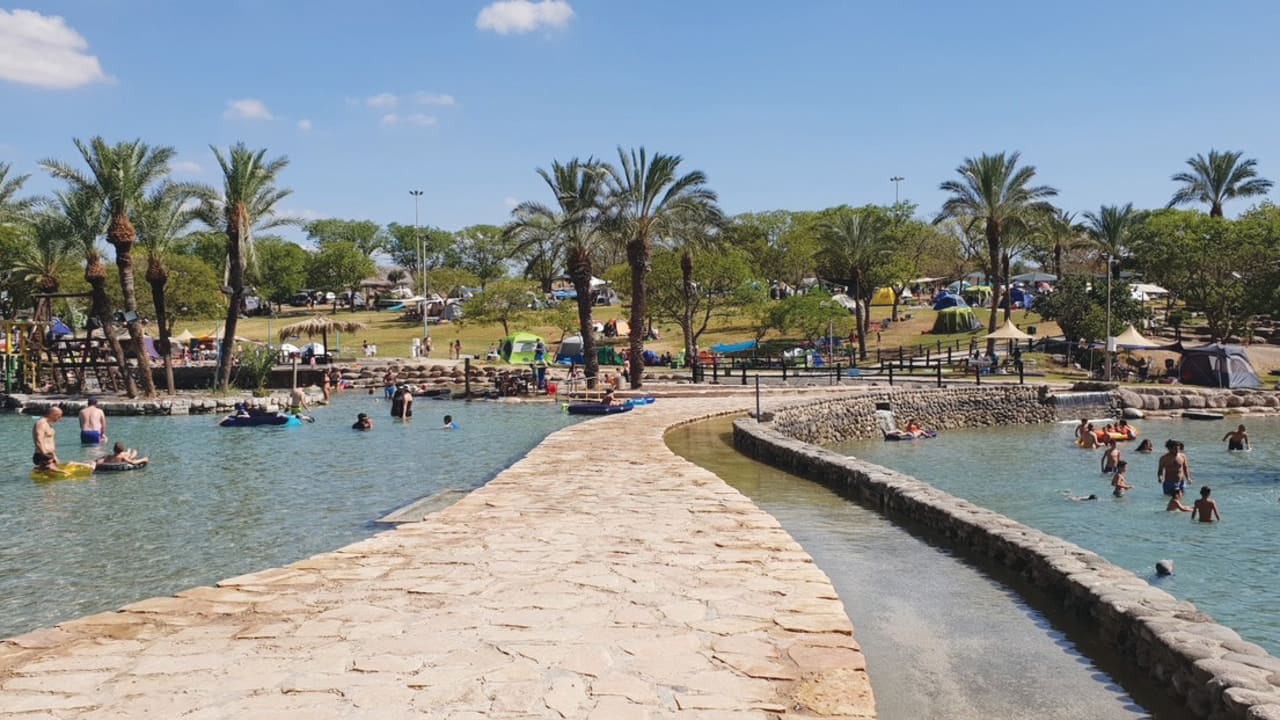
Flowing spring water supplies three large but relatively shallow pools, supervised by lifeguards. The smallest pool has slides for toddlers, and another has a zip line. Ganei Huga also has a campground where you can pitch a tent or reserve an air-conditioned yurt with mattresses and a fridge.
4. Aniam Artists’ Village
The only artists’ village in the Golan Heights, this bohemian enclave in Moshav Aniam welcomes visitors into the workshops to watch the artists at work. The genres include goldsmithing, paintings, pottery, jewelry, ceramic and stone sculpture, painted tiles, sewing, painting and engraving on wood, handicrafts, macramé, laser cutting and engraving, housewares, and more.
In addition to the workshops, there are galleries, a framer, and purveyors of secondhand nostalgia, gourmet chocolate, and Judaica. An assortment of eateries and craft vendors line the romantic open pedestrian mall.
5. Gan Garoo
Gan Garoo in Emek Hama’ayanot is a four-acre zoo devoted to Australian wildlife, particularly kangaroos.
Kids love hand-feeding the free-roaming, tame kangaroos, as well as the parrots (the birds love sitting on the heads and shoulders of visitors), and seeing the koalas sleeping in the trees. Another kid-friendly feature is a dinosaur maze featuring faux dinosaurs that move and make noises when you press a button.
6. Karnei Hittin National Park
Karnei Hittin (Horns of Hittin) are the remnants of an ancient volcanic crater that imploded. There was a Jewish settlement on one of the horns in biblical times. Many Christians believe this was the site of the Sermon on the Mount.
You can take a circular hike, lasting about 90 minutes, to the top of the crater, where there are wonderful views over the Arbel Valley and Mount Arbel. A longer “same way there and back” hike starts on a path by the cowsheds at Kibbutz Lavi.
At the top of the trail is a path for viewing the site of the pivotal Battle of Hattin, where Saladin defeated the Crusaders in 1187 CE.
7. Ein Keshatot (Spring of Arches)
This National Heritage Site in the southern Golan, near Moshav Natur, contains the remains of a Jewish village and a painstakingly reconstructed 6th-century synagogue that was destroyed by an earthquake in 749 CE.
“The reconstructed synagogue at Ein Keshatot is the largest and most impressive of the more than 30 ancient synagogues discovered in the Golan Heights,” states Slyper.
You can watch a movie about the reconstruction project in the visitors’ center before entering the synagogue. One special feature is the pillars surrounding the stone Torah ark, engraved with symbols of the Jerusalem Temple: a seven-branch menorah, a lulav and etrog, and an incense shovel.
Down the hill, there’s a two-pool spring, where flax was whitened for textile manufacturing in ancient times.
8. Park Hama’ayanot (Springs Park)
In contrast to the nearby popular Gan Hashlosha (Sachne), Park Hama’ayanot, at the foot of the Gilboa mountain range, has no admission fee. Though it has fewer amenities than Gan Hashlosha, it offers many options for swimming, hiking, water hiking, and cycling on its nine miles of winding paths.
At the visitors’ center run by the Israel Nature and Parks Authority, you can rent bikes or a golf cart for four or eight people. The carts come in handy for getting to Ein Muda, a swimming pool and picnic area located some distance from the main part of the park.
9. Kfar Kedem
This biblical living history site in Hoshaya, in the Lower Galilee between Tiberias and Haifa on an ancient trade route, offers visitors guided hands-on experiences that vary by season: riding donkeys, milking goats, pressing olive oil, crafting artisanal cheese, threshing wheat and grinding it into flour to make pita, spinning wool, and making grape juice – all while dressed in traditional garments. Pre-ordered kosher meals are available in Kfar Kedem’s Shepherd’s Tent.
10. Ein Afek Nature Reserve
This popular wetland nature reserve encompasses remnants of the Na’aman Stream wetlands that were once part of the larger Acre Valley marshes. The reserve’s rich biodiversity includes water buffalo, amphibians, and various bird species.
The visitor experience includes a short film, a scenic walking trail, and a walkway built on a bridge over the swamp. There’s a Roman and Crusader flour mill and a garden for endangered plants.
“The swamp, pools, and Na’aman Stream are created by dozens of springs that arise from the ground. The Hexagonal Spring is an example you will pass. These springs are fed in turn by the Na’aman aquifer, which draws rainwater from the Western Lower Galilee and eastern Acre Valley,” Slyper explains.
You can also walk up to Tel Afek, where you can see remains of several ancient civilizations; for instance, the Canaanites had a purple dye industry, and the Crusaders grew barley and sugar cane there.