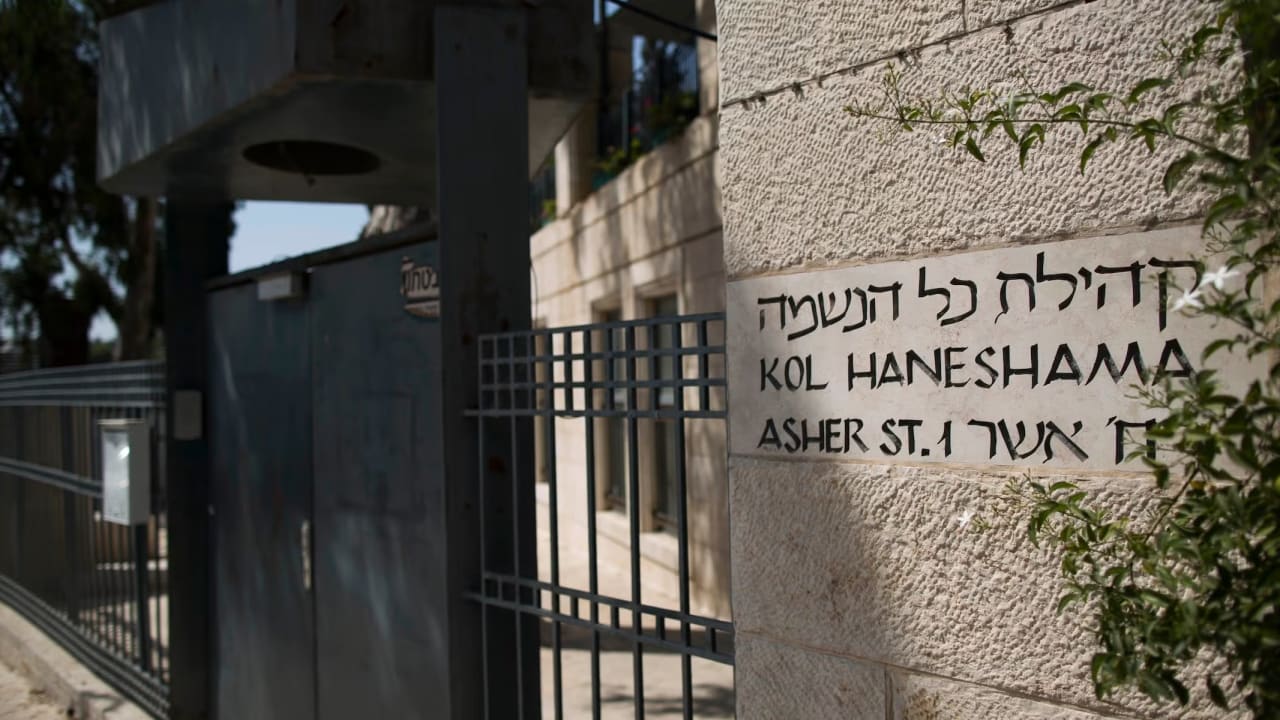
Forty years ago on Simchat Torah, Eliahu Abergil, the Sephardic rabbi of Jerusalem’s Baka neighborhood, arrived at a service held by the fledgling Kol HaNeshama Reform congregation with a group of followers after learning that women were dancing with Torah scrolls alongside men.
The confrontation turned physical, with some of Abergil’s followers trying to wrest the scrolls away from worshippers before police intervened.
New York-born Levi Weiman-Kelman, who was ordained at the Conservative Jewish Theological Seminary, had founded Kol HaNeshama in 1984 in his living room, with many of its early members young English-speaking immigrants settling in the neighborhood.
Multiple incidents of vandalism, harassment at the Reform synagogue
Four decades later, Kol HaNeshama again faced hostility, with five incidents targeting the Reform congregation over a matter of weeks, including break-ins, vandalism and harassment.
Its leaders say intolerance has hardened in Israeli society and have accused political leaders of helping create the climate around the attacks, whether through inflammatory rhetoric or by failing to condemn the attacks.
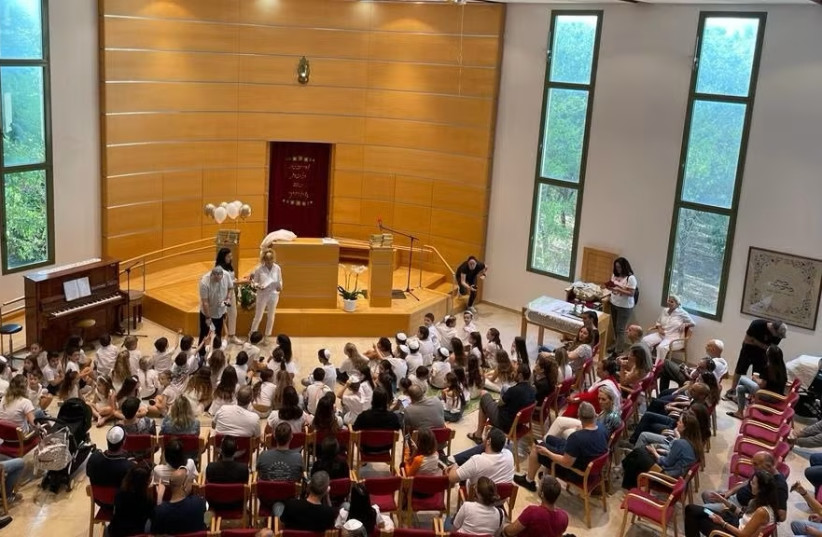
But at a solidarity gathering in Kol HaNeshama’s sukkah after the latest attacks, Weiman-Kelman, also a former president of Rabbis for Human Rights, pointed to a countervailing change: the circle of people willing to stand with Kol HaNeshama had grown considerably.
While in 1986 the communities that rallied around the synagogue were overwhelmingly Reform, this time Orthodox rabbis and congregations signed letters of support and stood alongside a community whose theology and practices they do not necessarily share.
Oded Mazor, Kol HaNeshamah’s current rabbi and a former rabbinical assistant to Weiman-Kelman, said some of the Orthodox communities were explicit: “We’re not Reform, we don’t think like you. But we value you, and we will defend your right to be who you are.”
'No Jew should feel unsafe because of the way they practice Judaism'
“It’s no longer only our issue, as Reform Jews, to confront this violence. There’s an understanding that responsibility for a shared, pluralistic and tolerant public space belongs to all of us together,” he said.
Anti-Defamation League CEO Jonathan Greenblatt attended the first Friday services after Sukkot in a show of solidarity with the congregation. “No Jew should feel unsafe because of the way they practice Judaism,” he wrote on X/Twitter.
Police arrested three minors suspected of involvement in the incidents, which included eggs thrown at worshippers on Rosh Hashanah and objects hurled through a window ahead of Yom Kippur.
Nearly two months later, Mazor said the congregation had received no further update on the investigation, and police had not responded to several inquiries from the Jewish Telegraphic Agency.
The youths involved appeared religious but not haredi, according to congregants who interacted with them and the synagogue’s security-camera footage. Congregants also reported harassment and homophobic comments.
A large Pride flag hung on one wall of the sukkah at the solidarity event. The repeated targeting of Pride symbols has convinced Mazor that the attacks were aimed not only at the congregation’s Reform identity but also at its embrace of LGBTQ inclusion.
“They didn’t vandalize Reform prayer books; they didn’t graffiti the walls. They came to tear down a Pride flag and commit a hate crime against a Reform community and the LGBTQ community,” he said.
The crowd in the sukkah, some 200 strong at its peak, reflected a wide cross-section of Jerusalem Jewish life: men with and without kippot, and women with and without head coverings, from kippot to headscarves.
Among them were David Goodman and his wife, Amirit Rosen, the co-rabbis of Moreshet Avraham in Jerusalem’s Armon Hanatziv neighborhood, a congregation affiliated with Israel’s Masorti movement, the Israeli branch of Conservative Judaism.
“An attack on a Jew because of their Jewish identity is an attack on me,” Goodman said. “That’s true when it happens abroad, and all the more so when it happens to my neighbors in Jerusalem.”
The gathering was organized with the support of Reshut Harabim, an umbrella network bringing together more than 65 Jewish organizations and congregations working to promote pluralistic Jewish life in Jerusalem, and as part of a nationwide sukkah initiative run by Shomrim al HaBayit HaMeshutaf, bringing Israelis from different religious and political backgrounds together.
Goodman said those networks help explain why the response to the attacks on Kol HaNeshama looks so different from the 1980s.
“What were once disparate communities have become a network that knows how to stand together,” he said. “There is immense power when we cooperate.”
Kol HaNeshama chosen to host Rabin memorial
Several Jerusalem organizations later chose Kol HaNeshama to host a memorial marking the anniversary of Prime Minister Yitzhak Rabin’s assassination, as a show of solidarity following the attacks, Mazor said.
Today Kol HaNeshama has about 280 member families and serves a much larger circle of worshippers, including native Israelis and immigrants who grew up Reform, Conservative, Orthodox, or unaffiliated.
After the 1986 confrontation, Jerusalem Mayor Teddy Kollek helped the congregation secure a permanent home in Baka. The city leased Kol HaNeshama an abandoned stone building, which it renovated before eventually expanding into the larger complex it occupies today.
While it has deep roots in Jerusalem’s English-speaking immigrant community, and counts New York Times senior correspondent Isabel Kershner, former Israeli ambassador to Germany Jeremy Issacharoff and solar-energy entrepreneur Yossi Abramowitz among its current worshippers, Kol HaNeshama never became simply an expatriate Reform transplant.
Services are more participatory and retain more of the traditional prayer sequence than the formal, cantor-centered style historically associated with classical Reform Judaism, while also incorporating meditation, chanting and elements Mazor said might once have been considered “New Age.” The congregation has also long experimented with liturgy, including gender-diverse language for God, innovations Mazor said later spread to other congregations.
For longtime congregant Laura Zeitlin, Kol HaNeshama became a family home as much as a place of worship. Her son attended the synagogue’s preschool and later celebrated his bar mitzvah there.
Zeitlin, who said she did not identify with a particular Jewish denomination while growing up in Argentina, said she was drawn to Kol HaNeshama because she could sit beside her husband and participate fully in services.
Her frustration over the recent attacks was directed not at religious difference itself but at what she saw as a lack of mutual respect. “We have respect for them, but they don’t have respect for us,” she said.
'More violence in Israel today'
Ezra Ende, rabbi of the Reform congregation HaDror in Jerusalem’s Kiryat HaYovel neighborhood and also involved with Mevakshei Derech in Katamon, said other congregations in Jerusalem, including his own, had also faced threats.
“The reality is that there is more violence in Israel today and all liberal communities are feeling it,” he said.
Jerusalem Mayor Moshe Lion’s response to the attacks was a recurring point of contention among congregants and supporters. Lion spoke privately with Mazor before Yom Kippur and expressed support for the community, but did not publicly name Kol HaNeshama in condemning the attacks, despite calls from Union for Reform Judaism President Rick Jacobs and Gilad Kariv, a Knesset member from the Democrats party, to speak out.
“The fact that Lion didn’t come out and say anything, naming the synagogue, "says everything," Ende said.
Lion later issued a general statement condemning attacks on others’ religious practices, customs and ways of life. His office rejected suggestions that political considerations, including sensitivity to Jerusalem’s large haredi electorate, explained his reluctance to speak publicly about Kol HaNeshama by name.
A spokesperson told JTA that the city had chosen not to draw further attention to the attacks “so as not to escalate things.”
Mazor invited Lion to the Sukkot solidarity gathering, but the mayor declined, citing prior commitments.
Naama Kelman, Weiman-Kelman’s sister and a former dean of Hebrew Union College’s Jerusalem campus, where in 1992 she became the first woman ordained as a rabbi in Israel, noted that Lion had addressed students at HUC about a year earlier. But she suggested Lion may have been more comfortable appearing at HUC because it serves as an event venue as well and is not publicly identified primarily as a Reform institution.
“Lion doesn’t get it,” Kelman said. “This neighborhood is what’s going to keep the city pluralistic.”
Mazor, who was also ordained at HUC, as were his father and sister, said Kol HaNeshama was once the only egalitarian synagogue in that part of Jerusalem; today it sits among Masorti, egalitarian and partnership Orthodox congregations. Even in some mainstream Orthodox synagogues, expanded roles for women have become common, including women dancing with Torah scrolls on Simchat Torah, the practice Abergil railed against in 1986.
Mazor sees that evolution as evidence that attitudes once thought fixed can change with familiarity and exposure.
Kol HaNeshama hosts dozens of school and pre-army academy groups each year, many arriving with little knowledge of Reform Judaism and asking why a Pride flag hangs in the synagogue. “If schools create that encounter, then the conversation happens,” Mazor said. “Without those touchpoints, students will only know what extremists want to tell them about Reform Jews or LGBTQ people.”
Both Kelman and Mazor saw the attacks as part of Israel’s wider political climate, but stressed that antagonism toward Reform Judaism was nothing new. After the 1986 confrontation, then-Sephardic chief rabbi Mordechai Eliahu declared that “there is no freedom of worship in Israel” if that meant equal recognition for different Jewish denominations, while then-Religious Affairs Minister Zevulun Hammer said he supported protection for private worship but opposed “importing problems,” an apparent reference to American-style Jewish pluralism.
Still, Kelman said, “it’s gotten worse.”
The attacks on Kol HaNeshama are “a direct result of the kind of incitement that Ben-Gvir spews, hate and messianic extremist Judaism,” she said, referring to National Security Minister Itamar Ben-Gvir.
Kelman also pointed to comments by other officials mocking Reform Judaism, saying she was “terrified” by what she saw as their contribution to a growing gulf between liberal American Jews and Jewish Israelis. In May, minister May Golan attacked Kariv, a Reform rabbi, in the Knesset, accusing him of “marrying dogs in your bizarre synagogues.”
Last year, Likud lawmaker Galit Distel Atbaryan told Kariv, “If you hold a bar mitzvah for a dog, I’ll come and celebrate,” before ordering “the enlightened Reform Jew” removed from a committee meeting she was chairing. The same rhetoric surfaced during one of the Yom Kippur incidents at Kol HaNeshama, when two youths who had been harassing worshippers arrived with a large dog and asked to arrange a bar mitzvah for it.
Mazor called the Oct. 27 parliamentary elections, which produced no clear governing majority and left coalition talks unresolved, critical for the “future of Israel as both a Jewish and democratic state, in which the Jewish character of the state is expressed through its democracy.”
“This is our national home, and we have to make it work,” he said.