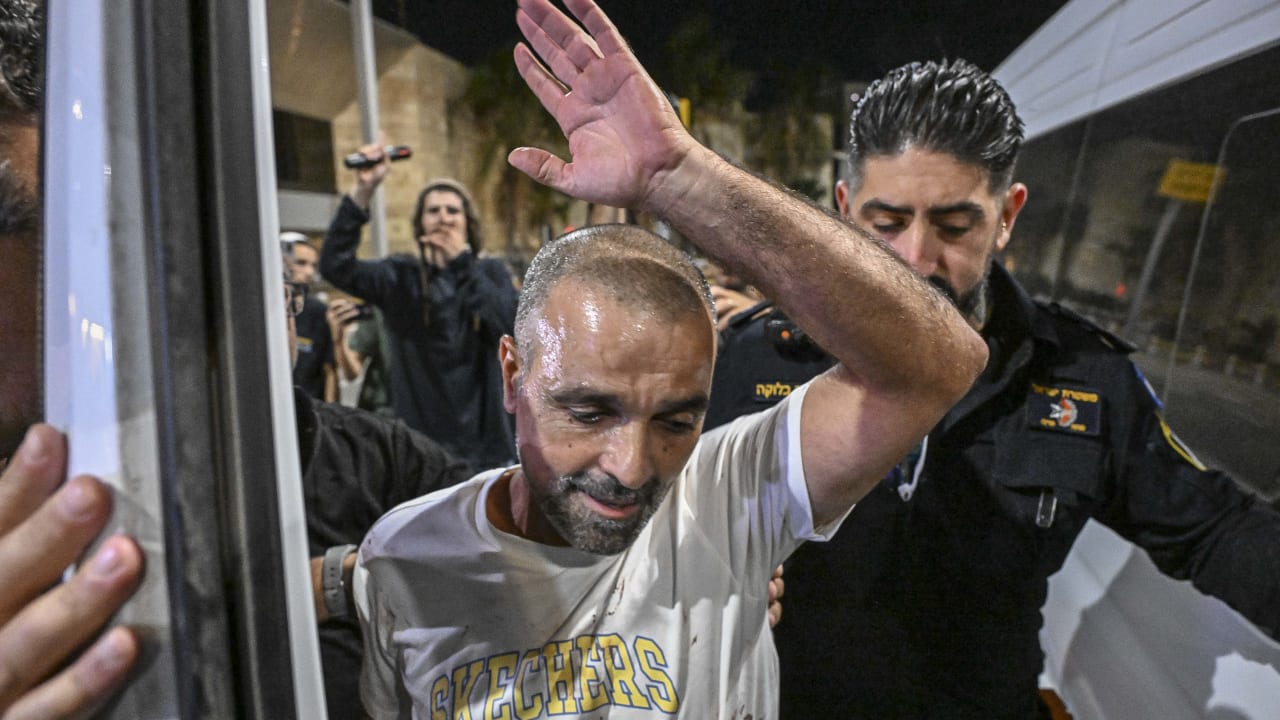
The attempted hijacking of flydubai flight 1073 came far closer to disaster than was apparent in the first moments after the incident, with the nearly four-year-old Boeing 737 MAX carrying more than 170 passengers and crew entering an extreme dive, reaching an angle of 39 degrees, approaching the speed of sound, and experiencing G-forces beyond the aircraft's operating limits, Ben Caspit explained on 103FM on Monday.
Using flight data cited in reports, Caspit addressed one of the most critical moments of the incident on Monday morning, focusing on how the dive was halted. According to Caspit, the rescue maneuver could have turned into a disaster if it had been carried out too aggressively.
Despite this, the aircraft did not break apart in midair. Two pilots who had been traveling in the passenger cabin managed to take control after the co-pilot was subdued and the captain was injured. They then continued flying for more than an hour with the aircraft already damaged before landing at Tabuk Airport in Saudi Arabia.
"If Yaniv Hayun had pulled the controls hard upward while in the dive, he would have crashed the plane. The plane would have broken apart in the air," Caspit said.
According to him, Hayun apparently pulled back on the controls more gradually and gently. Combined with the aircraft's characteristics and the autopilot system, this allowed the plane to recover from the dive.
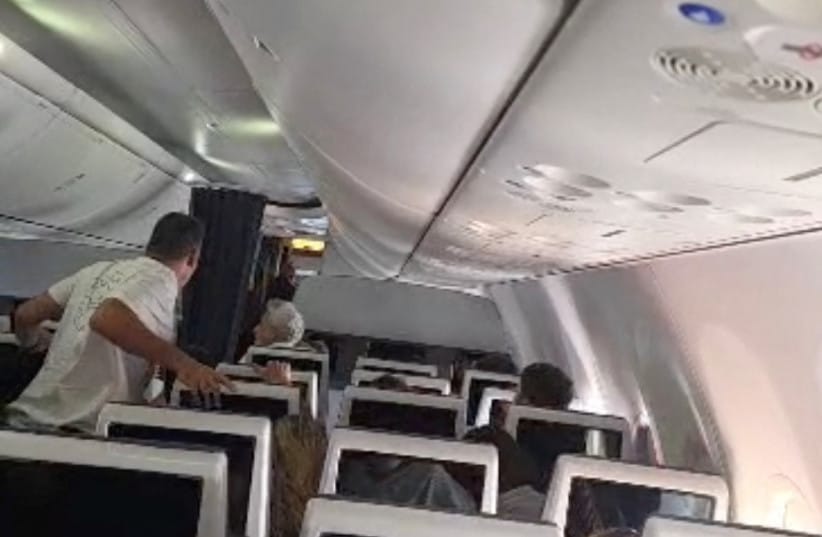
"He apparently did it gently, and together with the aircraft's characteristics, with the autopilot pulling itself out, that's how they were saved," he said.
Caspit stressed that this did not diminish the magnitude of the incident "by a milligram." He said that after the incident, the matter was examined and aviation experts were consulted. They explained that when an aircraft is diving at such high speed, abruptly pulling the controls upward can itself generate exceptional structural loads and lead to structural failure.
Caspit said that before speaking with the experts, he had not realized that an overly aggressive attempt to recover from a dive could itself endanger the aircraft.
Data published by The Wall Street Journal illustrated how close that scenario came to becoming reality: During the recovery from the dive, the aircraft was subjected to more than 3G, above the 737 MAX's operating limit.
7:03 a.m.: Aircraft leaves the airport
The flight began routinely. At 7:03 a.m. local time, the aircraft pushed back from its gate at Dubai airport. More than 170 passengers and crew members were on board.
The plane took off from Dubai at 7:05 a.m. and reached an altitude of 30,000 feet at 7:26 a.m. For nearly two hours, nothing unusual was recorded. Then everything changed.
9:21 a.m.: Attack in the cockpit
At around 9:21 a.m., while the aircraft was flying at approximately 34,000 feet, the co-pilot launched an attack on the captain.
According to preliminary flight data, the aircraft's nose was rapidly pushed downward, reaching an extreme dive angle of 39 degrees. By comparison, a passenger aircraft in a normal descent typically descends at about a 3-degree angle.
The dive caused the aircraft to accelerate to an exceptional speed. In just 92 seconds, the plane lost 17,400 feet of altitude.
During the steepest portion of the dive, between 9:21 a.m. and 9:22 a.m., it plunged from approximately 31,600 feet to around 16,600 feet, a loss of 15,000 feet in just 55 seconds.
At the same time, its speed was estimated to have reached Mach 0.96, nearly the speed of sound. The maximum operating limit of the 737 MAX is only Mach 0.82.
The Wall Street Journal noted that the Mach 0.96 estimate does not account for variables such as air density and wind speed. The figures are based on second-by-second satellite tracking data from Flightradar24, while investigators themselves will rely on the aircraft's black boxes to account for wind, outside temperature, and other factors.
What happens to an aircraft at such speeds?
At the speed the aircraft reached, its fuselage was exposed to highly unusual stress.
According to the published analysis, the airflow around the aircraft began imposing extreme loads on the structure. Shock waves can form along the surface of the wings as an aircraft approaches the speed of sound, and crossing the sound barrier can even produce a sonic boom.
The control surfaces are also in an especially vulnerable state at such speeds. The rudder, which controls left-to-right movement, can be subjected to violent vibrations at those speeds and face a risk of breaking.
The horizontal tail, which helps control the aircraft's movement up and down, is exposed to chaotic airflow coming off the wings.
The ailerons, hinged panels that help roll the aircraft from side to side, can also oscillate rapidly as a result of shock waves and wind. The same applies to the speedbrakes, which are used to slow the aircraft and alter airflow characteristics around the wing.
In the case of Flight 1073, the damage was not merely theoretical: Part of the aircraft's rudder broke off.
The pull that saved the aircraft
As the plane plunged at high speed, people from the passenger cabin rushed toward the cockpit.
One of them pulled the control column backward in an effort to raise the aircraft's nose and stop the dive.
Within approximately 43 seconds, the aircraft's speed fell from nearly 600 knots to around 390 knots. According to The Wall Street Journal's timeline, between 9:22 a.m. and 9:23 a.m., the aircraft slowed from a ground speed of 598 knots to 390 knots in roughly 45 seconds.
But recovering from the dive placed enormous stress on the aircraft's structure.
The vertical load is estimated to have peaked at 3.08G. That is a load comparable in magnitude to what a spacecraft experiences during launch and above the 737 MAX's operating limit of 2.5G.
This is where the data connects with Caspit's analysis: Pulling too hard on the control column when the aircraft was already traveling at such speed could have increased the load on the wings, tail, and fuselage even further.
In other words, the maneuver required to save the plane had to be strong enough to stop the dive, but not so abrupt that it caused structural failure.
9:22 a.m.: Dive halted, then aircraft plunges again
After the controls were pulled back, the first dive was halted.
Between 9:22 a.m. and 9:23 a.m., the aircraft climbed approximately 5,000 feet while rapidly slowing.
But the incident was not over.
Between 9:23 a.m. and 9:24 a.m., the aircraft plunged again, this time from around 21,725 feet to a low of 14,950 feet. The cause of the second dive remains unclear.
At around 9:24 a.m., the descent stopped, and the aircraft returned to controlled flight.
By then, the co-pilot had been subdued, and the captain was injured. Two pilots who had been traveling in the passenger cabin entered the cockpit and took control of the aircraft.
Preliminary data indicates that by 9:24 a.m., they had brought the aircraft under control.
Between 9:24 a.m. and 9:28 a.m., its speed gradually returned to a more normal range, although its altitude continued to fluctuate around 14,500 feet.
At 9:28 a.m., the pilots transmitted a "general emergency" declaration, indicating that they were in control and able to communicate with air traffic control.
At 9:35 a.m., the alert type changed to "unlawful interference," the standard designation for a security incident or an attempted takeover of an aircraft.

Now they had to fly a damaged aircraft
From 9:36 a.m. until 10:12 a.m., the aircraft proceeded toward the alternate airport at Tabuk, Saudi Arabia.
The flight was far from smooth. For more than an hour, the aircraft's altitude fluctuated repeatedly by about 500 feet.
According to the analysis, those fluctuations were consistent with the pilots struggling to control an aircraft that had been damaged during the dive.
Part of the rudder had already broken away from the tail.
Despite that, during the final descent toward landing, the aircraft's speed and controllability did not appear to have been significantly impaired by the structural loads endured by the ailerons and elevators, the control surfaces largely responsible for controlling the aircraft's nose-up and nose-down movement.
When exactly did the aircraft land? The source contains a discrepancy
According to the published detailed timeline, the aircraft landed in Tabuk at 10:45 a.m. This also corresponds with a flight lasting approximately three hours and 40 minutes from the 7:05 a.m. takeoff.
However, elsewhere in The Wall Street Journal report, the aircraft was said to have landed at "around 9:45 a.m. local time."
The original source therefore gives two different times, 9:45 a.m. and 10:45 a.m., and until final investigative data is available, the discrepancy should not be independently reconciled.
What is clear is that the aircraft reached Tabuk safely and completed the flight after being exposed to highly unusual speeds and structural loads.
Will the aircraft ever fly again?
The 737 MAX remains parked at Tabuk Airport.
It is expected to undergo an extensive series of inspections to determine whether the exceptional speeds and G-forces caused irreversible structural damage.
Tony Farina, an aerodynamics expert at Embry-Riddle Aeronautical University who has worked on flight-related projects with NASA and the US Air Force, doubted the aircraft could return to service.
"I'm not sure it can be used again," he said. "At the very least it will have to undergo a complete and thorough inspection."
The fact that the aircraft remained intact after the extreme dive was viewed as a particularly significant engineering achievement for a model that has endured severe crises in recent years.
According to Boeing's own data, the 737 MAX once had the worst safety record among modern passenger aircraft.
The model was at the center of a global crisis following two fatal crashes, and the manufacturer later faced difficult questions regarding workmanship and production quality at its factories.
For Boeing, the fact that the aircraft survived an incident in which it was subjected to loads beyond the limits it was designed to withstand could be viewed as a bright spot after years of crises.
The problem aviation has struggled to solve
Beyond the question of how the aircraft survived, however, the incident raises a much deeper issue in aviation security.
Since the September 11, 2001, attacks, most changes to cockpit security have focused on preventing a threat outside the cockpit from gaining entry.
Cockpit doors were reinforced, access procedures were tightened, and security systems were built around the assumption that the primary threat would come from the passenger cabin.
But incidents since then have exposed a more complicated problem.
The 2015 Germanwings crash demonstrated how a threat originating inside the cockpit could bypass the layers of protection designed to prevent entry from outside.
The flydubai incident now sharpens the same question once again: What can be done when the person endangering the aircraft is one of the people authorized to fly it?
Joel Sercel, an aerospace engineer and CEO of space company TransAstra, summed up the dilemma: Modern passenger aircraft are engineering marvels, but even they cannot save an aircraft if a qualified person in the cockpit commands it to dive and the other person in the cockpit cannot stop them in time.
Flight 1073 demonstrated how far modern engineering can stretch the limits of a passenger aircraft's survivability: a 39-degree dive, nearly Mach 1, more than 17,000 feet lost in under two minutes, loads exceeding 3G, and part of the aircraft's tail breaking away, followed by a safe landing.
But it also demonstrated the limits of that engineering. Ultimately, even an aircraft designed to withstand enormous forces still depends on the person sitting behind the controls.