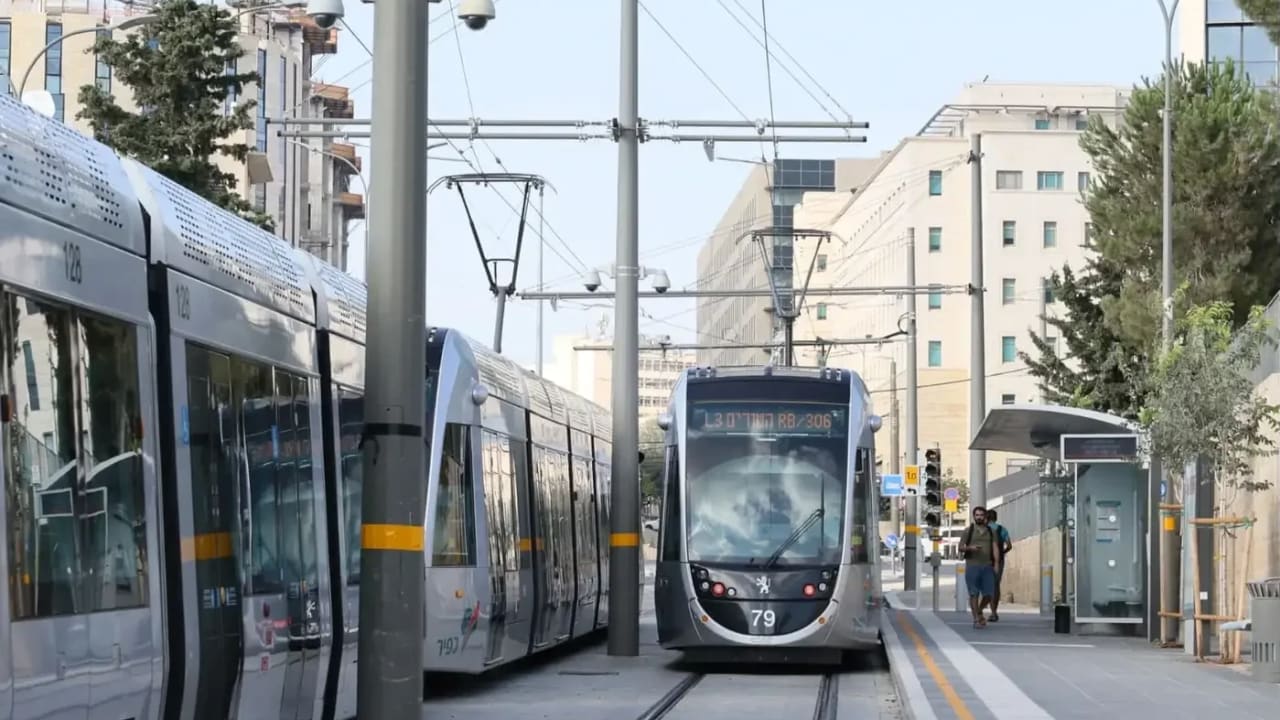
Jerusalem is moving ahead of the Tel Aviv metropolitan area with the launch of its second light rail line.
Following months-long delays caused by the war, the first section of the Green Line, designated L3, became operational today. The line runs between HaTurim station, near Jerusalem’s Mahaneh Yehuda Market, and Malha, in the southern part of the city.
Jerusalem Mayor Moshe Lion said, “This is a historic day for the capital and great news for Jerusalem residents and visitors to the city. This is a giant step in the transition from a city that has a light rail to a city with a light rail network. Jerusalem is once again a pioneer, and what began here 15 years ago with the Red Line, L1, is today becoming a network that does not exist in any other city [in the country].”
Jerusalem’s Red Line, L1, opened in 2011 and currently runs between Neveh Ya’acov in northern Jerusalem and Hadassah Ein Kerem Medical Center in the southwest.
The new line is approximately 7 kilometers (4.3 miles) long and includes 13 stations, 12 of them new. During peak hours, trains are expected to run every eight minutes.

New line, like rest of system, won't operate on Shabbat
The route connects several of Jerusalem’s major employment, government, education, cultural, sports, and entertainment centers. These include the International Convention Center (ICC), the government complex, the Hebrew University of Jerusalem’s Givat Ram campus, the HU’s hi-tech park, the Botanical Gardens, Teddy Stadium, the Pais Arena, and Malha Mall.
The line also serves the Givat Mordechai, Pat, Gonenim, and Malha neighborhoods.
The new service is expected to make it easier for passengers traveling from other parts of Israel to reach soccer and basketball games in Malha by connecting with Israel Railways, allowing them to avoid traffic congestion and parking difficulties.
That option, however, will only be available on weekdays. Those attending games on Shabbat will still need to use private vehicles because most public transportation in Israel does not operate from Friday evening until Saturday evening.
The L3 line connects with the Red Line at two transfer points, one at HaTurim station and another near the Central Bus Station and ICC, behind the Yitzhak Navon train station.
Together, the connections create a broader light rail network and provide passengers with easier transfers to Israel Railways and city bus routes.
The next stage is scheduled for December, when the L4 light rail line is expected to begin operating between the Central Bus Station and Gilo in southern Jerusalem.
Gilo is the city’s largest neighborhood, with more than 100,000 residents, and the new service is expected to provide residents with faster access to Givat Ram and Navon Station.
In June 2027, the route is scheduled to be extended to HU’s Mount Scopus campus, passing through French Hill and the area near the Israel Police National Headquarters.
A branch of the line serving Givat Shaul and Har Nof is expected to be inaugurated at the end of 2027.
Between 2029 and 3031, the Blue Line is expected to begin operating from Gilo through downtown Jerusalem, Har Hotzvim, and the Ramot neighborhood.
The project is being overseen by Transportation Master Plan Jerusalem, formerly known as the Jerusalem Transportation Master Plan Team, together with Kfir, the concessionaire that operates Jerusalem’s light rail system.
“Alongside the expanding parking and riding facilities,” Lion said, “this will become the city’s transportation backbone in the near future, change the face of the city and the quality of life in it, connect neighborhoods, employment centers and major institutions, and allow drivers to leave their private vehicles at home, thereby reducing traffic congestion and air pollution.”
“The network will expand with additional lines, connect more and more parts of Jerusalem and turn it into an accessible and advanced city, similar to capitals and major cities around the world.”