
Prime Minister Benjamin Netanyahu told the head of the Mateh Asher Regional Council, Moshe Davidovich, that a solution to Hezbollah's drone threat will soon be deployed, according to Davidovich, who spoke to 103FM on Wednesday morning.
Netanyahu would not share any additional details on what the solution is to defend against Hezbollah's first-person view drone threat, Davidovich said.
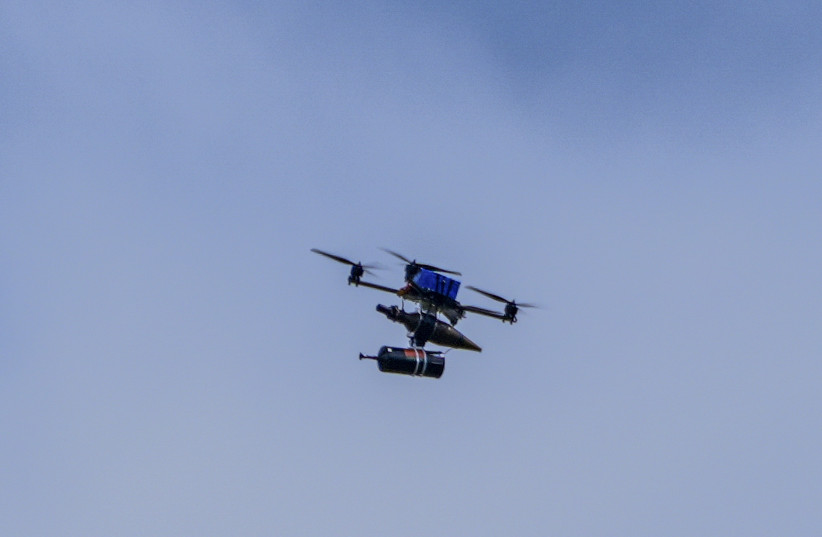
FPV drones are considered to be one of the challenging tactical threats in southern Lebanon, primarily because they do not rely on wireless communication and are, therefore, immune to GPS jamming or other electronic defenses. They operate by being physically connected to the operator's controller via a micro-thin fiber-optic cable, allowing continuous, precise control of the aircraft right up to the moment that the drone hits, or attempts to hit, a target.
However, while Davidovich thanked Netanyahu for the decision, he told the prime minister that “the decision will not be complete without ensuring the safety of our residents.”
“There is a war in the North,” Davidovich added, raising concerns over Hezbollah drones.
Netanyahu also informed Davidovich of the government’s decision to allocate five billion shekels for protection and advance tax benefits for residents and businesses in the North, the latter said.
Budget meeting allocates billions in security funding
The budget decisions were made at a meeting postponed from Sunday night to Tuesday, which was poorly attended, with many ministers instead attending the Bat Mitzvah of the head of the Shomron Regional Council, Yossi Dagan's daughter.
The budget submitted for government approval consists of several key components. In the first phase, an urgent, immediate budget of 105 million shekels will be allocated for emergency protection needs on the ground. This will be supplemented by an additional special budget of six billion shekels, designated for long-term protection programs in the North, modeled similarly to the system in the Gaza envelope.
Alongside the protection budgets, the government will approve approximately five billion shekels for civilian needs, including welfare, health, and transportation. This is part of the previously promised 12-billion-shekel budget for the confrontation line, which had been stalled in government channels.
Amir Bohbot contributed to this report.