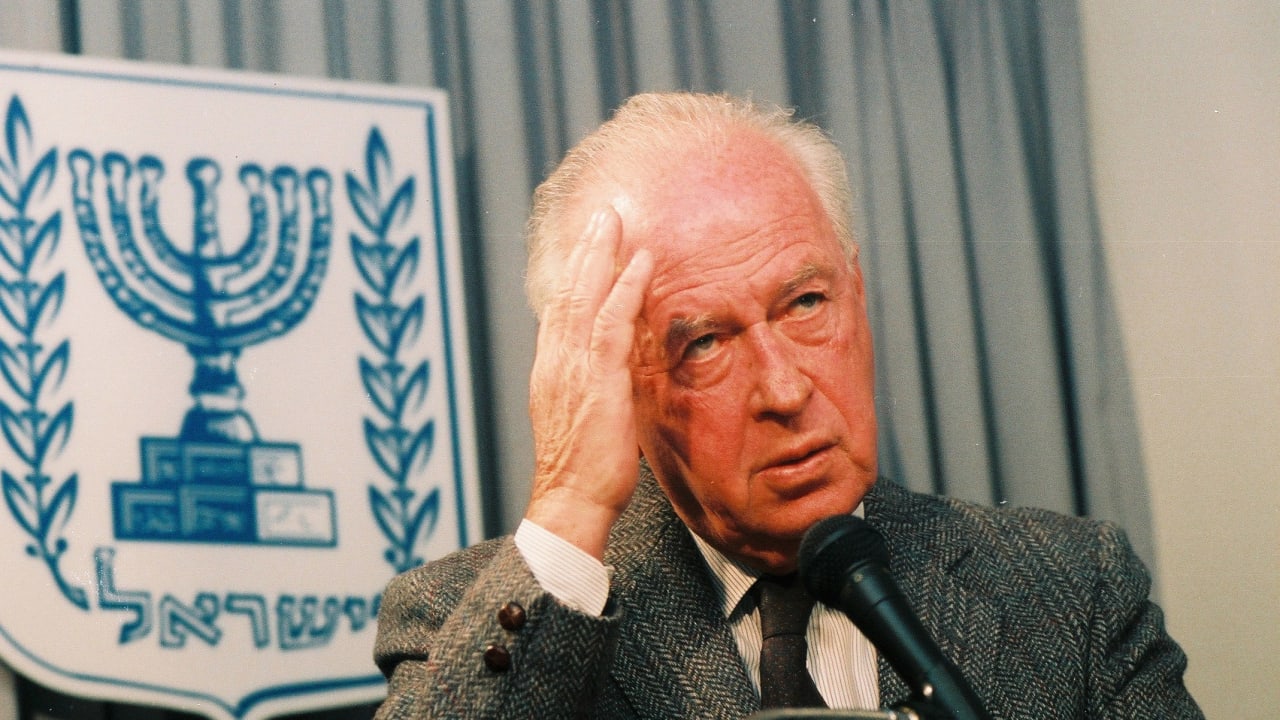

The past week has been full of events that in one way or another marked the 30th anniversary of the assassination of Yitzhak Rabin.
The first native son to hold the office of prime minister of Israel, Rabin was the only prime minister who was born in Jerusalem.
Although his private marital home was in Tel Aviv, he maintained an abiding connection with Jerusalem. During the War of Independence, he was chief of operations in Jerusalem. During the Six Day War in 1967, he walked through the Lions Gate to enter the Old City of Jerusalem as IDF chief of staff. In that same year, the Hebrew University of Jerusalem conferred an honorary doctorate on him, which he accepted on behalf of the entire IDF.
In the address that he delivered at the conferral, Rabin said: “It may well be asked why the university should have been moved to bestow upon me the degree of honorary doctor of philosophy, upon a soldier in recognition of his war services.
“What have soldiers to do with the academic world, which stands for the life of civilization and culture? What have those who are professionally occupied with violence to do with spiritual values?

“The answer, I think, is that in this honor which you have conferred through me upon my fellow soldiers, you chose to express your appreciation of the special character of the Israel Defense Forces, which is itself an expression of the distinctiveness of the Jewish people as a whole.
“The world has recognized that the Israel army is different from most other armies. Though its first task, that of maintaining security, is indeed military, it also assumes numerous tasks directed to the ends of peace. These are not destructive but constructive, and they are undertaken with the object of strengthening the nation’s cultural and moral resources.”
Just as extraordinary feats of courage have been shown by current soldiers and civilians, Rabin pointed to the same qualities in the soldiers and civilians who were involved in the Six Day War and its victory.
“War is intrinsically harsh and cruel, and blood and tears are its companions,” he said. “But the war we have just fought also brought forth marvelous examples of a rare courage and heroism, and the most moving expressions of brotherhood, comradeship, and even spiritual greatness.
“Anyone who has not seen a tank crew continue its attack even though its commander has been killed and its tank almost destroyed; who has not watched sappers risking their lives to extricate wounded comrades from a mine field; who has not witnessed the concern for a pilot who has fallen in enemy territory and the unremitting efforts made by the whole air force to rescue him, cannot know the meaning of devotion among comrades.”
The iconic photograph by David Rubinger of the awed expressions on the faces of three soldiers as they stood at the Western Wall was alluded to by Rabin when he stated:
“Our soldiers have no taste for sentimentality and shrink from any public show of emotion.
“In this instance, however, the strain of battle and the anxiety which preceded it joined with the sense of deliverance, the sense of standing at the very heart of Jewish history, to break the shell of hardness and diffidence, stirring up springs of feelings and spiritual discovery. The paratroopers who conquered the Wall leaned on its stones and wept. It was an act which, in its symbolic meaning, can have few parallels in the history of nations.”
Rabin also spared a sense of empathy for the enemy when he said: “The men in the frontlines saw with their own eyes not only the glory of victory but also its cost, their comrades fallen beside them soaked in blood. And I know that the terrible price the enemy paid has also deeply moved many of our men.”
Yitzhak Rabin's legacy
Rabin went on to become a diplomat, politician, statesman, and Nobel Peace Prize laureate, though unfortunately his battle for peace did not end in triumph.
As a politician, he was frequently in Jerusalem to attend meetings at the Knesset. As prime minister, his residence was in the heart of Jerusalem on the seam of Rehavia-Talbiyeh.
The security measures now in force did not exist in his time. Other than the extremists who cursed him and the people who plotted his demise, few Israelis imagined that the prime minister would be assassinated. There was no high fence around the Prime Minister’s Residence. Passersby could see through the glass doors at the entrance to the house. And when Rabin had to go somewhere in his car, it was parked outside in the street, and he walked out of the house carrying his suit jacket, slung over his shoulder. Demonstrations – whether for or against – were right outside the house and not on the next street.
The tight security did not immediately come into force – not even after the assassination when King Hussein came with his wife Queen Noor to offer their condolences to Leah Rabin. Journalists waiting in the street for the royal arrival simply trooped into the house together with the king and queen. That could never happen today – one of the effects of the assassination.
Politically, Rabin should be remembered for his decision not to enter into deals with coalition partners but to appoint the people he saw fit for the job as ministers.
Just as Rabin came into the world in the eternal capital of the Jewish people, it is also where he has his final resting place, in the section on Mount Herzl that is reserved for leaders of the nation.
It is where his family, friends, and admirers gather every year to share memories of a leader of great integrity who unfailingly took responsibility for failures that occurred on his watch, and visited bereaved families of soldiers without being asked to do so.
Unfortunately, the numbers of his admirers are declining, not because they have changed their minds but because they have been summoned by the Grim Reaper. After all, people of Rabin’s generation who are still alive are in their nineties.
Future generations will learn more about Rabin’s character than his politics, and hopefully they will be no less inspired by the former than by the latter.
greerfc@gmail.com