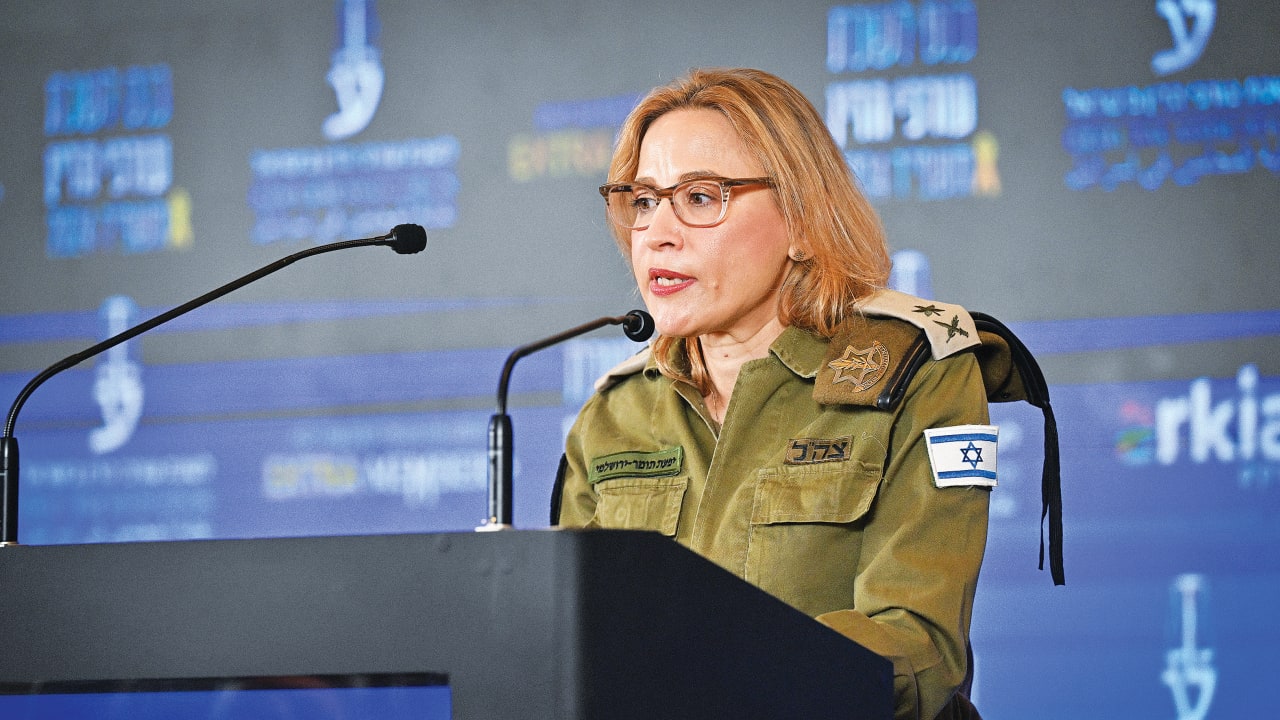
The IDF on Wednesday suspended Military Advocate-General Maj.-Gen. Yifat Tomer-Yerushalmi in connection with a probe by Attorney-General Gali Baharav-Miara into the leak of a video in the Sde Teiman abuse of Palestinian prisoners. The suspension shook the entire defense establishment.
In a sign that the latest development had blindsided many top officials, IDF sources did not even know, as of early Wednesday afternoon, who was in charge of the IDF’s legal division during Tomer-Yerushalmi’s suspension.
Other IDF legal sources had not responded to inquiries about the issue as of press time.
None of the sources could explain why Tomer-Yerushalmi was being suspended only now, when the Sde Teiman case broke into the headlines in July 2024.
Defense Minister Israel Katz issued three statements attacking Tomer-Yerushalmi and the Sde Teiman cases. In the third statement, he said he would not allow her to return to her role until the probe was concluded.

Katz also hinted that he might not let her return to her role, even if she is cleared of criminal charges, if there are disciplinary concerns. That being said, it was unclear whether he could prevent her return.
The appointment of the military advocate-general requires the defense minister’s approval, but returning from a suspension may be a gray area left up to the attorney-general and the IDF chief of staff, but not the defense minister.
Tomer-Yerushalmi’s term would normally have concluded after five years in the fall of 2026.
The most likely candidate to replace her is Deputy Military-Advocate General Col. Gal Asael.
Tomer-Yerushalmi’s suspension has major strategic implications not only for the Sde Teiman cases, but for Israel’s ability to fight international war-crimes cases at the International Court of Justice and the International Criminal Court, being that she is the lead legal official in charge of such issues.
Multiple cases of Sde Teiman
Furthermore, as the top IDF legal official, her suspension could be used by politicians who are disgruntled about the legal establishment to try to further tar and feather the legal class in the country more generally in the ongoing battles over the judiciary and the prosecution.
There are multiple Sde Teiman cases.
On February 6, an IDF court sentenced an IDF reservist who had abused Gazan detainees in Sde Teiman to seven months imprisonment in the first major jail term handed down to a soldier relating to the war.
Given that the defendant had spent about 80 days in prison after he was first arrested, he was sent back to prison to complete his sentence.
At the time, the Public Committee Against Torture in Israel (PCATI) said the sentence had been woefully inadequate for deterring such conduct.
Pressed by The Jerusalem Post about what length of prison time would have been enough, PCATI demurred, saying only that it was clear that such a short prison term would not prevent future detainee abuse.
The Post also sought to understand why the Military Prosecution had agreed to such a short sentence.
The Military Prosecution, the Post understood at the time, viewed the beatings as being especially serious, because they had taken place many times to many different detainees, even though other soldiers had told the defendant to stop.
The Military Prosecution also gave credit to the defendant for confessing his crimes up front and agreeing to a plea deal to save the prosecution and the court time, resources, and the need to prove many points at trial.
Finally, the Military Prosecution and the court took into account that the defendant and his family had experienced some of the horrors of the October 7 massacre up close, something that left him traumatized.
In addition to the prison sentence for this “small” Sde Teiman abuse case, the defendant was also given potential additional prison time if he would again violate certain laws, and was demoted to the rank of private.
In the “large” Sde Teiman abuse case, five soldiers were indicted on February 19 for sexual assault.
Pre-indictment hearings were held in the “large” case last November. Sources told the Post that there had not been delays in deciding that case, which also dates back to summer 2024, due to fears of political fallout from the right-wing coalition government.
In that case, masses of right-wing activists, including some MKs, broke into an IDF facility to interfere with the arrests of the soldiers accused of abusing Palestinian detainees.
In light of the latest developments, however, it is also possible that the indictments were delayed by the separate probe into the leaking of a surveillance video from the Sde Teiman detention facility, which allegedly showed soldiers severely abusing a Palestinian detainee.
Tomer-Yerushalmi’s suspension was self-initiated and voluntary, the IDF said in a vague statement.
Baharav-Miara made it clear that the probe into who leaked the video involved Tomer-Yerushalmi herself and likely members of her staff, so even if she was not directly involved, it would be problematic for her to manage the case.
Tomer-Yerushalmi’s suspension was justified, Katz said, adding that the Sde Teiman case was a “blood libel” against Israeli soldiers. Nevertheless, there is significant evidence that the soldiers did commit crimes against the Palestinian detainee.
Rather, the probe into the video leak suggests that, in parallel to those soldiers committing alleged crimes, IDF officers, including possibly those within the IDF legal division, may also have committed a violation or crime by leaking evidence against the soldiers.
It is also possible that the leaked video was edited in a way to try to make the charges appear more severe. Nevertheless, no argument has been made to date that the incident did not occur.
Instead, the focus of the soldiers’ defense teams has been to try to slow and undermine the prosecution case by going after the leak of the video and claiming that the soldiers acted in self-defense.
Despite the defense lawyers’ claims, the Post has been informed of significant evidence, along with the indictment itself, which would undermine a clean self-defense claim.
Serious allegations at Sde Teiman
Sde Teiman is a military base in the Negev that was turned into a detention facility during the Israel-Hamas War. It held Palestinians captured in Gaza under the Unlawful Combatants Law, which allows temporary detention without a court order.
There were serious abuse allegations at the Sde Teiman facility. Reports by various media outlets described beatings, prolonged blindfolding, lack of medical care, and other mistreatment of detainees.
On July 29, 2024, the Military Police arrested nine reservists suspected of severely abusing a Palestinian detainee at the facility. The detainee had serious internal injuries, including broken ribs and rectal tearing, according to reports.
The arrests sparked protests by far-right activists, families of soldiers, and several MKs, who claimed the soldiers were being punished for doing their job.
Demonstrators gathered at the Sde Teiman base and later at Beit Lid, where the suspects were being held. Some broke through the gates of military property, including MKs.
Sarah Ben-Nun contributed to this report.