Did you know that when you vote in Knesset elections, you are also electing delegates to the World Zionist Congress? Are you aware of the six different unions with full voting rights, or the international Jewish organizations with limited voting rights?
If not, you should be.
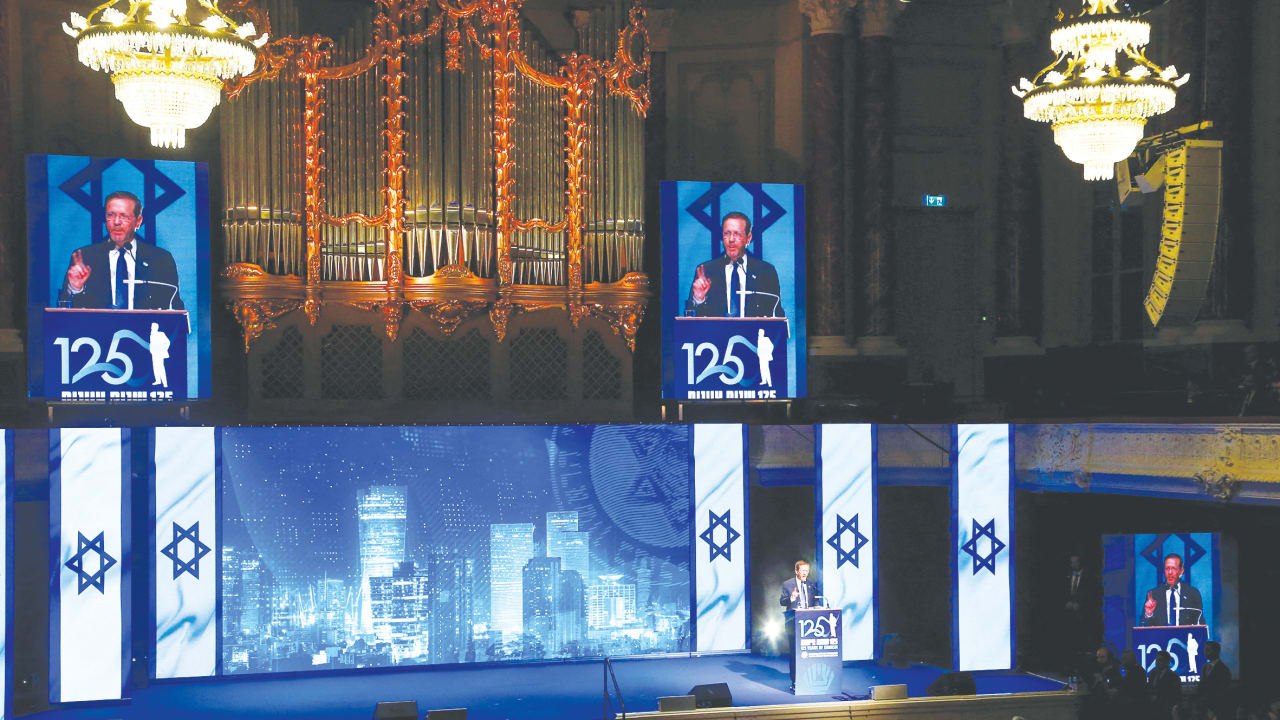
The World Zionist Congress, that body of living history founded by the father of Zionism, Theodor Herzl, has convened in Jerusalem for its now-quinquennial gathering as the supreme authority of the World Zionist Organization.
The 39th Congress takes place in Jerusalem beginning today and running until Thursday. Delegates will consider dozens of resolutions in committee sessions, culminating in a plenary vote on Thursday. But beneath the procedures and formal settings, many of these resolutions touch directly on some of the most heated political fault lines in Israel.
Several draft resolutions go to the heart of contentious debates in Israeli society: military service, sovereignty over Judea and Samaria, and the establishment of a state commission of inquiry into the October 7 massacre.

The Sovereignty & Borders Committee plans to deliberate three items relating to sovereignty – one week after Noam Party MK Avi Maoz’s bill to apply sovereignty to Judea and Samaria advanced to committee after passing its first Knesset reading.
The Pluralism, Social Justice & Jewish Unity Committee plans to address equity issues that expose deep national rifts, chief among them the military draft. One resolution brought by Masorti Olami, the international umbrella organization for Masorti/Conservative Judaism, calls on the WZC to support legislation establishing mandatory service in the IDF or national service for all citizens.
And while the Knesset State Control Committee voted last week against a state commission of inquiry into the October 7 massacre, MERCAZ Olami has proposed a resolution calling for the establishment of such a commission.
These are questions that are also being asked across Israeli politics, security, and society right now.
The WZC is often dismissed as a historical relic and nothing more than the ceremonial gathering of Diaspora and Israeli representatives distributing jobs and budgets. But this Congress wields genuine influence.
It oversees key appointments and allocations in the Jewish Agency for Israel, Keren Kayemeth LeIsrael-Jewish National Fund, and other Zionist national institutions that control significant funding and land resources.
Decisions made at the Congress can help shape educational priorities, settlement activity, aliyah policy, religious pluralism, and funding strategies that have far-reaching consequences. In other words, the WZC has a hand in how Zionism is implemented in practice, both in Israel and the Jewish world.
That influence is also reflected in its makeup. Israel holds 38% of the delegate seats, the United States 29%, and the remaining Diaspora 33%. For a body that meets only once every five years, the Congress plays an outsized role in defining the global Zionist agenda. It is also, increasingly, a stage for Israel’s domestic political battles to spill over into the broader Jewish world.
This year, those battles have extended beyond ideological debates. An internal power struggle within World Likud is already disrupting coalition negotiations over leadership positions in Israel’s national institutions. Two separate factions – one led by WZO chairman Yaakov Hagoel, the other by Culture and Sport Minister Miki Zohar – are negotiating independently for top jobs.
Each side accuses the other of delaying the World Likud Conference and its internal elections out of fear of losing control. That dispute has, in turn, created friction with other slates hoping to reach power-sharing agreements and has cast a shadow over the opening of the Congress.
For some, the WZC feels distant as a symbol of Herzl’s time with little relevance to daily life in Israel or the Diaspora. But ignoring it would be a mistake.
In a Jewish world where our identity, politics, and power are more important than ever before in a post-October 7 world, this Congress remains one of the few global platforms where all major Zionist streams, Left and Right, religious and secular, Israeli and Diaspora, must sit together, debate, and decide.
Its influence may be quieter than a Knesset vote or a street protest, but it is important, often shaping the background against which those louder debates unfold. One can only hope the delegates will be able to sit and debate accordingly.
So, do we still need the World Zionist Congress? Perhaps it is better to ask whether we’re aware how much it still matters.