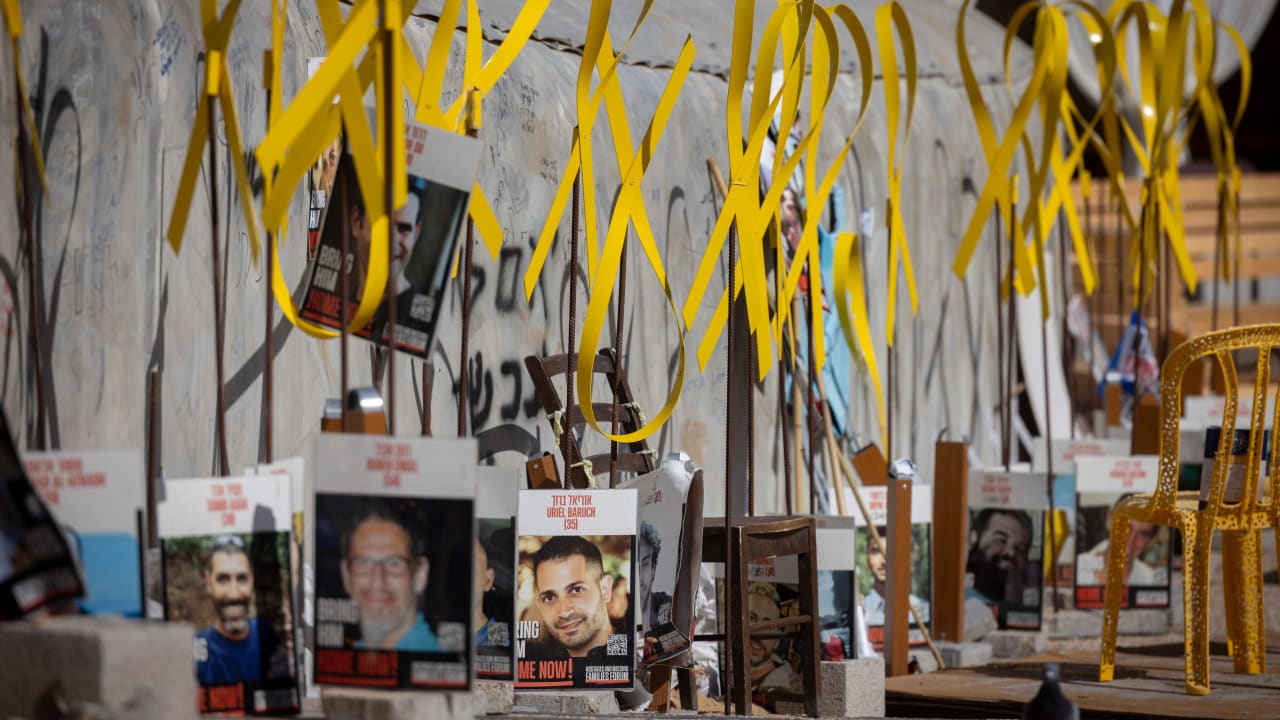
The national October 7 commemoration ceremony, which took place on Tuesday night following the first day celebration of the Sukkot holiday, was heartbreakingly beautiful, engaging, poignant, and everything such a ceremony should be.
It included speeches from Anat Angrest and Viki Cohen, mothers of hostages Matan Angrest and Nimrod Cohen, as well as filmed segments of: bereaved fathers, a topic that culturally has gotten less attention; the wife of a reservist who committed suicide after struggling with PTSD; earnest gratitude to ZAKA staff for their incomprehensibly difficult and incredible work of identifying bodies in the days that followed the massacre, granting families a sense of closure; and a live, heartfelt plea to the world to bring the hostages home so that the nation can begin to heal.
Forty-eight hostages remain in Hamas captivity, being used by the terrorist organization as bargaining chips to demand the full military withdrawal of Israel from the Gaza Strip. Two years ago, Hamas led the cross-border massacre attack on southern Israel, triggering the Gaza war. Terrorists killed 1,200 people and kidnapped 251 people back to Gaza.
Ceremony logistics
An interesting debate stemmed around the logistics of the ceremony, particularly its date and time.
It began when, as shown on a map provided by the organizers, save for a handful of settlements, the ceremony was not scheduled to be broadcast in the West Bank. This angered some, who saw in it a sense of apathy towards the trauma and grief of that horrid Saturday, as well as the issue of the hostages, which they saw linked to broader sectoral and political splits.

In response came arguments that commemoration and remembrance take different shapes for everyone, and also, given that most settlements are also religiously observant, scheduling the ceremony for just a few hours after a major religious holiday ended, in Tel Aviv, would effectively cater the experience only to those who would be able to make it: anyone who has the time to drive and lives close enough to the Center.
The commemoration was broadcast live on YouTube, making it available for anyone to watch on their personal devices if they chose to do so.
While both sides may hold valid points, the tone of the debate in and of itself has no place in Israel’s post-October 7 dialogue. This is an October 6 dialogue, clad with generalizations and finger-pointing. With the premise that the state will continue to exist for a very long time, there are many more years to nail down the commemoration experience exactly right. Doing that requires thinking on a much larger scale of outreach.
Let’s not forget where the debate caught Israeli society last year: a brutal and bitter fight between the grassroots ceremony and the official state-run one. In the end, the civilian organizers changed the time so as not to put the public in a position where it would have to choose which one to watch.
That was another example of pre-October 7 dialogue, but since last year, the advancements in maturity can be tracked.
But we are not yet there. The ceremony was a traditional one and included nods and audience members from all walks of life – including the observant and religious.
Galit Dan, whose 13-year-old daughter, Noya, was killed alongside her grandmother, Galit’s mother, Carmela, in Kibbutz Nir Oz, said at the ceremony, “We do not seek revenge; we seek healing. We want to defeat fear and find hope. To overcome hatred and reconnect to our humanity. To overcome rage and reconnect to compassion. To awaken once more the values that my grandparents came here for.”
To be sure, this healing will only begin when the 48 hostages are freed back to their homeland, but healing requires maturity, particularly maturity in outlook and speech, and in the refusal to address stigmas upon entire population groups.
Healing requires nuance, patience, and dialogue. These are the goals Israeli society should set for itself, sure of its worthiness to take on such a challenge.
The day of commemoration itself could be a set date, similar to any other commemoration date, to make sure it doesn’t fall on a holiday that clashes for many people. These things can be ironed out, not in sharp and hurtful words, but in conversations.