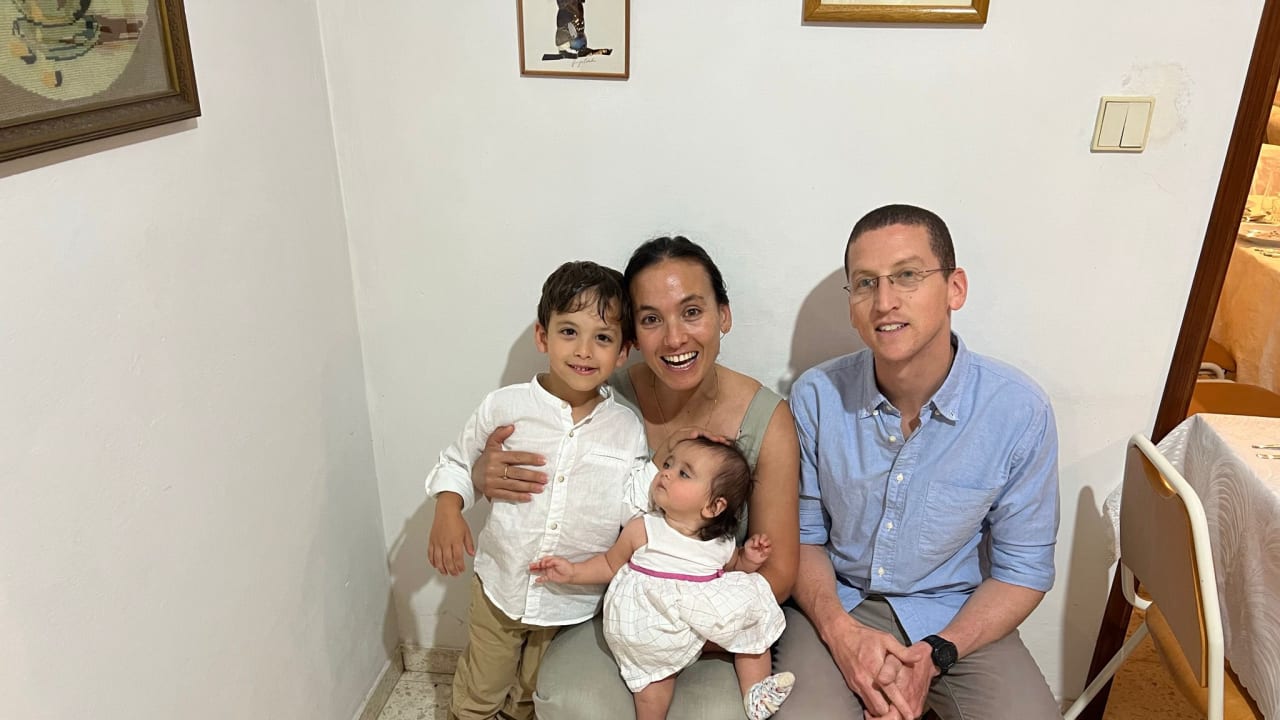
The High Holidays arrive each year like a tide: sweeping into homes with familiar melodies, the fragrance of honey cakes, the glow of candles, and the piercing call of the shofar. They carry with them the hope of renewal, the promise of forgiveness, and the gathering of families around festive tables. Yet for women who walk through the valley of widowhood, these sacred days are shadowed by an absence too heavy to ignore.
For the widows of fallen IDF soldiers, the High Holidays are not merely spiritual milestones. They serve as reminders that family rituals, no matter how carefully maintained, will never be complete again. And yet, amid the grief, these women carry a deep strength: the determination to honor each her husband’s legacy, nurture their children despite their loss, and cling to faith even when their hearts are broken.
Their stories are different, but they are united by love, resilience, and the courage to face the Holidays with trembling hands, determined that the light will not be extinguished. Raya Adani, Sharona Idan, Sarit Elkouby, and Tal Rubinstein each speak in voices heavy with memory and alive with devotion.
Raya Adani: “When I see his chair empty, I can barely breathe.”
In Raya Adani’s home, the widow of Sergeant Major (res.) Eliran Yeger z”l, the High Holidays bring a heavy weight. “Holidays highlight the absence,” she says. “Since he passed away, I find it hard to participate. There’s a sense of something broken in the family dynamic, and he’s always the missing piece.”
The sense of absence permeates her table, rituals, and even the air. Eliran loved The Holidays, not for their religious aspect but because they gave him a sense of belonging. He joined Friday night dinners with Raya’s family, and on Yom Kippur, he had his own traditions. “He would wake early, bike to Hadera for breakfast with friends, then take the kids biking around Tel Aviv. He even spent Yom Kippur alone once, riding with Eitan. Meanwhile, I went to the Ne’ilah prayer, and we’d meet afterwards to end the day together. I miss that so much.”
With Eliran's birthday on October 11, which often overlaps with the holiday season, Sukkot is especially painful. This year, between Rosh Hashanah and Sukkot, she faces not only his absence but also the memory of October 7th. “This season is incredibly difficult on every front.” Raya feels keenly the contrast between her brokenness and the joy around her.
“I try, for the children’s sake, to create holiday experiences: festive meals, new clothes, traditions. I want them to have memories like I did with my grandmother. But inside, my heart is broken. I can’t truly sit at the table and rejoice. I am happy for others – yet for me, it’s not whole.” Despite her grief, she refuses to succumb to despair.
“I believe happiness is a choice. When Eliran died, I decided early on to choose happiness – real joy, wholehearted happiness. I don’t want to live a half-life.” She holds onto that conviction, even while admitting the days feel impossible. “Honestly, I just want the holidays to pass quickly. Traveling alone with the children is too difficult logistically and emotionally. I try to hide until it’s over.”
There are moments of grace, though. “Loss brings unexpected opportunities. I’d give anything to bring Eliran back, but since I can’t, I focus on what has grown from it. My connection with the children has deepened and so has theirs with each other.” Her fears, however, extend beyond her home.
“The social fabric of Israel feels like it’s unraveling, and that frightens me. If Eliran’s children didn’t grow up in a country he loved, that would be unbearable. We must ensure their deaths are not in vain. People often say, ‘May we be worthy.’ Some dismiss it as cliché, but I believe it.”
As the High Holidays approach, Raya may not currently feel the joy, but she still lights candles, dresses her children in new clothes, and keeps tradition alive. “My kids and I will be okay – more than okay.” In this, lies a fragile hope that memory and celebration can coexist.

Sharona Idan: “I’d like to be able to celebrate again one day.”
For most families, the Jewish High Holidays are a time of gathering and warmth around the table, but for Sharona Idan, widow of Warrant Officer (res.) Guy Idan z”l, the season has become unbearable. “Since he was killed, I haven’t celebrated a single holiday. Not one. At first, it was almost an act of defiance, I simply couldn’t. So I don’t believe I’ll celebrate the upcoming High Holidays either. The holiday atmosphere clashes too deeply with my grief.”
The difference between what The Holidays once were and what they are now is striking. Before his death, Guy was committed to maintaining traditions, even when joy was difficult to find after his cousin Tzachi Idan was kidnapped on October 7. “Even before Guy was killed, it was very hard for him to celebrate holidays after Tzachi’s kidnapping. But he insisted because for him, holidays centered on family. To him, family was everything, and holidays were a vital part of that.”
These Holidays weren't always about religious rituals; rather, they embodied the spirit of belonging. “Our Holidays weren’t religious, but tradition mattered. He wanted our daughters to have the same experiences he had growing up in the kibbutz, where Holidays were big communal celebrations.” For Sukkot, the family always cooked a poike stew outdoors.
“That was a tradition. And he always made sure there was a vegetarian pot just for me. He was thoughtful, funny, and always made us laugh. He truly was a humorous man.” Today, as the kibbutz resonates with singing, meals, and children playing in decorated sukkot, Sharona cannot join.
“I don’t participate in the celebrations. I stay home. I understand life must go on, and I’d be happy to join – but it’s beyond me. I don’t feel anger at others’ celebrations; I understand that’s what he fought for, so life could continue. But I can’t.” Over time, neighbors understood.
“Initially, they suggested what I should do, what would help me. But eventually, they realized I know what I need. You can’t force it.” Deep inside, she still hopes for joy to return someday. “I’d like to celebrate again one day, to carry on what he started, because that’s what he wanted. I really hope I can do that eventually. Right now, we don’t talk much about Holidays at home. It’s suppressed. We talk about him constantly, but not linked to Holidays.”
When Sharona talks about Guy, his presence fills the room as if he had just left. She remembers his decision at fifty-one to serve in reserve duty in Gaza and later in Lebanon, where a rocket barrage claimed his life. And she recalls his laughter, the same that once carried the family through Holidays, the same she longs to hear again.
“I just want people to know about Guy. He was an extraordinary man who loved his country deeply. I know, without a doubt, that even if he knew how it would end, he still would have done it. That was him. He couldn’t stand aside; he didn’t know how. He was amazing. And it’s important to me that everyone knows that.”

Sarit Elkouby: “Our home will remain a joyful home”
The sound of the shofar, the glow of holiday candles, the crowded table where blessings are sung, these moments are meant to unite families. For Sarit Elkouby, widow of Lieutenant Colonel (res.) Netanel (“Nati”) Yaacov Elkouby z”l, they also serve as reminders of everything lost. “First of all – frustration. Sorrow. A sense of emptiness. The holidays now mainly bring pain, loss, and the desire for it to pass.”
Her family’s foundation had already been shaken when her beloved mother-in-law died suddenly, leaving a void at the head of every holiday table. But the blow of Nati’s death shattered what was left. “When Nati was killed too, it felt like the entire structure of our family collapsed. Holidays shifted from being exciting and celebratory to just trying to survive.”
Sarit and Nati’s story began long before. They met as children in seventh grade, grew up side by side, and by the end of high school, they were inseparable. Together, they raised five children: Anael, Avishag, Talia, Aviad, and Evyatar. To his family and soldiers alike, Nati was both anchor and guide. On the battlefield, he commanded Battalion 630 of the Givati Brigade; at home, he led the kitchen, preparing feasts with a chef’s creativity and a father’s warmth, wanting everyone close.
Their final exchange was heartbreakingly ordinary: a check-in about the kids, a reminder about the battalion’s end-of-tour ceremony. Sarit wrote, “Take care of yourself, I love you.” His reply was simple but full: “I love you too!” “That was our goodbye,” she recalls.
Now, each holiday brings back the rituals that defined their life together. “He used to place his tallit on the children’s heads for a blessing. My little one, Evyatar, still says what he misses most about his father is going to synagogue with him.” Friday nights also carry another memory another memory, one both tender and unexplainable. “At Kiddush, ever since our wedding, there was always a point where we would look at each other and start laughing, without knowing why. It happened every time, and the kids would always ask, ‘Why are you laughing?’ We could never explain. It was just joy.”
In the face of such loss, Sarit made a vow. “Already on the very day I received the news, I made a decision – that my home would remain a joyful home. That we would live good, happy lives, because that’s what he wanted. About six weeks before he was killed, he even told me explicitly: ‘If something happens to me, move forward. Don’t hesitate. Live.’”
So Sarit chooses life. Even when her daughter trembled beside her asking, “Mom, what will we do?” she found the strength to promise: “We will be okay.” Now, as the holidays approach, she sets her table not only with food and ritual but with resilience. In every candle lit and every blessing whispered, Sarit insists that Nati’s voice, his joy, and his love still fill their home.
Tal Rubinstein: “The holiday is about more than us”
Tal Rubinstein, widow of Captain (res.) Sagi Ya’akov Rubinstein z”l, feels like The Holidays arrive unexpectedly and harshly. “Honestly, I wish The Holidays would be canceled,” she confesses. “I joke that if another war starts, it might be because I prayed for The Holidays not to come.” Behind the joke lies thinly veiled pain. Holidays used to be Sagi’s time, when his presence filled every corner of their home. Now, the thought that he won’t be there is almost too much to bear.
Sagi cherished the holiday atmosphere – decorating the home with the children, planning meals and outings, welcoming friends from across the country to their kibbutz in the north. For him, The Holidays weren’t just dates on a calendar; they were moments to create, experiences to strengthen family bonds. “He loved decorating with the kids, filling the house with a festive mood,” Tal recalls. “Holidays were when his presence was most felt.”
Now, the contrast feels cruel. Friday nights, holiday meals, even small rituals like preparing salads with the children or sipping coffee after tidying up, each reminder of her loss. “We were married for eight years,” she says. “It was a complete life together.”
Sagi had many dreams. Initially, it was the military, serving as a platoon sergeant, participating in Operation Protective Edge, and helping find the three kidnapped boys. Later, health issues prompted him to leave the military. He then devoted himself to security work on the kibbutz, agriculture, volunteering, and eventually, medicine. Just six weeks before his death, he started studying to become a doctor. “He lived for others,” Tal says simply. As a paramedic, as a youth mentor, as a father, he gave endlessly. Patients he treated briefly came to his funeral to honor him. Volunteers he trained still speak of his dedication and warmth.
But his absence is most deeply felt in family traditions. Sagi wanted the children to understand the meaning of The Holidays. He made sure they had their own prayer books, took them to synagogue, and explained Tashlich and Torah portions with enthusiasm. At home, he was the one chopping vegetables for the holiday salads, with the boys standing beside him, learning. He turned acts of giving into rituals – for Rosh Hashanah or Passover, he would take the children to help pack food for needy families. “He wanted them to know the holiday is about more than us, about helping others,” Tal recalls.
Now, Tal continues those traditions because her children insist and because she feels she has no choice. “Just today I made schnitzels with Sagi’s recipe. My oldest said, ‘Abba’s were better.’ Then he added, ‘Actually, yours are better.’ It broke my heart, but I was also proud.”
Even little Rona keeps his memory alive. “She was only one when he was killed, but she knows her father. She points to his picture and says ‘Abba.’ She keeps him with us.”
Tal says her current work isn’t really a job but survival. “People ask what I do, and I say: I work at living my life. Carrying on our traditions, keeping the light alive – that’s my mission now.” Despite her prayer for The Holidays not to arrive, she prepares again, sharing her husband’s stories, and reminding her children, just as he did, that The Holidays are made sacred by giving, faith, and love.
Raya, Sharona, Sarit, and Tal teach us that grief does not diminish devotion, that absence does not lessen legacy, and that even in sorrow, life and its traditions can remain meaningful. Their homes may be different and their tables less filled, but through every act of remembrance, every tradition upheld, and every story shared, they honor those they've lost while fostering resilience in the lives that continue. During the High Holidays, they reflect both on what has been lost and what endures: love, faith, and the quiet strength to carry on.
This article was written in collaboration with IDF Widows & Orphans Organization (IDFWO).