
A global association of genocide scholars has adopted a resolution stating that Israel’s military actions in the Gaza Strip meet the legal definition of genocide, the group’s president confirmed on Monday.
Eighty-six percent of those who voted among the 500-member International Association of Genocide Scholars backed the resolution, which declares "Israel’s policies and actions in Gaza meet the legal definition of genocide in Article II of the United Nations Convention for the Prevention and Punishment of the Crime of Genocide (1948)."
There was no immediate response from the Israeli foreign ministry.
The move comes amid proceedings at the International Court of Justice (ICJ), where South Africa is pursuing a case against Israel under the Genocide Convention. The case, filed in December 2023, accuses Israel of attempting to eradicate Palestinians in Gaza.
It gained further traction in May, when South Africa submitted a detailed memorial that spurred several countries to signal support for the proceedings.
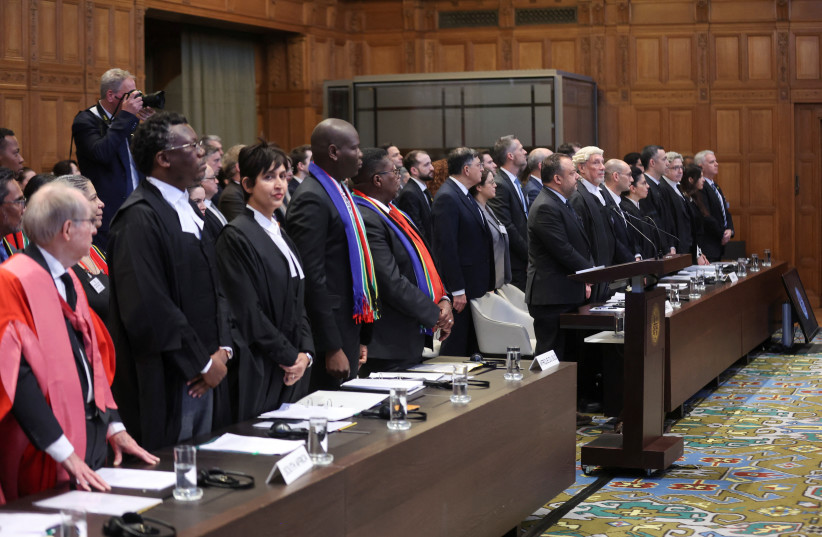
In July 2024, the ICJ granted Israel an extension to file its counter-memorial. Analysts said the delay offered temporary relief but did not ease broader diplomatic or legal pressure.
By August, a coalition of countries, including Ireland, called on the court to broaden its interpretation of genocide -seeking to expand the legal framework under which states can be held accountable.
Throughout 2024 and into 2025, Israeli officials continued to express skepticism about international legal institutions, describing proceedings at the ICJ and the International Criminal Court as politically motivated and aimed at delegitimizing Israel’s right to self-defense.
Israeli scholars, public figures divided on issue of Israel commiting genocide
In Israel, public figures remain divided over the use of the term genocide.
Author David Grossman, whose son was killed while serving in Lebanon, said in August that Israel’s actions in Gaza amounted to genocide - making him one of the most prominent Israelis to publicly adopt the terminology.
Others reject the accusation. In July, international law scholar Nitsana Darshan-Leitner acknowledged the war’s high civilian toll but argued that the criteria for genocide had not been met. She warned that overuse of the term risks undermining its legal and moral weight.
War studies specialist John Spencer said after reviewing Israeli military targeting procedures that he saw no evidence of genocidal intent. He described the use of the term genocide in this context as political rather than legal.
Commentator Sherwin Pomerantz said Israel’s actions, while devastating in their consequences, lacked the premeditated intent required for genocide under international law.
The debate had surfaced earlier in 2024. In June, political analyst Alon Ben-Meir warned that framing Israel’s actions as genocide risked inflaming antisemitism by blurring lines between Israel and global Jewish communities.
Since its founding in 1994, the genocide scholars' association has passed nine resolutions recognizing historic or ongoing episodes as genocides.
The resolution by the genocide scholars’ group has drawn sharply opposing reactions. Supporters say it underscores the humanitarian scale of the war and affirms longstanding concerns about the conduct of the campaign. Critics argue it represents a misapplication of international law’s most serious charge.
This is a developing story.