
Many young boys these days want to be hi-tech executives, astronauts, or scientists. The status symbol for their mothers is no longer “My son the doctor” or “My son the lawyer,” though on a per capita ratio, Israel outshines many other countries in both professions.
Israelis often obtain law degrees for the sake of having another option under their belts, but they don’t necessarily practice law, though the degree may prove helpful in business negotiations and acquisitions.
That was partially the case with one of Israel’s leading jurists, Elyakim Rubinstein, the former deputy chief justice of the Supreme Court.
When Rubinstein was a boy in the nascent years of the state, army officers were the nation’s heroes – more so the heroes of the younger generation.
After all, the period when the Jewish people had neither a state nor an army was not that far behind them.

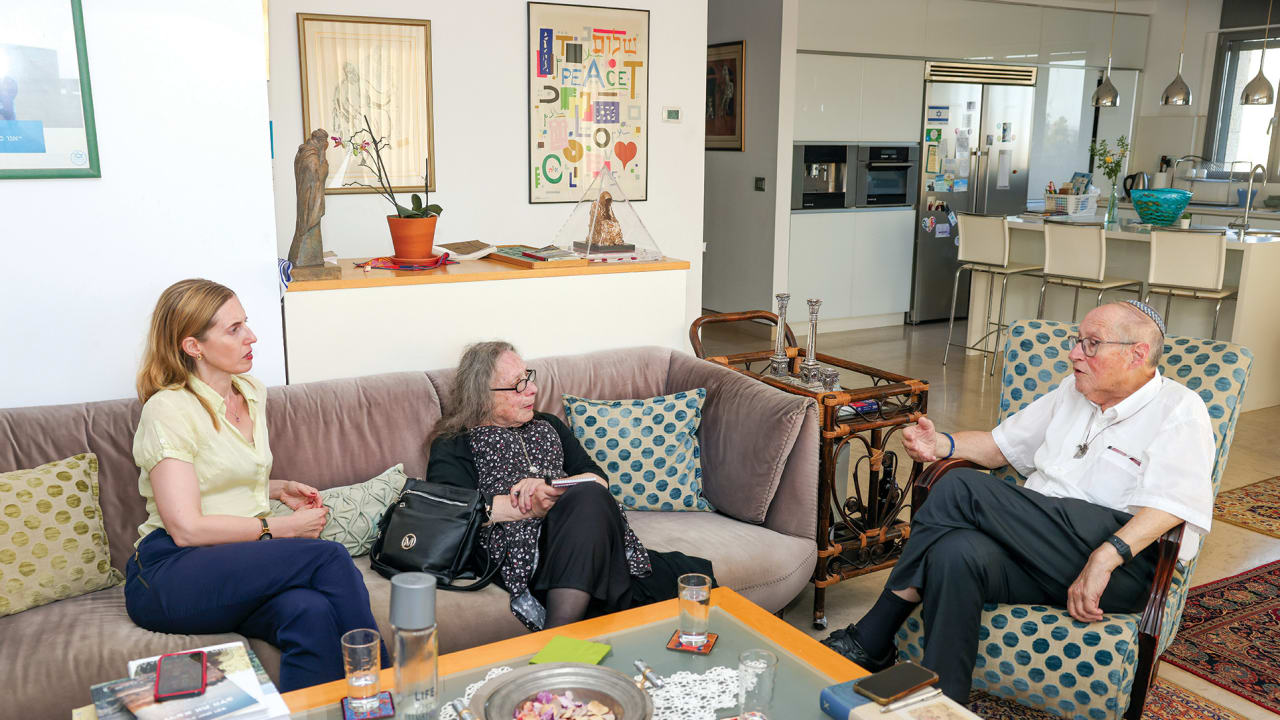
“Moshe Dayan was not my hero,” Rubinstein confided as we sat in the tastefully furnished, sunlit living room of his Givat Oranim apartment. “My hero was Abba Eban.”
Throughout the years, it became increasingly obvious why Rubinstein looked up to Eban, a master of the spoken and the written word – especially after he learned that Eban was the uncle of British film director and screenwriter Jonathan Lynn, who created the highly acclaimed prize-winning political TV satire Yes Minister and its follow-up, Yes Prime Minister.
It was no secret that the plot originated from something Eban had told Lynn, and that from time to time during the series, Eban continued to supply him with political anecdotes.
Anecdotes of a historic career
Rubinstein has his own collection of anecdotes, which he frequently trots out as ice breakers or simply to lighten the mood when there seems to be a stalemate situation.
But a lot depends on the sense of humor of his interlocutor.
Rubinstein reminisced about Israel’s talks with Jordan in 1994 at Beit Gabriel, which is situated on the shore of the Sea of Galilee. Then-prime minister Yitzhak Rabin had considered moving the meeting to another venue because he worried that the Jordanians, on seeing the water, would want as much as they could get.
But no one defied the feisty Jerusalem-based philanthropist and political activist Gita Sherover, who had built Beit Gabriel in memory of her son, as well as other projects in Jerusalem in his name, and there was no way that she would permit a change of venue for such an important meeting.
Rabin had confided his fears to Rubinstein, who said he would think of something.
On the day that he met his Jordanian counterpart, they went out on the balcony overlooking the sea, and Rubinstein remarked: “This is not water.” The Jordanian negotiator immediately got the message, and they both laughed. A potential, albeit imaginary, crisis was averted.
IN A sense, Rubinstein walked in Eban’s footsteps.
Eban was a diplomat, and for part of his multifaceted career Rubinstein was too – not only as a legal adviser to the Foreign Ministry but also as deputy chief of mission at the Israel Embassy in Washington.
In addition, he was a leader or member of Israeli negotiating teams in peace process negotiations.
There was a time, when Dayan was foreign minister, that Rubinstein also worked with him. Dayan was his first mentor and Rubinstein liked him a lot, particularly because Dayan had a great sense of humor and because both had a talent for writing limericks, which they sent to each other.
Both were part of the 12-member Israeli team that in 1978 accompanied prime minister Menachem Begin to Camp David at the invitation of US president Jimmy Carter to meet with Egyptian president Anwar Sadat and his delegation.
Rubinstein also had enjoyable conversations with Begin, whom he admired. Begin invited Rubinstein and his wife, Miriam, for afternoon tea. He accepted the invitation, and they went to Begin’s home thinking that there would be some 20 other people present. But it was more intimate – just the two of them with Miriam, and Begin’s wife, Aliza – and they had a very interesting discussion in which “there was no politics.”
From secondary to sought after
As a university student, Rubinstein’s first love was Arabic literature. He also met wife Miriam at the university.
When asked whether he thinks that Arabic should be a compulsory subject in all state-run schools, Rubinstein replied, “Absolutely!”
The law may have come later, but now his legal opinions are most sought after.
When we arrived at his apartment in the late afternoon, Miriam was standing in the open doorway to welcome us with drinks. Apologizing that he would be a little late for our appointment, she explained that “he’s Zooming.”
The man for whom law had initially been a second option is today one of the most respected jurists in the country. We suspected he was either being interviewed, having a debate on Zoom, or perhaps giving a lecture as he did during COVID.
He does his Zooming in his study, which according to his wife is a holy of holies where no one else can tread.
There are essentially three retired jurists who are first in line to be questioned by the media when certain legal issues become headline news. The other two are Aharon Barak, a former long-term chief justice of the Supreme Court; and Dorit Beinisch, who was the first female chief justice.
These days, unfortunately, there’s plenty for them to talk about – and with regard to law and democracy, the three are generally on the same page.

Positions on the issues
Rubinstein, a former attorney-general himself, thinks that the cabinet’s attacks against Attorney-General Gali Baharav-Miara in the effort to achieve her ouster is contrary to procedure and completely unacceptable.
“Nobody is perfect,” he said, “but she spent her whole life in law and service to the state.”
As for the haredi draft or non-draft, Rubinstein, who is Orthodox, said there is nothing in Halacha which states that men studying Torah should not serve in the army.
Having come from a Religious-Zionist home, not a haredi one, Rubinstein did serve in the IDF.
Rubinstein also understands why the Druze community is upset with the Nation-State Law and said that it could have been worded differently.
Regarding converts to Judaism, according to the status quo they must have the approval of the Chief Rabbinate of Israel. Those converted abroad cannot have citizenship status or live in Israel permanently unless the rabbi who converted them is approved by the Chief Rabbinate.
His opinion about conversion is that there should be harmony between the civil registration and halachic rabbinical standards, which should include a friendly Orthodox conversion process.
Rubinstein was an exception to the trend of cronyism, by serving as cabinet secretary to two prime ministers, Rabin and Yitzhak Shamir, who were from both sides of the political aisle. He was attorney-general during the administrations of both right- and left-wing prime ministers, and he understandably had occasional disagreements with them. Those disagreements were never based on political ideologies and affiliations, however, but rather on legal opinions expressed without fear or favor.
The way Rubinstein sees it, a civil servant is the servant of the state and not of a political party or its head, so there should not be a problem with serving prime ministers of different political viewpoints.
Rubinstein is among the legal experts working with the Jewish People Policy Institute in preparing a lean constitution that will incorporate certain reforms by way of bylaws and ordinances.
“The existing situation is that you can change Basic Laws as if they were bylaws of a municipality. Thin constitution wants, inter alia, to have a Basic Law on legislation which will change this unfortunate situation. “Anything can be changed,” he explained, noting that there are proper legal means by which change can be introduced.
Due to the time factor, we barely started discussing the need for a constitution or other issues such as judicial reform.
Still variously active and back to academics – during so-called retirement
Not quite a year older than the state, Rubinstein has not only witnessed its development and history evolve but has also been an influential factor in making that history, and he continues to be active in various organizations and institutions.
He was the chairman of the Public Committee within the Defense Ministry for the rights of child orphans of the IDF; chairman of the committee for the preservation of historic sites; chairman of Yad Vashem’s Committee for the Recognition of Righteous Among the Nations for a short time; and a board member of the Israel Center for Volunteerism.
He is also co-chair of Kav Mashve, which works for employment of Arab academics, and chair of the public committee of Igul LeTova, enabling people to make small monthly donations from their credit cards for social matters, which has accumulated to total many millions of shekels.
Rubinstein has a very personal reason for his work with Yad Vashem: Most of his father’s family in Belarus were murdered by the Nazis.
Anyone reviewing this list, alongside what he has done in his career, could be forgiven for thinking that it describes a social worker – though in a way, it also characterizes a judge, whose pledge of office emphasizes dealing fairly with all who come before the court.
But Rubinstein’s favorite position since going into so-called retirement in 2017, upon reaching the age of 70, was his appointment as president of Ashkelon Academic College, which has relations and joint ventures with overseas institutions of higher learning.
He is particularly pleased that haredim are included in the student population and in pre-military studies, a factor that falls in line with his deep belief that pluralism makes for better relations between people of varied backgrounds. The college also has Arab students, mainly Bedouin, he said.
Having started his career as a teacher at Bar-Ilan University, Rubinstein said, “Coming back to teaching after many years excited me. I taught voluntarily as a professor in the Hebrew University for six years after my retirement.”
This is something that he has in common with Aharon Barak, who teaches at Reichman University, where he says he feels most at home. Miriam eventually retired as a deputy state attorney.
Rubinstein’s career mosaic, together with his current crop of interests, is mind-boggling. When asked about why he chose so many different fields in which to give of himself, his simple response was: “I’m curious.”
Hobbies, honors, associates
Given his many activities, does he have time for hobbies? Yes – studying Torah, Talmud, and Jewish topics.
Over the years, Rubinstein has been the recipient of numerous honors, the most recent of which was being named as Yakir Yerushalayim (Worthy Citizen of Jerusalem). When asked how he felt about that, Rubinstein replied that it was a great honor because he loves Jerusalem and thinks that Mayor Moshe Lion is doing a great job, especially in keeping the streets clean.
He’s known Lion for a long time – in fact, since before either of them moved to Jerusalem and became internationally known personalities. Both lived in Givatayim, and Rubinstein’s father taught Lion for his bar mitzvah.
Asked to comment on how the high-rises that have sprouted up everywhere have changed the character of the city, Rubinstein was reluctant to criticize, but he did say that Jerusalem does not have the proper infrastructure for such buildings.
Urged to name the honor which moved him most, Rubinstein thought for a moment, then rose from his chair and went over to the bookcase, from which he extracted a handsomely bound Bible inscribed with kudos for his having served the state in so many capacities on the blood-soaked soil of our forefathers.
When asked who wrote such a beautiful tribute, he answered with a slight touch of emotion in his voice: “My mother.”
We would have liked to continue the conversation and to get his views on some of the many distinguished personalities whom he has met, but Rubinstein kept glancing at his watch. He had to go to afternoon prayers – “Mincha” in a local minyan – while it was still daylight.
Praying to his creator was obviously more important than speaking a little longer with two journalists and a photographer.