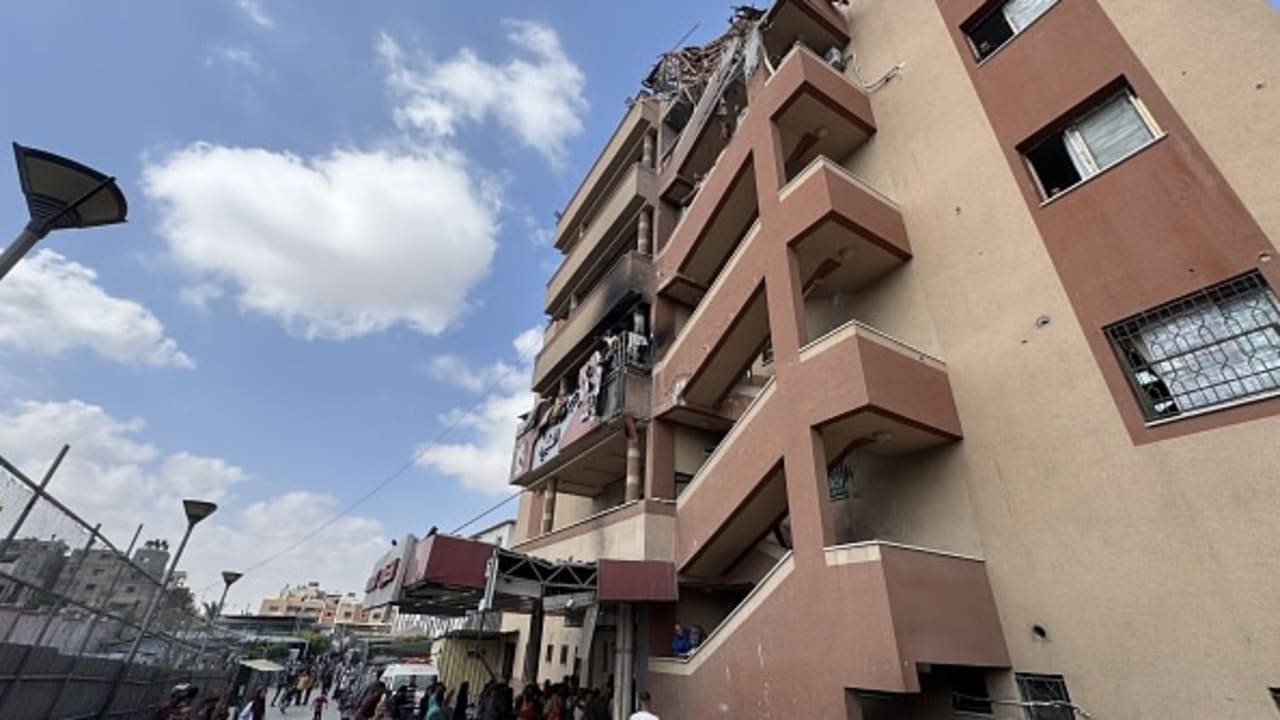
The IDF on Monday finally admitted mistakenly attacking Nasser Hospital in Khan Yunis in southern Gaza, killing well-known journalists, including from Reuters, and as many as 14 others.
Next, the military admitted that the attack on the hospital was approved, meaning there was some Hamas target in place. It said it is probing the attack, meaning significant aspects of the attack and its results are viewed as a major mistake.
The IDF said it did not intend to harm journalists or innocent Palestinian civilians.
Earlier in the day, IDF sources told The Jerusalem Post the IAF was not in charge of anything related to any operation in that area. They said the “address” for managing any such attack would have been IDF Southern Command, which is headed by Maj.-Gen. Yaniv Asor, although different levels of officials approve targets of varying levels of sensitivity.
It appeared that the attack was carried out with shelling, although it was still unclear whether the shells were fired by a tank or by artillery, with no IDF sources denying this narrative.

In addition, the IDF did not deny that there were two separate rounds of fire on the hospital. The second round caused additional deadly harm to medical and media officials who came to the scene to try to assist after the first strike.
The likelihood that there were two rounds of shell firing was condemned even more strongly in global media coverage. It appeared to be an issue that would be even harder to explain.
Generally, higher-level officials must approve an attack on a hospital, even if there is a terrorist in the vicinity.
The IDF tries to avoid striking civilians, IDF Spokesperson Brig.-Gen. Effie Defrin said, adding that it must sometimes pursue Hamas terrorists even when they hide in hospitals.
Oddly enough, Deffrin gave no specific information about the Hamas assets that were struck during the incident. That led to speculation that there were disagreements within the IDF about what the target was and whether it was negligent to fire at such a target using shells as opposed to a more surgical and precise strike.
Since Asor took command of IDF operations in Gaza in March, sources in the IAF have periodically slammed him for being less thorough in avoiding civilian casualties than his predecessor, Maj.-Gen. Yaron Finkelman.
The IDF’s recent ratios of civilians harmed compared with terrorists harmed have likely been the worst since the start of the war.
For much of the war, a ratio of 60% civilians harmed to 40% terrorists harmed seemed broadly accurate, various IDF officers said off the record. That would have put Israel in good standing compared with other countries that had to fight terrorists in urban areas with the systematic use of human shields.
But this was at the stage when the IDF was sometimes killing thousands of Hamas terrorists per week or month.
In contrast, over the past half year, the IDF has said it had killed more than 2,000 Hamas terrorists. According to the Hamas-run Gaza Health Ministry, about 11,000 Gazans have been killed during that same period.
The IDF has cited numerous examples of Hamas exaggerating or downright inventing nonexistent mass civilian casualty incidents. But the IDF has not tossed Hamas’s estimates completely out the window, and it has declined to provide its own estimated civilian casualty tally – something that it always did in prior conflicts in Gaza.
Journalists killed in the strike
Cameraman Hussam al-Masri, one of the journalists killed in the strikes, was a contractor for Reuters. Photographer Hatem Khaled, also a Reuters contractor, was wounded.
The officials in Gaza named the three other journalists as Mariam Abu Dagga, who the Associated Press said freelanced for the AP and other outlets since the start of the Gaza conflict; Mohammed Salama, who Qatar-based Al Jazeera said worked for the broadcaster; and Moaz Abu Taha. A rescue worker was also among those killed, the Gaza health officials said.
The hospital was reportedly operating at full capacity, treating more than 1,000 patients at the time of the strikes, Nasser Hospital Director Atef al-Hout told Al-Arabiya TV. More than 50 people were wounded, he said.
Reuters contributed to this report.