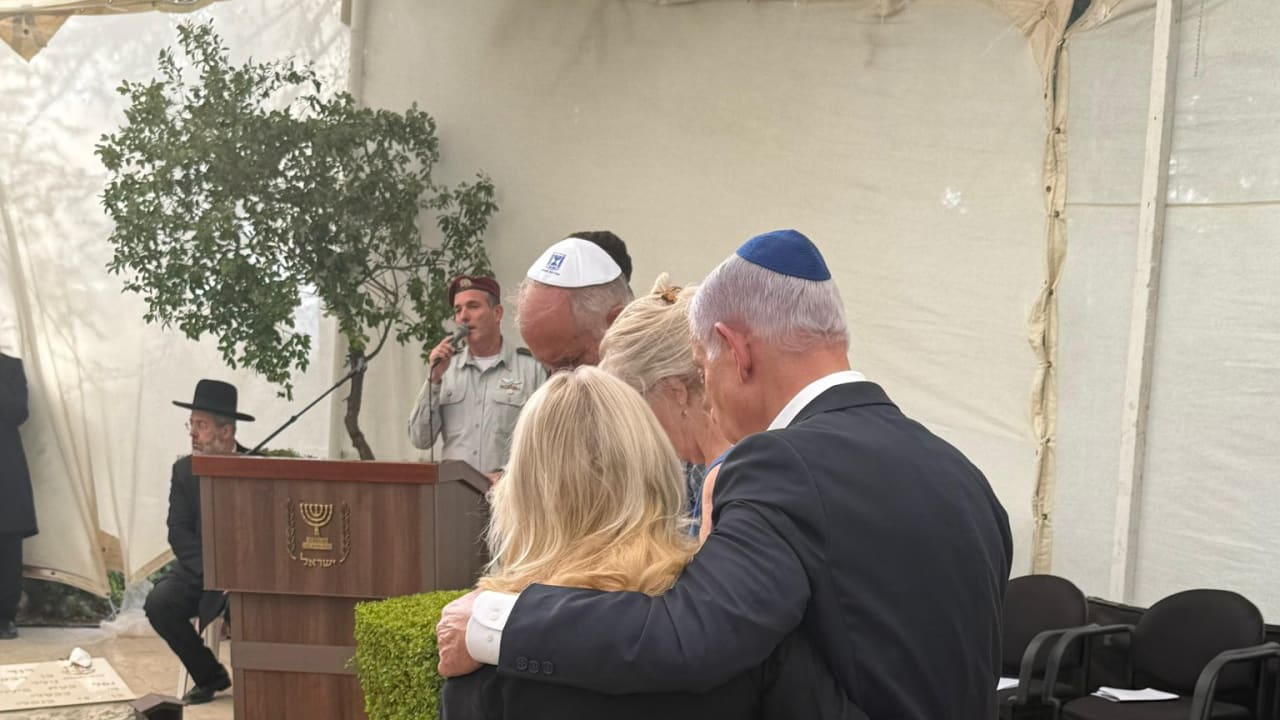
Israeli Prime Minister Benjamin Netanyahu paid tribute to his brother Yonatan "Yoni" Netanyahu in a statement on X/Twitter on Wednesday, after visiting his grave on Mount Herzl earlier in the day.
This is the 49th anniversary of Yoni's death. He was killed in action during Operation Entebbe in 1976, a hostage rescue mission at Entebbe Airport in Uganda.
"Almost 50 years have passed – but it feels like it was yesterday. Not a day goes by that I don’t think of him. Of his final moments. Of what he managed to be – and all that he didn’t have the chance to become. Of his laughter. His vision. His spirit," Netanyahu wrote.
"Thank you to everyone who remembers him. Yoni, my brother, you were so dear to me. I miss you – every single day."
Before Operation Entebbe Yoni enlisted in the IDF Paratroopers, served in the Six Day War
Yoni Netanyahu was born in New York in March of 1946 and moved back and forth between the United States and Israel with his family. As a high school junior, after a brief return to the United States in 1963, he returned to Israel, enlisting in the IDF Paratroopers Brigade. He then fought in the Six Day War as a commander.

After the war, Yoni Netanyahu married his girlfriend, Tuti. They soon left for Boston, where he enrolled at Harvard University.
During his studies, Israel was in the midst of fighting a “War of Attrition” against Egypt and Jordan. Believing he should be in his homeland, Yoni and Tuti returned to Israel in 1968. Yoni enrolled at the Hebrew University of Jerusalem and studied mathematics and philosophy.
Yoni commanded a General Staff Reconnaissance Unit (Sayeret Matkal) force in the Golan Heights during the Yom Kippur War. The unit killed more than 40 Syrian commandos and thwarted the attempted Syrian raid in the Golan's heartland. He also rescued wounded Lt.-Col. Yossi Ben Hanan from Tel Shams.
The 2012 documentary film Follow Me is based on Yoni Netanyahu's life and his final mission. The film’s narration uses transcripts from his personal letters and other spoken words.