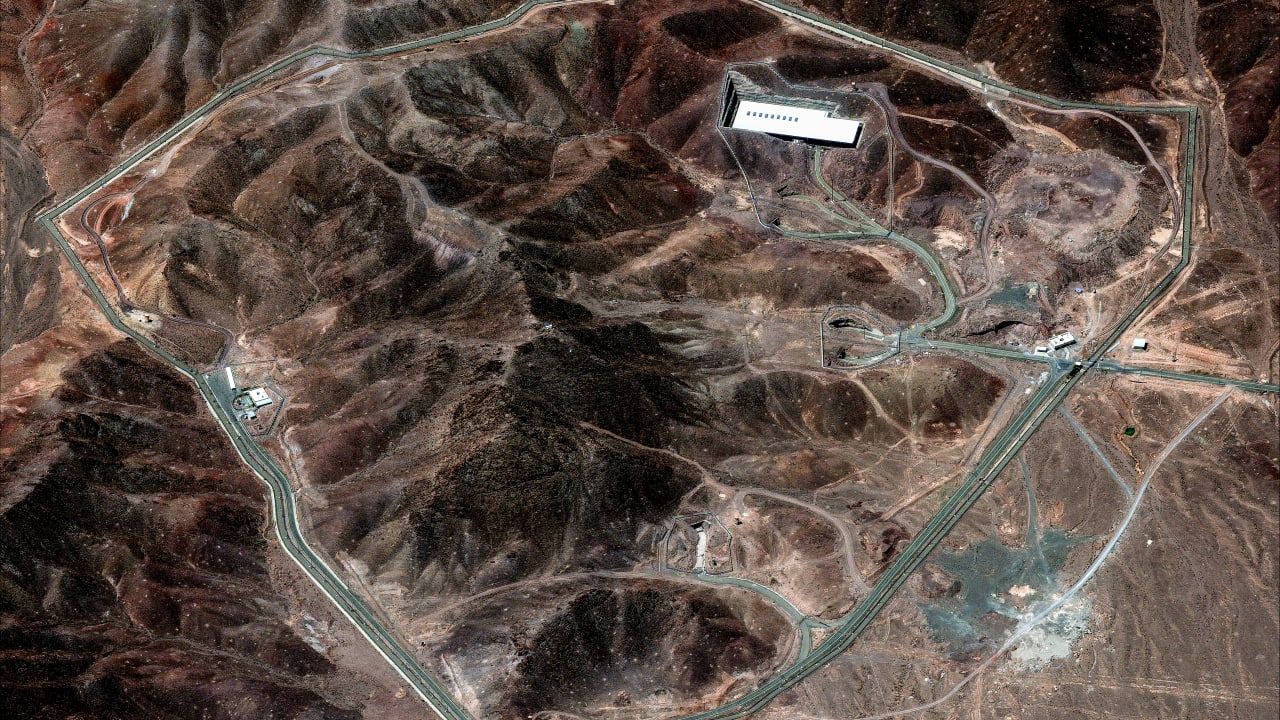
The mountain overlooking the city of Fordow in Qom province may seem like any other rocky peak in Iran’s deserts. However, beneath its surface lies a nuclear facility that was built in total secrecy and first revealed in 2009 by US intelligence.
This uranium enrichment site was strategically placed deep inside the mountain to make it as hard as possible to attack. The thick rock, remote location, and physical isolation make it one of the hardest sites to strike from the air— and one of the most dangerous in terms of the nuclear threat it poses.
Fordow is located about 180 km south of Tehran, near the religious city of Qom. The area is close to key religious and security centers of the regime, including the IRGC. The mountain, on which and inside which the facility was built, is tall and stable. Inside, expansive underground tunnels have been carved, housing some of Iran's most dangerous enrichment facilities.
The Fordow facility is a multi-layered underground structure and is guarded exceptionally well from airstrikes. Reports from intelligence sources and the International Atomic Energy Agency (IAEA) confirm that the site has several main tunnels, each several hundred meters long, leading to wide internal chambers with centrifuges and monitoring systems.

What is inside the Fordow facility?
Each main tunnel is heavily fortified and has thick gates, fences, electronic security, and infrastructure designed to ensure continuous operation without relying on external factors. Inside the complex, there is a central control system, advanced cooling systems, operational rooms, and technical laboratories; they are all built to be able to continue functioning even if the site is hit by external bombing or communication failure.
The ventilation systems and backup infrastructure are likely connected to a dedicated energy network separate from the general grid. This facility is well engineered, reflecting a massive investment of resources and an effort to create a nuclear capability that would be difficult to reach with conventional attacks.
After the United States withdrew from the nuclear deal and reinstated sanctions, Iran moved its most advanced systems to Fordow. Previously, the facility housed outdated IR1 centrifuges. Today, however, it hosts the more advanced IR6 and IR8 models and, according to some estimates, possibly the IR9 centrifuges, which can enrich uranium at a rate tens of times higher than the older models.
These centrifuges operate on natural uranium gas, which contains mainly uranium-238. The centrifuges separate it to obtain the fissile isotope uranium-235. The higher the rotational speed and more advanced the design, the faster and more efficiently the uranium can be enriched. Indeed, a report from the UN's International Atomic Energy Agency in early 2024 stated that the Fordow facility achieved an enrichment level of 83.7%. This indicates the facility has the technical capability to reach the 90% enrichment required for a nuclear bomb.
The primary concern for intelligence agencies is not just the level of enrichment but the fact that Iran no longer requires extended time or multiple facilities to build a nuclear bomb. One underground facility like Fordow, combined with only a few tens of kilograms of enriched uranium, is enough to produce the explosive material needed for at least one bomb.
Another concern for the West is the level of monitoring at the site. Since 2021, Iran has begun restricting access to IAEA inspectors, and in some periods, continuous monitoring has not been possible.
Meanwhile, US and Israeli military satellites continue to track suspicious activities around the site, including the construction of new facilities, changes in the layout of the centrifuges, and even the creation of new control and operational buildings. Some estimates suggest Iran may be considering assembling a nuclear warhead at the site itself, though this claim remains unproven.
Over the years, Iran has consistently denied any intention of developing nuclear weapons, claiming that the facility is for medical research, producing isotopes for cancer treatment, and conducting civilian nuclear research.
However, experts in Western countries point out that there is no need for such high enrichment levels for medical research, and the activities at Fordow clearly exceed the stated civilian purposes.
Israel, for its part, is waiting for the US decision on military action against Iran, primarily to target the Fordow facility. Stealth B-2 bombers, capable of carrying bunker-busting bombs such as the GBU-57, are on standby in case of an attack. According to foreign reports, the US has started moving large forces closer to Iran, with stealth aircraft stationed at the US Air Force base in Diego Garcia ready to take action.