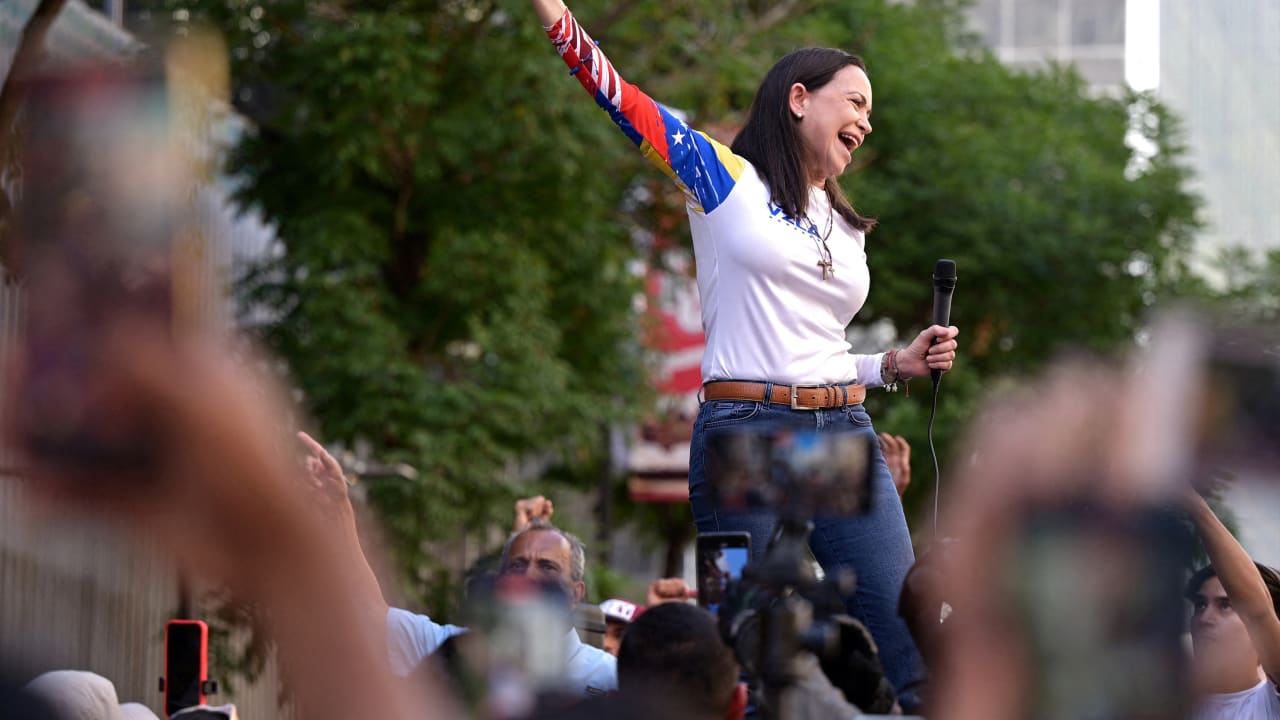
On January 6, 2025, four members of Venezuelan opposition leader Maria Corina Machado’s team piled onto a couch in a Capitol Hill office, across from Mike Waltz, who was soon to become Donald Trump’s national security adviser. Machado made a cameo via video call from her hideout in Venezuela.
During the meeting, David Smolansky, who runs Machado’s office in Washington, explained how Venezuelan gang Tren de Aragua was controlled by Venezuelan President Nicolas Maduro, according to two people present who described the meeting. Waltz scribbled notes the whole time, they said.
The meeting, details of which have not been previously reported, was part of a high-stakes gamble by Nobel Peace Prize-winner Machado to align with hawks in the Trump team who argue that Maduro, through links to criminal gangs, represents a direct threat to US national security, despite US intelligence reports casting doubt on that view.
Reuters conversations with more than 50 sources, including former and current US officials, members of the Venezuelan opposition and informants to US security agencies, provide new details about efforts by members of Machado’s team to help the Trump administration build the case for an aggressive stance against the Venezuelan government, despite worries about blowback from Trump’s policies on Venezuelan immigrants living in the US.
Opposition leaders held multiple meetings with the Trump team before and after his inauguration, seeking increased pressure on Maduro. Allies contributed research for reports supporting the stance. Team members fed details about Maduro and the gangs to security agencies, the sources said.

The reporting suggests the opposition lent legitimacy to the idea that Maduro controls Tren de Aragua, advocating for the theory publicly and in private, seeing its interests align with the Trump administration. Reuters could not establish whether the campaign influenced Trump’s policies.
In the months after the Waltz meeting, Washington designated Tren de Aragua as a terrorist organization threatening the United States and under Maduro’s control. It has offered a $50 million reward for his arrest.
US bombs drug boats
Since September, the US military has bombed at least eight drug boats off the coast of Venezuela, part of a major naval build-up in the Caribbean. Only a fraction of US-bound cocaine passes through the South American country, according to the US Drug Enforcement Administration.
Trump said the 11 people killed in the first strike were members of Tren de Aragua, without offering evidence. Earlier this month, Trump said he authorized covert CIA operations in Venezuela and has said strikes on its territory might be in the cards.
Machado is unwavering in her support for Trump's militarized strategy, saying Maduro should step down to prevent escalation.
Machado declined to comment for this story. Waltz, now the US ambassador to the United Nations, did not respond to questions about the January 6 meeting.
Venezuela’s Information Ministry did not respond to detailed requests for comment from Maduro about the allegations made in this story.
In office since 2013, Maduro has overseen economic collapse and is accused of extrajudicial executions, corruption, and political repression. Backed by the military, he refused to relinquish power despite international recognition that the Machado-led opposition won 70% of the vote in a presidential election last year.
Sanctions, negotiations, and criminal indictments have failed to unseat him.
“You cannot have freedom without strength when you are facing a criminal structure,” Machado said, when asked on NPR after her October 10 Nobel win, whether the US military should intervene to restore democracy to Venezuela, which has the world’s largest proven oil reserves.
Machado dedicated her prize to the Venezuelan people and to Trump, “for his decisive support of our cause.”
Maduro told Trump in a September letter that it was “absolutely false” that his government was connected to drug gangs. Maduro says accusations of rights crimes are untrue and insists Venezuela is a democracy.
Reuters was unable to reach any representatives of Tren de Aragua.
Several governments in Latin America say Tren de Aragua, originally a prison gang and now present across South America, is a major threat in their countries. However, a US appeals court rejected the idea that it was mounting “an invasion” into the United States in a case brought by the American Civil Liberties Union (ACLU) against the administration’s deportation policy.
A declassified US National Intelligence Council report from April that examined the Venezuelan government’s ties to Tren de Aragua found that while some Venezuelan officials “may cooperate with TDA for financial gain,” Maduro is not directing the group’s US operations.
Reuters could not find independent evidence that Maduro controlled Tren de Aragua, or was using it to invade the United States.
Within Machado’s team, some have wrestled with what one member of the opposition-in-exile called an “impossible dilemma.” Because of Tren de Aragua, Trump has applied the kind of pressure on Maduro the opposition has long called for.
But, to support his immigration goals, he simultaneously vilifies Venezuelans in the United States as violent members of the gang.
Machado was largely silent when Trump stripped immigration protections for hundreds of thousands of people, began deporting thousands back to Venezuela, and sent alleged members of Tren de Aragua to a mega-prison in El Salvador, where several claimed they were tortured.
She says the boat strikes, which kill Venezuelan citizens without trial, are a US national security decision. The bombings have killed at least 38 people, many of whom Washington has suggested were Venezuelans or working for Tren de Aragua. UN human rights experts described them as extrajudicial killings.
Machado's team understands they risk being accused of betrayal by compatriots, but sees allegiance to Trump as the best way to achieve democracy, according to two opposition sources.
Despite the potential pitfalls, “the bigger picture” is to remove Maduro, said one of the sources.
Machado the 'patron saint of Venezuela'?
If it works, “she will be the patron saint of Venezuela,” said David Smilde, a Venezuela expert at Tulane University. If nothing happens, he said, she risks losing support from Venezuelans desperate for change and frustrated with the broken promises of a long line of opposition leaders.
And if US military action against Maduro leads to chaos, she will be blamed “for huge destruction inside the country and huge collateral damage outside, he said.
“It’s a high-risk strategy,” he said.
Military action in Venezuela might be justified, says Rubio
Ahead of Trump taking office on January 20, Machado’s people were in touch with Florida Republicans, including then-Senator Marco Rubio, as part of their campaign to lobby for more pressure on Maduro, two of the opposition sources said, without providing further details.
Rubio, who has the additional role of Trump’s national security adviser after Waltz left the post, argued as early as 2018 that military action might be justified in Venezuela. Once a bitter Trump rival and now one of his closest allies, Rubio is a central figure shaping US foreign policy, especially in the Americas.
A source close to Trump administration policymakers on Venezuela said they believed Machado and her team had little sway over Rubio’s views.
However, the meetings helped bolster the administration’s assessment of Maduro's links to Tren de Aragua and the threat it and Cartel de los Soles, another criminal gang, pose to US security, the source said. Machado has left little doubt, both in public and private, of her belief that outside military pressure could be useful against Maduro, the source said.
White House spokesperson Anna Kelly did not provide specific responses to Reuters's questions about the conversations between Venezuela's opposition and the administration.
State Department spokesman Tommy Pigott strongly denied that Rubio had frequent communication with Venezuela's opposition or that they influenced the US approach to Tren de Aragua.
Rubio’s support for the Venezuelan opposition is longstanding and public. He previously championed US backing for its leaders during a 2019 attempt to oust Maduro.
Along with Waltz, he signed a 2024 letter nominating Machado for the Nobel Peace Prize. In April, writing fulsome praise of Machado to support her inclusion on Time Magazine’s list of influential people, he said they met a decade ago.
Even before Trump started focusing on Tren de Aragua during his 2024 campaign, Ivan Simonovis, an outside security consultant for Machado’s team, alleged in media appearances that the gang was sent by the Maduro government to destabilize the United States, without providing evidence.
That argument would later feature in the Trump administration’s invocation of the 1798 Alien Enemies Act to deport alleged members of the gang without due process, which also stated that Maduro was wielding the gang to destabilize the United States, without providing evidence.
Simonovis, a former Venezuelan police chief, told Reuters that he provided information and contacts he had to US security services, cautioning that the information was based on intelligence from Venezuelan security officials and people linked to the gang, but that it was up to the agencies to do a full investigation. He declined to put Reuters in touch with the informants.
Later in 2024, exiled former Colonel Gustavo Arocha, who is close to Machado’s team, fed reporting into research on the gang, including for a paper by right-leaning think tank the Heritage Foundation that called the gang a proxy for Maduro, said a third US official.
The report’s author, Joseph Humire, has since been appointed US Deputy Assistant Secretary of Defense for Western Hemisphere Affairs. Humire and Arocha declined to comment. The Heritage Foundation said it stood firmly behind its research.
Between January and April, Machado’s team held at least eight meetings with Waltz, Rubio, then-Special Advisor Mauricio Claver-Carone, and Deputy Secretary of State Christopher Landau, according to four sources with knowledge of the meetings.
Claver-Carone is a Cuban-American like Rubio who has long supported military action against Venezuela, which helps prop up Cuba’s communist system. He declined to comment for this story.
“We have a constant and fluid communication with the administration and Congress,” Smolansky said, in response to questions about the January meeting and other subsequent contacts with the administration.
Landau did not respond to a request for comment.
US accuses Maduro of leading Cartel de los Soles
At three meetings with Claver-Carone in that period, they talked about designating the Cartel de Los Soles as a terror organization, said two of the US-based Venezuelan opposition sources. A former US official confirmed the meetings but disputed the subject.
The US says Maduro heads the Cartel de los Soles, which it sanctioned as a Specially Designated Global Terrorist in July. The group leads and coordinates with Tren de Aragua to use narcotics as a weapon against the United States, the Treasury Department said at the time, without providing evidence.
Within the Trump administration, not everyone supports military might against Maduro, with envoy Richard Grenell advocating for oil deals rather than war until Trump called off diplomatic outreach earlier this month.
Venezuela continues to profit from a Chevron oil license approved by Trump under deals brokered by Grenell.
Machado, a conservative allied with populist right leaders Jair Bolsonaro of Brazil and Argentine President Javier Milei, promises to open Venezuela's oil industry to US and other investors with sweeping privatizations. Her economic pitch claims that under her movement's control, Venezuela could generate $1.7 trillion in wealth within 15 years.
Jimmy Story, US ambassador to Venezuela until 2023, says the opposition has few options left beyond seeking Trump’s help to remove the president.
“They’ve protested and been killed. We’ve asked them to negotiate, they negotiate, we asked them to do elections, they do elections, they win, and he still won’t leave. What remains but supporting this?”