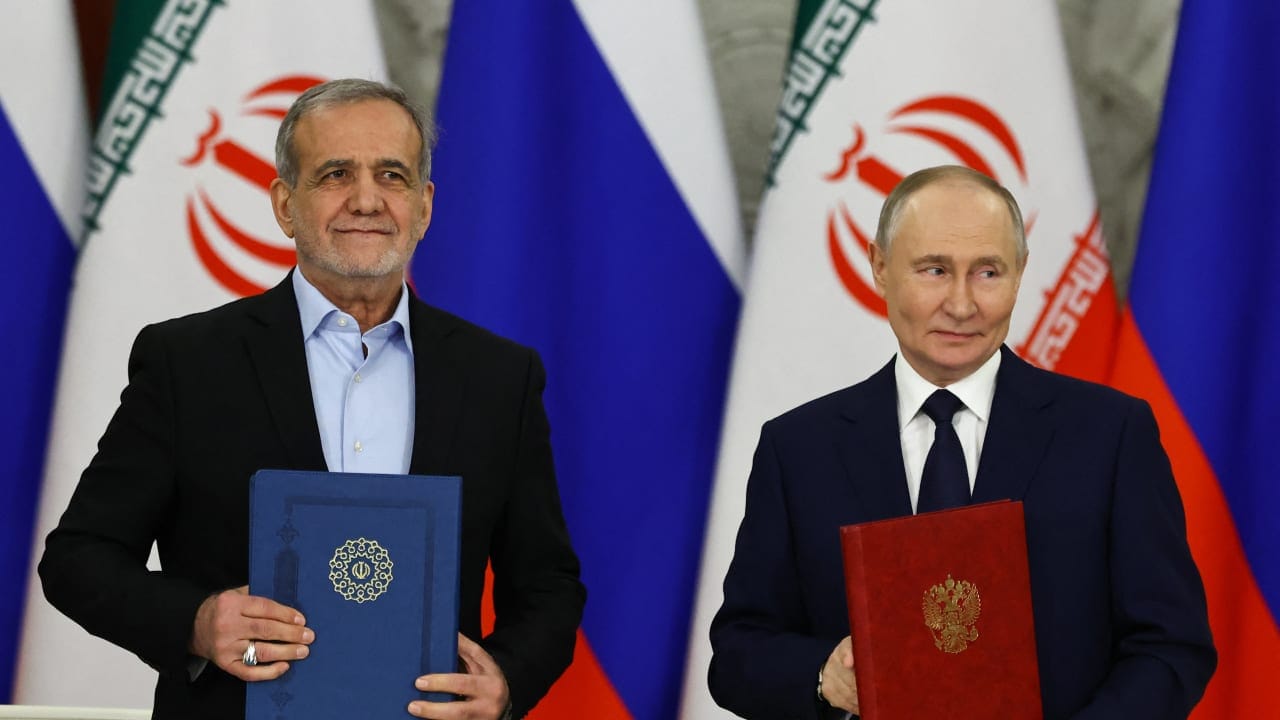
Russia and Iran signed a $1.75 billion deal in 2023 so that Russia could domestically produce Iran's Shahed-136 drones, but two years later, Western security officials say Tehran feels abandoned after Moscow began improving the model and producing it for cheaper, CNN reported on Friday.
Russia has heavily relied on the Shahed-136 drones in its war on Ukraine, and now has localized nearly 90% of production, much to Iran’s surprise.
Sources who spoke to CNN said that they believe that this has made Iran feel like it has had little return on the deal after it supported war, leading to a rift between Tehran and Moscow.
“This evolution marks a gradual loss of control for Iran over the final product, which is now largely manufactured locally and independently,” a Western intelligence source told CNN.
The source explained that Moscow’s goal was to “fully master the production cycle and free itself from future negotiations with Tehran.”

Take Russia’s Alabuga factory, where production efforts for the drones have grown exponentially.
“This is a complete facility,” CEO of Alabuga, Timur Shagivaleev, says in a Russian documentary on the Shahed’s production.
He goes on to explain that most of the components for the drone are produced within Russia.
“Aluminium bars come in, engines are made from them; microelectronics are made from electric chips; fuselages are made from carbon fiber and fiberglass – this is a complete location.”
Russia can export an improved, battle-tested version of Shahed-136 drones back to Iran
The factory is also expanding rapidly with more dormitories and production facilities. CNN reported that this could mean that Russia would be able to export an improved, battle-tested version of the Shahed-136 drone back to Tehran.
The discontent between the two allies came to a head during June’s 12-day war between Israel and Iran. Many expected Russia to provide its ally with more support than the basic condemnation statements it provided.
“Iran may have expected Russia to do more or take more steps without being required to do so,” said analyst Ali Akbar Dareini from the Iranian Center for Strategic Studies, which acts as the research arm of the Iranian President’s office.
He told CNN that Iran may not have expected Russia to intervene militarily, but Moscow could have beefed up “operative support, in terms of weapons shipments, technological support, intelligence sharing, or things like that.”
But the Western analyst who spoke with CNN said that this proved the “purely transactional and utilitarian nature” of Moscow and Iran’s partnership.
“This explicit disengagement demonstrates that Russia never intervenes beyond its immediate interests, even when a partner – here an essential supplier of drones – is attacked.”
In the initial 2023 contract, the two countries aimed to produce 6,000 drones by September 2025. Those were completed a year ahead of schedule, CNN reported, citing Ukrainian Defense Intelligence. The Alabuga factory now produces some 5,550 drones a month in a more cost-efficient way.
“In 2022, Russia paid an average of $200,000 for one such drone,” a Ukrainian Defense Intelligence source told CNN. “In 2025, that number came down to approximately $70,000.”
Ukrainian military officials believe that Russia modernized the drone as well. Now, the Russian-produced Shahed-136 drones boast better communication modes, longer-lasting batteries, and larger warhead capacity.
Darieni said that this behavior isn’t surprising from the Kremlin, characterizing the relationship between his country and Russia as “both cooperation and competition.”
“It’s obvious that Russians want more, to get more and give less, and this applies to Iran as well,” he told CNN. “Iran has provided Russia with drones and technology and the factory, and it has not been for free.”
In addition to these frustrations, Iranian officials say that they have not been paid by Russia.
The Western official told CNN that this adds to Iran’s “frustration with the blockages hindering the transfer of Russian aeronautical technologies to Iran, which were promised by Moscow in exchange for its support.”
Former UN weapons inspector and chief of the Institute for Science and International Security (ISIS), David Albright, said that the expansion would allow Moscow to better support Iran in any future conflicts, which he said was “very dangerous.”
“Some of [Iran’s] drone production facilities were bombed, and they fired a lot of [drones], so as a way to build back stock, they may do that,” Albright told CNN. “And then Iran could reverse engineer or receive the technology to make a better quality Shahed.”
CNN reported that other military equipment was now headed to Iran from Russia in the wake of the war. Iranian media reported that a Russian S-400 air defense system was recently delivered to the country.
However, Iranian officials like Dareini believe that while there is tension between the two countries now, ultimately Iran will benefit from the cooperation.
“Iran has got, and very likely will get, the things it needs for its own security,” he told CNN. “Whether it’s military hardware, whether it’s in terms of economic cooperation, technology, and whatever it needs.”