
Sam Firstenberg, the Israeli-raised director behind cult B-movie staples like “American Ninja” and “Breakin’ 2: Electric Boogaloo,” is getting an unexpected career revival - thanks to one of his most overlooked films.
“Riverbend,” his little-seen 1989 action drama, will screen for one night at Alama Drafthouse theaters in five cities on April 29, offering a fresh look at a film about a group of Black Vietnam veterans who arrive in a Southern town and liberate it from a racist sheriff.
It could also revive interest in the 25 or so films Firstenberg directed between 1981 and 2002, which fans celebrate for their unironic commitment to over-the-top action, niche cultures, and pure entertainment value. In films such as “American Samurai,” “Cyborg Cop,” “Delta Force 3: The Killing Game,” and “Breakin’ 2: Electric Boogaloo,” Firstenberg has been a prolific purveyor of what some critics praise as “earnest shlock.”
It’s a career rooted in the long afternoons a young Firstenberg spent at Smadar, the movie theater in Jerusalem’s German Colony neighborhood. Firstenberg watched the best that midcentury Hollywood had to offer.
Firstenberg, whose given first name was Shmulik, was born to a Jewish family in March of 1950, in Wałbrzych, Poland. His parents had returned to Poland after fleeing east to the Soviet Union during the Nazi invasion.
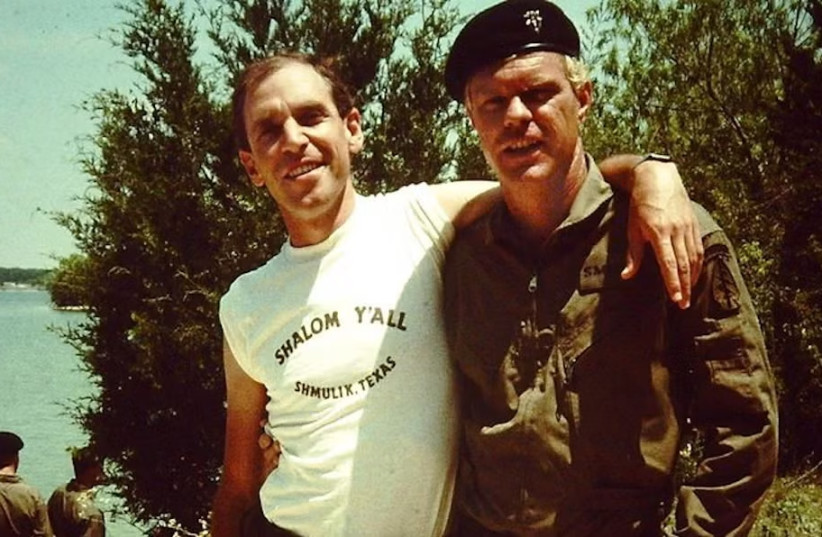
The family arrived in Jerusalem when Firstenberg was 6 months old. Once in Israel, Firstenberg became immersed in cultures other than his own, which, he says, was key to his versatility behind the camera.
“I grew up in a neighborhood that consists of a lot of immigrants from all over the world,” Firstenberg said in an interview. “So, you know, we came from Poland with a Polish background, but around us, there were Hungarian Jews, Romanian Jews, Jews from Morocco, Jews from Tunisia, from Iraq, from Yemen, from all over the world, Indian Jews.
“So my neighborhood was a melting pot of all kinds of cultures from all over the world. I didn’t understand it. I’m telling you all of this [retrospectively], but I grew up in this, all kinds of different food and cooking and languages, and everybody was talking different languages,” he said. “We grew up in a kind of chaos of listening to 30, 40 different languages and cultures.”
Eventually, this led the future filmmaker to the movies. Smadar, now known as Lev Smadar, began screening films for the public in 1950. Firstenberg would spend afternoons watching double features.
“That’s where we were exposed to cinema. So from a very early age, maybe 7 or 6 years old, I would go, and every week he would change the two movies,” he said.
It was a crash course in genres.
“Those movies were mainly Hollywood movies, mainly Westerns, adventure movies, World War II movies, organized crime, gangster movies. Here and there are some musicals,” he said. The showings ranged from classics like “High Noon” and “Bridge on the River Kwai” to escapist movies like “The 7th Voyage of Sinbad.”
“This was the diet of movies that I grew up. And that’s how I was exposed,” he said, adding that Israel didn’t yet have much of a domestic film industry.
By the time he was 18 or 19, Firstenberg realized that he was interested in pursuing a career in cinema.
Firstenberg heads to Hollywood after IDF service
After finishing his Army service in Israel at age 21 - which included a stint as a projectionist when movies were shown to soldiers - Firstenberg decided to go to Hollywood.
“When I finished the military service, I decided, OK, I want to go and study how to make movies. How do you make cinema?” he said. “Now, I’m not fascinated by European movie-making. I’m not crazy about any of that French, Italian, I don’t know, Swedish movie-making. I like Hollywood. I always liked Hollywood movies. I like bullets. I like James Bond.”

In 1972, he enrolled in film school at the LA campus of Columbia College. He still lives in Los Angeles, although he continues to speak with a distinctly Israeli accent. He and his wife both have family back in Israel, and they try to visit annually.
While his connection to Israel remains strong, he also regards the film industry as his people.
“I immediately kind of had this feeling that I arrived at home. I was surrounded by people who all had the same language, we all wanted the same thing: ‘Let’s put a story on the screen,’” he said. He relished getting to know people from all walks of life, from Vietnam veterans to students from Japan to aspiring Black filmmakers from the South.
Eventually, his Israeli connection helped him when he met Menahem Golan, the flamboyant Israeli-born producer who helped pioneer Israel’s film industry in the 1960s and set out to conquer Hollywood in the ’70s. Golan later took over Cannon Films and produced several of Firstenberg’s films, along with Golan’s cousin Yoram Globus.
Golan invited Firstenberg to work on “Lepke,” Cannon’s 1975 film starring Tony Curtis as a Jewish gangster in New York. Firstenberg described his job on the film as a “really nothing, very low job, like bringing and taking and schlepping and nothing serious, whatever, you know, drive the car here, drive the car back.”
He ended up taking the advice of the film’s cinematographer, Andrew Davis, who went on to direct “The Fugitive” in the 1990s, to “get next to the director,” to learn how movie sets really work. So he stayed close to Golan, and “forged a connection” with Golan’s Ameri-Euro Pictures, which specialized in low-budget films. Firstenberg spent five years as assistant director on various films, both in the United States and in Israel.
Quentin Tarantino, at the Jerusalem Film Festival in 2021, described Firstenberg as “my favorite” of Cannon Films’ in-house directors, and listed Firstenberg’s “Ninja 3: The Domination” as one of his favorite Cannon pictures.
In 1979, Firstenberg went back to school to earn a graduate degree at Loyola Marymount. While there, taking advantage of his access to equipment, he set to work on his first feature, the 1981 drama “One More Chance,” which also marked the film debut of actress Kirstie Alley.
Firstenberg soon became a prolific director, churning out “Revenge of the Ninja” in 1983, which got major distribution and was successful, and “Ninja III: The Domination” in 1984, both for Cannon Films.
In late 1984, Firstenberg directed “Breakin’ 2: Electric Boogaloo,” a sequel to the successful break-dancing movie “Breakin.’” The sequel, or its title, anyway, has earned a sort of immortality as a joking reference, in shows like “Family Guy” and “It’s Always Sunny in Philadelphia,” to any unnecessary or ridiculously named sequel. The film was released just seven months after the arrival of the first “Breakin,’” a film with which Firstenberg had no involvement.
“I had nothing to do with the title of the movie,” Firstenberg said. “It became a big deal through the years.”
Firstenberg kept up a breakneck pace in the 1980s and ‘90s, sometimes completing two or three movies in one calendar year. In 1985, he directed “American Ninja,” which he calls his most popular movie, and its sequel two years later. He continued directing movies until after the turn of the millennium.
“I was busy with other movies. I was still directing. I was getting directorial jobs,” he said. “And then at some point I stopped directing, and I started to look into the movies that I have done, what happened to them.”
Some of them are easy to find. Much of the director’s work, including “Breakin’ 2: Electric Boogaloo,” is available on the free streaming service Tubi. But other movies have proven harder to track down.
“Out of 25 movies that I directed, some of them became very famous,” he added. “But some other movies … stuff happened.”
Firstenberg came to direct “Riverbend” after he was approached by a group of private investors from Texas - a pair of married couples, one white and one Black - who weren’t experienced in the movie business. But they were familiar with his previous work, and were hoping to lure actor Steve James, who had starred in Firstenberg’s “American Ninja,” and ended up starring in “Riverbend.”
“Riverbend,” which had a minor theatrical release in 1989 and was later relegated to VHS, has been restored thanks to the efforts of Philadelphia-based archivist Michael J. Dennis. Dennis, who hosts a YouTube channel and film screenings focused on African-American-oriented film, had discovered the film in his days as a video store clerk in the early 1990s, only to find it had almost completely dropped out of sight.
“Riverbend” is “the best movie you’ll see that you never heard of,” Dennis told cinéSPEAK Journal. “One of the things we talk about on my channel is self-reliance and empowerment, and ‘Riverbend’ is a rare film in that it shows Black people standing up for one another. It shows Black people teaching and training one another to fight for their rights.”
Dennis got in touch with Firstenberg and, during the pandemic, tracked down a 35-millimeter copy of the film in South Africa. He eventually obtained the original negative, which led to a crowdfunding campaign and, ultimately, the film’s full restoration. This has led to a series of one-off screenings around the country, hosted by Firstenberg, Dennis, and actors from the film. A Blu-ray release is also planned.
“I feel very comfortable with different cultures,” Firstenberg said. “This is exactly the way I grew up when I was a kid. I grew up with many, many people. So, for me to understand, I believe so: understanding a different culture is easy. It’s no problem for me.”