I’m not at all surprised at the savagery we are seeing on the streets, and some halls of power, in countries generally seen to be enlightened, civilized. “Like us.”
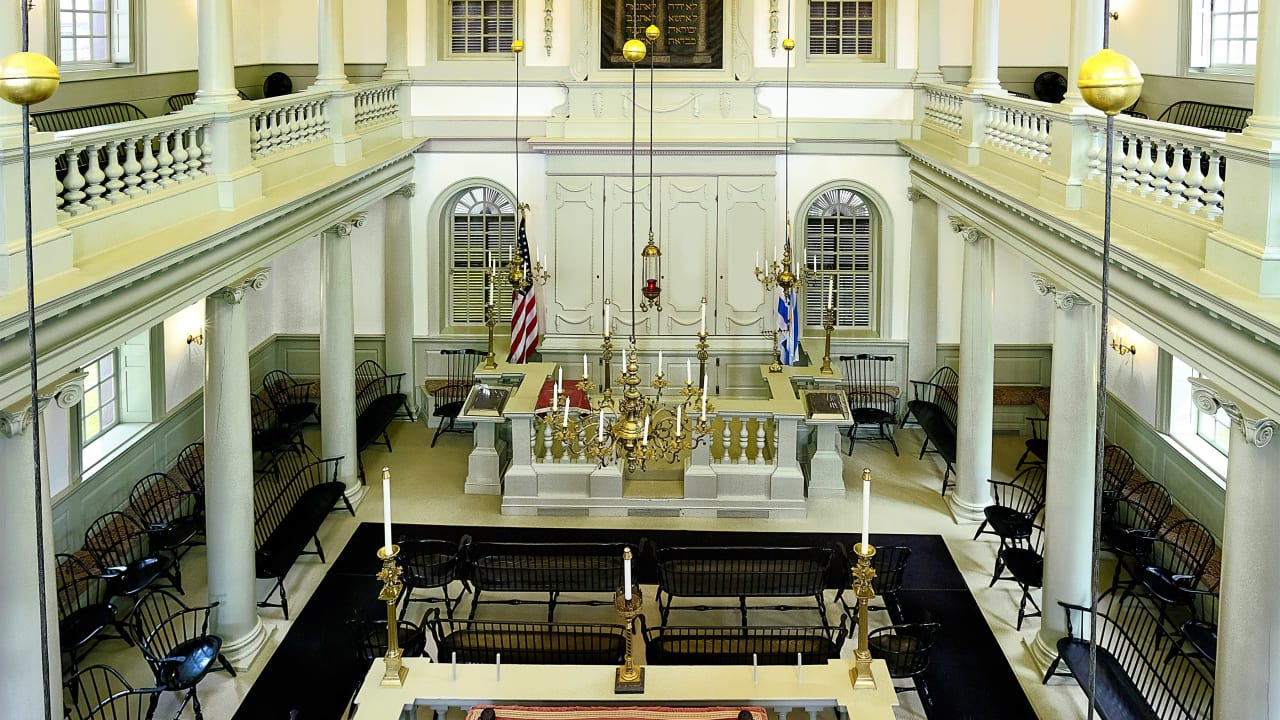
They love to tell about George Washington’s speech at the small Touro Synagogue in Newport, Rhode Island in 1790, where the president embraced the congregation with a remarkable speech, saying, “Every one shall sit in safety under his own vine and fig tree, and there shall be none to make him afraid.”
Religious persecution, he assured the congregants, would not be tolerated in America.
“The police are protecting us here,” he snapped.
True. Until they are not.
What has transpired so many times throughout history – pogroms and officially condoned attacks on Jews – never came about overnight. There is a continuum of what some might call “micro-aggressions” on the descent to full-on Jew hating.
They sought, and found, a pogrom-free life. But to say it was free of antisemitism is fantasy.
“As long as they’re not throwing you in the ovens,” my father once said to me, “it’s not so bad.” He did have a way with words, but that was his experience. A bad day was being on the next train to Auschwitz. Or some other hellhole devised and operated by what had been considered one of the most cultured nations in Europe.
In recent weeks, we have seen chilling video clips of Jews being attacked and physically beaten in Germany, Canada and, yes, the United States of America. These have tended to be random, vigilante outbursts, and rarely have police officers been on hand. But bystanders, rather than trying to intervene and do the Good Samaritan thing, stand aside, hold their cameras aloft to get a clear shot, often laugh and encourage the attacker. I have heard of only one attack, in NYC recently, where a passing taxi driver – who happened to be Muslim – saved two young Jewish boys from a savage beating.
Whereas I do not believe that the broader society would openly encourage anti-Jewish violence, it is downright scary to acknowledge the rather complacent response to this recent wave, from media and many government officials.
But so many lawmakers are silent, not wanting to anger constituents of one side or the other. Which is odd, really. Because when it comes to an attack on so many minority groups, visibly identifiable or not, the press and organized woke culture blanket the issue with support.
Not when it comes to Jew-hating, however. Many civic and political leaders are silent. Many Jewish organizations are afraid, with a few notable exceptions, like the ADL and Canada’s B’nai B’rith. I expect that many are carrying on with their routine meetings and reassuring themselves that this will pass. This is America.
SEVERAL DAYS ago, I received a forceful letter from a fierce longtime activist who expressed her dismay and anger that the leaders of organized Jewish communities in North America were not reacting. Aside from a statement of outrage and concern here and there, she noted, they seemed to be doing nothing. She quite rightly rang the bell, urging some form of immediate, strong, unified response, both to reassure terrified Jews and to demonstrate Jewish strength.
It was an impressive list of recipients to whom the letter was sent, each one in a position to effect change, and not a single person has responded.
It’s eerily reminiscent of the disbelief and confusion that permeated Germany throughout the 1930s, and in Europe beyond. As then Histadrut activist Golda Meir observed in her travels in Europe during those years, there was a surreal disconnect between the extreme and quite widespread persecution of Jews already and the seeming impossibility to extricate them. Anyone paying attention, she noted repeatedly, could see that things would only get worse.
Attending the Evian Conference in Switzerland in July 1938, Meir listened as one country after another expressed compassion for Jews and disgust for Nazi Germany but, alas, each one refused to find a way to adjust their restrictive administrative emigration quotas to offer refuge to the doomed.
Interviewed many years later, Meir stated plainly, the tragic truth we all know today: “I realized then that a world that is not necessarily antisemitic – because Hitler was denounced at the conference and there was considerable pro-Jewish sentiment – could stand by and see others who were weaker victimized.” (Noted in Lioness, by Francine Klagsbrun.)
And the German observers at Evian returned home triumphant, reporting that they could do whatever they wanted with the Jews.
Ironically, those Jews who felt most “protected” and least vulnerable? German Jews. So many had fought for the Fatherland in WWI, were highly regarded and accomplished in their society. And yet, in the end, antisemitism spared none.