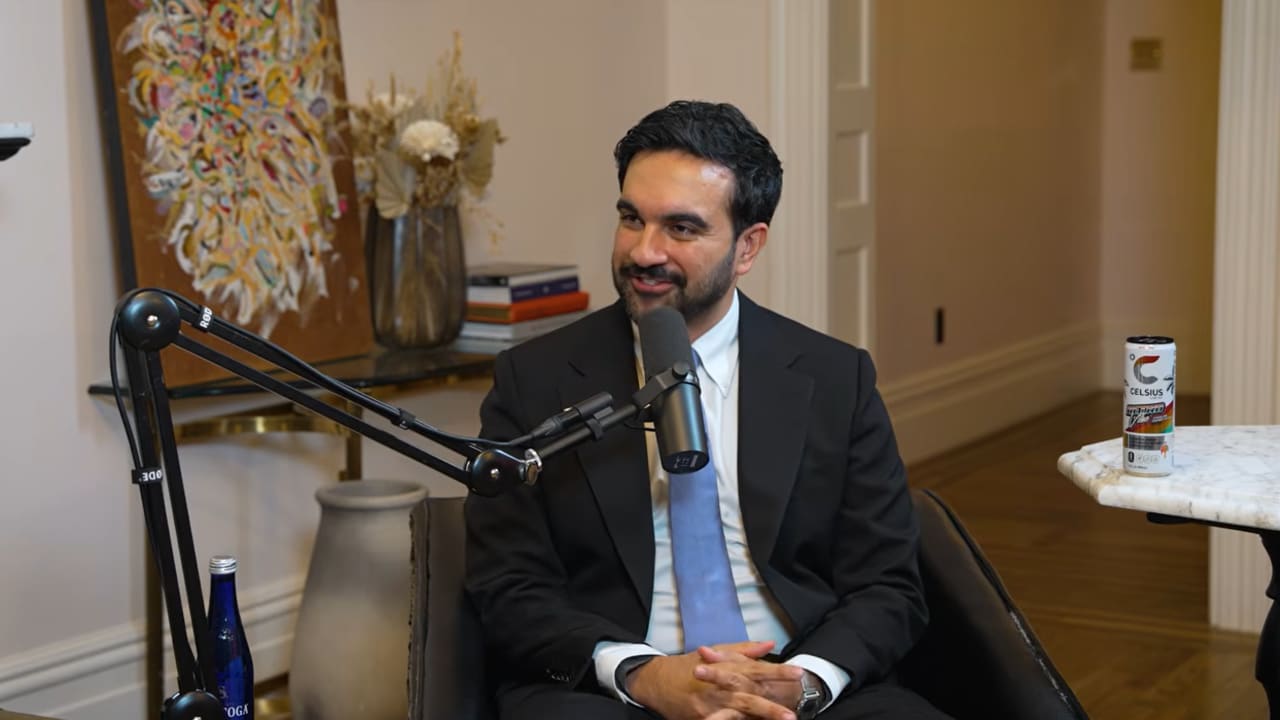
New York City Mayor Zohran Mamdani again sharply criticized Prime Minister Benjamin Netanyahu, calling him “the architect of a horrific genocide” and saying he supports the United States joining the International Criminal Court in The Hague, as well as enforcing the arrest warrants it has issued, including the one against Netanyahu.
Mamdani made the remarks in an extensive interview on the American podcast This Past Weekend, hosted by Theo Von, a well known comedian and podcaster who regularly interviews public figures, politicians, and entertainers.
The conversation initially focused on the cost of living, socialism, and the management of New York City, but toward the end shifted to a lengthy discussion about Israel, Gaza, and Netanyahu’s recent visit to the city.
Von raised the question of whether Netanyahu could have been arrested during his visit to New York and asked whether it had ultimately become clear that the mayor lacked the legal authority to arrest him or prevent him from entering the city.
Mamdani replied that after reviewing the legal framework, it became clear that the relevant authority rested with the federal government.

“If the federal government were to join the International Criminal Court, it could enforce an arrest warrant,” he said.
When Von noted that the United States is not a member of the court, Mamdani replied, “We’re not. But I believe we should join it, and that we should enforce its warrants.”
Accountability, rule of law shaken by not arresting Netanyahu, Mamdani says
The mayor said he viewed the issue as part of a broader principle of accountability and the rule of law.
“The more that people see someone breaking a law or a rule and there being no accountability for it, the more they begin to ask whether those rules have any value at all,” he said.
“We always talk about international law, about the things that began to be created after World War II, about the UN and the idea of multilateralism. A lack of enforcement also undermines their value.”
Mamdani added, “The United States government should join the International Criminal Court. It should enforce every warrant that has been issued. In the case of the prime minister, the warrant was issued over allegations of crimes against humanity and war crimes.”
Von later returned to the question directly.
“But if it were up to you, we would arrest this guy, you think?” he asked.
Mamdani replied, “If it were up to me, the United States government would join the International Criminal Court and honor every arrest warrant it has issued.”
Mamdani says Netanyahu's UNGA speech was attempt to divert attention
Referring to remarks Netanyahu made about him during his speech at the UN General Assembly, Mamdani said that at the time he had been meeting with the prime minister of the Netherlands at an LGBTQ center in Manhattan.

“When I came back from the meeting, they said to me: Oh, by the way, here’s what he said at the UN. It was strange,” Mamdani said.
Asked whether he felt Netanyahu had attacked him personally, Mamdani said, “All of this is an attempt to divert attention from accountability. Mention as many people as possible and try to turn it into an exchange. This is not about me and him. This is about the fact that he is the architect of a genocide.”
Mamdani added pointedly, “If I were the architect of a genocide, I would probably talk about anything else but that.”
Von also asked how anger directed at Israel and its policies could be prevented from turning into hostility toward Jews in the United States.
Mamdani said he was proud that New York has the largest Jewish population of any city in the United States and stressed, “No Jewish person in New York City is responsible for the actions of the State of Israel.”
He said those seeking to assign responsibility should direct it toward decision-makers, the prime minister and the State of Israel, “and also toward our own complicity as American taxpayers, given the billions of dollars we have sent and continue to send in the form of bombs.”
Mamdani said New York City had published a municipal plan that day to combat antisemitism, which he said was intended not only to condemn incidents but also to prevent them.
At the same time, he stressed, “Criticism of the State of Israel, of its policy decisions, of the genocide, is not in and of itself antisemitism.”
Mamdani hosts Gazan Palestinians at official residence
Mamdani argued that despite talk of a ceasefire, civilians in Gaza were continuing to be harmed.
As an example, he cited a claim that the IDF had killed an 11-year-old Palestinian boy the previous week in an area considered safe.
He said he had hosted Palestinian families from Gaza at his official residence, Gracie Mansion, the previous week.
Among them, he described meeting two sisters and their mother, who told him that the strike in which one of the sisters was wounded had killed two of their siblings.
“An elderly grandmother came up to me at the end of the meeting and simply asked, ‘Can you bring my son here?’ I had to tell her that I would try, but as mayor I could not promise it.”
Addressing the future of US policy after the Trump administration, Mamdani said there needed to be a commitment to a different approach.
“How are you going to provide something other than 1,000-pound bombs?” he asked.
Future US policy, he said, should be based on “humanity, not only toward the people we represent at home, but also toward the people we bomb abroad.”