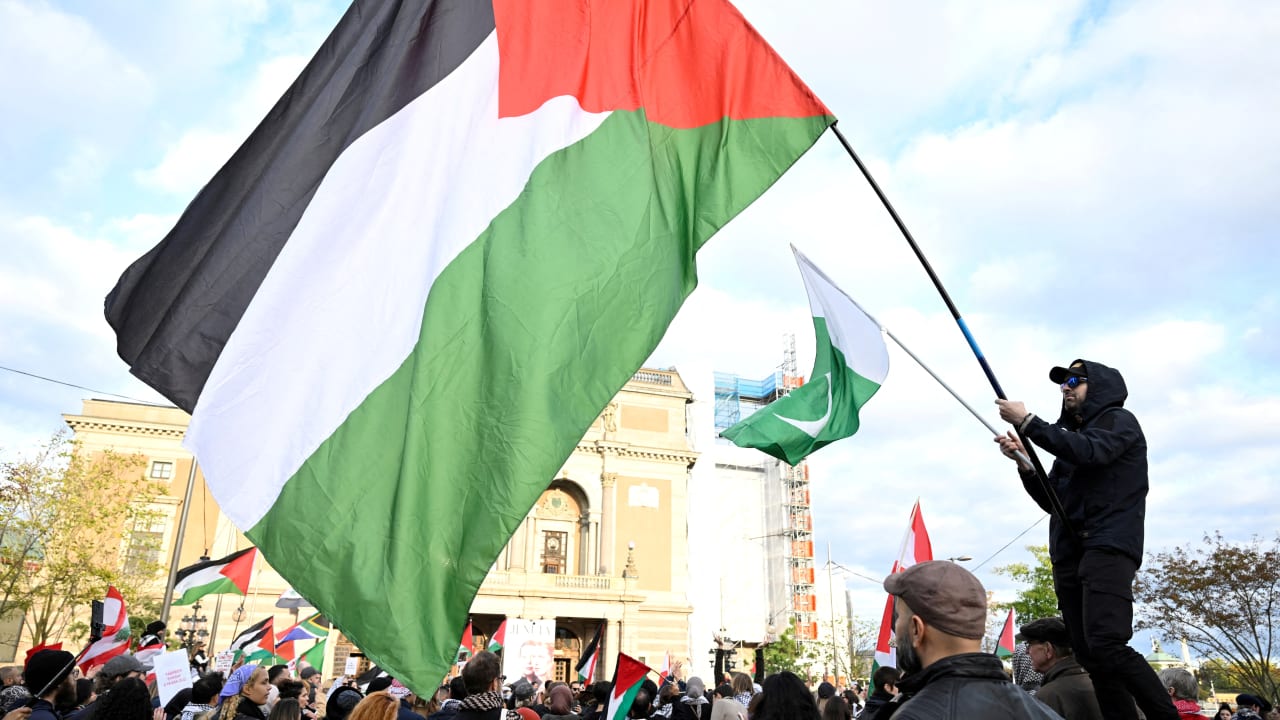
Hamburg Administrative Court allowed a pro-Palestinian protest camp to take place at the site of WWII Jewish deportations, despite outrage from the local Jewish community.
Moorweide in Hamburg is the site from which around 6,000 Jews, as well as Sinti and Roma, were deported during the Holocaust. The former north-western tip of the Moorweide is now called Platz der Jüdische Deportierten (“Square of the Jewish Deportees”), where a memorial stone commemorates the victims.
The protest group Bridges of Resistance, which focuses on pro-Palestine advocacy, registered a multi-day protest camp at Moorweide in Hamburg. The aim was to address Hamburg’s “complicity” in Israel’s “genocide,” for example through arms exports to Israel via the port.
The city and police objected to the location because Moorweide is historically sensitive, and Hamburg authorities and police attempted to restrict and partially relocate the camp to the nearby 12-hectare (30-acre) Sternschanzenpark.
Authorities also argued that there was a heightened risk of antisemitic incidents, inflammatory slogans, criminal offenses, and clashes with counter-protesters.
Similar camps were accompanied by intimidation and an aggressive atmosphere
This meant that the case reached the Hamburg Administrative Court.
In its May 7 decision, sent to The Jerusalem Post on Monday, the court ruled in favor of the Bridges of Resistance camp, suspending the city’s attempt to relocate the event.
The court held that freedom of assembly under Germany’s Basic Law protects the organizers’ right to choose the location, message, and form of their protest, including politically controversial expression.
It also said that Hamburg authorities had failed to demonstrate a concrete and imminent danger sufficient to justify restricting the assembly. It also ruled that the fears about possible antisemitic incidents were speculative.
The case then travelled to the Hamburg Higher Administrative Court (Oberverwaltungsgericht), which ruled to uphold the lower court’s ruling in full. In this May 8 decision, shared with the Post on Monday, the higher court rejected the city’s argument that crime statistics from a similar 2024 camp justified restrictions, and said that authorities had failed to prove a concrete likelihood of comparable offenses at the new nine-day event.
It also ruled that isolated antisemitic incidents and slogans from previous protests could not automatically be attributed to the current organizers without evidence.
The court strongly reaffirmed that hostile reactions from opponents cannot justify limiting a peaceful protest and stated that even allegedly extremist or anti-Zionist views among organizers are legally insufficient grounds for restrictions.
The protest, therefore, went ahead. According to pictures from its first day, the protesters focused on German complicity in Nakba.
One poster read “Stop Nakba Now: End the Occupation and German Complicity.”
There were also workshops, speeches, and exhibitions.
On Sunday, a counter-protest was organized by members of the Jewish community. In a public statement, Hamburg’s Antisemitism Commissioner Stefan Hensel, who was present, said that people from a wide variety of backgrounds came together to make it clear that antisemitism and hatred must not go unchallenged in the city.
He criticized the pro-Palestine protest for choosing a location with such significance: “Many Hamburg residents therefore see the fact that anti-Israel agitation is once again taking place there as a political and moral declaration of bankruptcy.”
Representatives of the Jewish community described it as a mockery of the victims of the Holocaust.
Hensel noted that, in previous years, similar camps were accompanied by intimidation and an aggressive atmosphere, particularly toward Jewish life in Hamburg. He specifically alluded to the group “Thawra [revolution in Arabic] Hamburg,” which has been under observation by the Federal Office for the Protection of the Constitution (Bundesamt für Verfassungsschutz) since 2025 and has been classified as extremist and openly antisemitic.
Hamburg’s State Rabbi Shlomo Bistritzky wrote on X/Twitter: “We, the Jews of Hamburg, are deeply concerned about this.”
The Israeli Embassy in Berlin said, "Those who call for the killing of colonialists, glorify Hamas terror, and promote resistance by any means do not defend human rights. This is not a peaceful movement. This is extremist hate."
Bridges of Resistance, however, told news outlet NDR: “Our protest camp is not a provocation, and certainly not a questioning of Jewish remembrance.”