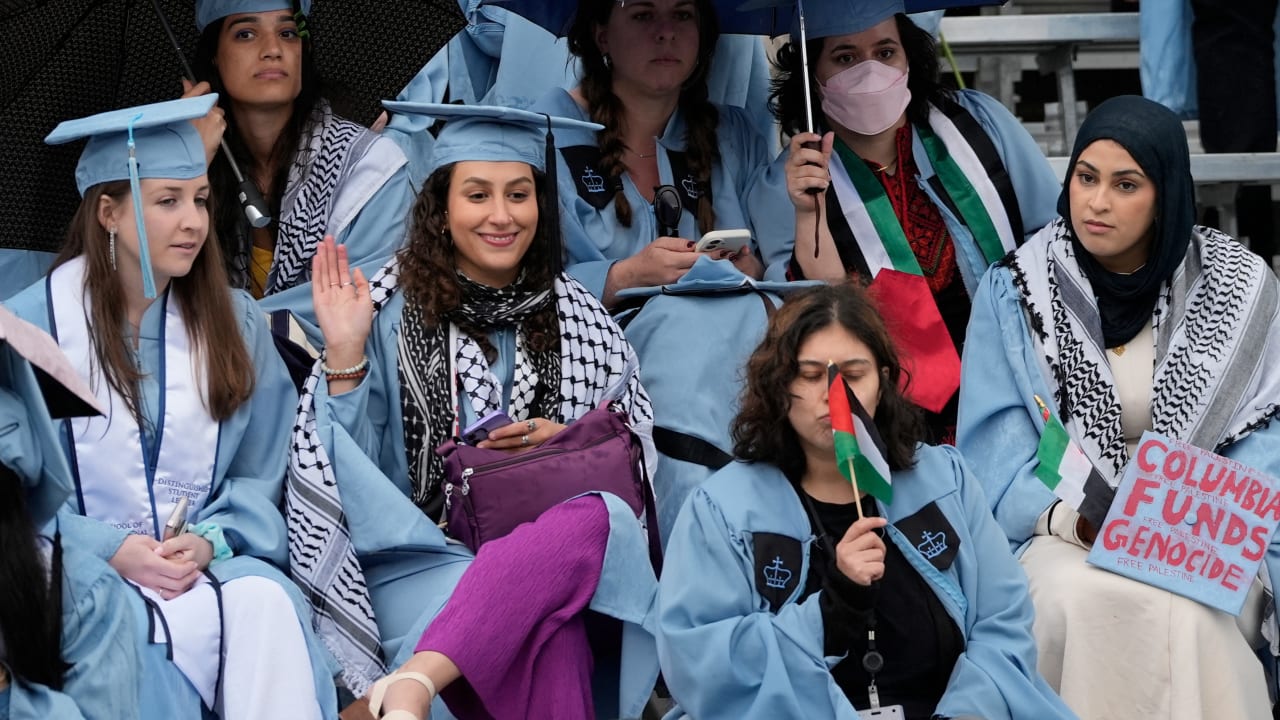
“Antisemitism continues to spread like wildfire at schools across the nation,” said Chairman Tim Walberg (R-MI) of the Education and Workforce Committee in a new report named 'How Campuses Became Hotbeds.'
Walberg said that over the past several years, "we’ve seen university leaders surrender to the radical demands of terror-supporting mobs targeting Jewish students and faculty," adding that this weakness has emboldened hatred and allowed campuses to devolve into hotbeds of radical antisemitism.
Under Title VI of the Civil Rights Act of 1964 (Title VI), universities receiving federal funds must end antisemitic harassment and prevent it from recurring.
The Committee therefore set out to examine whether schools are meeting their obligations under Title VI and whether existing statutes are sufficient to protect Jewish students from discrimination. The Committee also investigated antisemitism at overseas satellite campuses.
The Committee concluded that four main factors are driving campus antisemitism.

First, the Committee determined that decisive leadership by university presidents is critical for preventing and correcting a hostile antisemitic environment on campus. Institutions without such leadership allowed antisemitism to proliferate unchecked.
Report criticizes universities for weak response to antisemitic harassment
The Committee said strong leaders publicly condemn antisemitism, and to investigate and punish antisemitic harassment.
Secondly, the Committee said that faculty members have played a significant role in legitimizing and amplifying antisemitism on college campuses.
At the universities investigated by the Committee, some faculty sought to strip Jewish students of protections, incited antisemitic protests that turned violent, taught antisemitic content in their courses, and hosted programming that isolated Jewish students and demonized Israel.
As an example, Haverford College praised a professor who made antisemitic comments, calling him 'brave.' The incident occurred in October 2023. Haverford mathematics professor Tarik Aougab shared a post describing the attack, "a historic moment to be recorded in the history books.” Haverford’s Vice President for Institutional Equity and Access Nikki Young thanked Aougab for “being brave and honest here at the College.”
Another example was at Berkeley, which called history professor Ussama Makdisi 'a fine scholar' despite him describing Hamas’ attack against Israel as “resistance” and reposting an article online that praised Hamas terrorists’ “determination and courage” and stated that they “heroically defended [their] homeland.”
Thirdly, the Committee found that student groups, most prominently Students for Justice in Palestine (SJP), have consistently acted as ringleaders for the antisemitic harassment faced by Jewish students on campus. It also accused colleges and universities across the country of failing to meaningfully discipline students for this violence and even acceding to their antisemitic demands, thereby incentivizing further misconduct.
For example, Sarah Lawrence College’s SJP chapter repeatedly circulated antisemitic posts online after October 7th. In the spring of 2024, instead of condemning it, SLC presented its SJP chapter with a Student Leadership Award, "further emboldening the group to spread antisemitism on campus."
Finally, the Committee specifically cited Northwestern and Georgetown’s satellite campuses in Qatar as failing in critical ways to fulfill their stated goal of promoting Western values and liberal education abroad, including with respect to their commitment to Title VI principles.
The report claimed that neither NU-Q nor GU-Q have disciplined any faculty, students, or staff for antisemitism since October 7, 2023. The Committee found that after October 7th, GU-Q entities that should be neutral "promoted, participated in, or hosted deeply one-sided events that legitimize antisemitic rhetoric."
An example of such an event was after the October 7th attacks, when GU-Q Dean Safwan Masri led GU-Q in institutionally supporting events that demonize Israel, himself speaking at events such as “Israel’s War on Palestinians” and “Israel’s Apartheid Against Palestinians.” Then, in September 2024, GU-Q held a “Reimagining Palestine” conference that featured an array of speakers who have fomented antisemitism.
In light of its findings, the Committee recommended that the universities adopt a robust definition of antisemitism, such as the IHRA definition.
It also urged schools to reform hiring policies to include an examination of applicants’ online presence for antisemitic content. It argued that, if prospective administrators or faculty members are spreading antisemitism prior to employment, they are likely to continue to do so, which could produce harassment actionable under Title VI.
It also asked schools to engage in counter-speech when faculty or students make antisemitic remarks that violate school policies, consistent with other types of discrimination, and to exercise significantly greater control and oversight of overseas campuses, including hiring, admissions, and programming.
"The findings in this report make clear that antisemitism in higher education is not confined to encampments at a handful of elite universities, nor did it begin or end with the events of October 7th," read the report's conclusion. "Instead, antisemitism in higher education is a systemic problem that affects a broad swath of America’s colleges and universities."
"Time and again, school leaders appeared before my Committee and failed to take responsibility for the hatred they let spiral out of control," said Wallberg. "Let the release of this report serve as an important reminder: if university leaders forget their legal responsibility to address discrimination of any form on campus, my colleagues and I will remind them.”