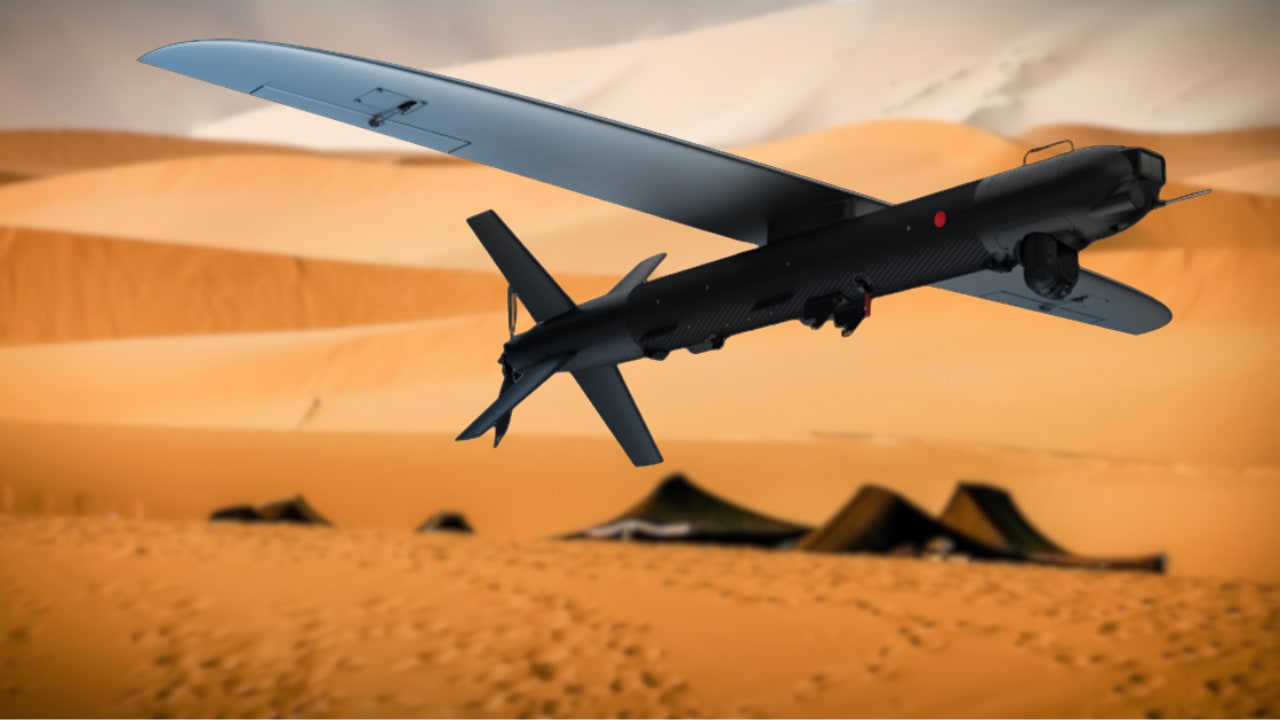
The Spanish parliament received an unusual question from lawmakers of the far-right Vox party in late May: Was Madrid prepared to respond to a potential Moroccan attack using Israeli-designed SpyX suicide drones, now being manufactured domestically through a joint venture between Morocco's Royal Armed Forces and Israeli firm BlueBird Aero Systems?
The question was framed as a national security concern. It is better understood as a measurement. When a NATO member's legislature begins formally calculating whether it can defend against Israeli-made weapons now produced on the other side of the Strait of Gibraltar, the Abraham Accords' defense technology transfer has moved well beyond diplomacy into the geometry of regional power.
The 2026 fiscal year has produced a stark divergence in defense philosophies between Rabat and Algiers. Morocco has embraced a qualitative modernization strategy, allocating $17.1 billion toward advanced technology and the creation of a domestic defense industry through joint ventures with Israeli firms, including BlueBird Aero Systems.
Algeria, by contrast, has committed a record $25 billion to its military, representing 20.6% of the national budget and nearly 9 percent of GDP. The spending exceeds Algeria's combined education and health budgets and is financed through a central government deficit surpassing 10%.
Algeria's defense spending as a share of GDP is now the second-highest in the world, trailing only Ukraine. Unlike Ukraine, Algeria is not fighting a war. The force it is building exists in direct response to the capabilities Morocco is acquiring, which are substantially Israeli in origin.

On the outskirts of Casablanca, in the Benslimane industrial zone, Israel Aerospace Industries subsidiary BlueBird Aero Systems inaugurated a dedicated production facility for its SpyX loitering munitions, the first such factory anywhere in North Africa or the Middle East outside Israel.
The Israeli-designed man-portable systems feature a 50-kilometer operational radius, up to 120 minutes of loiter time, terminal dive speeds exceeding 250 kilometers per hour, and a 2.5-kilogram warhead optimized for precision strikes against armored vehicles, command posts, and high-value targets.
The SpyX slots into a broader multi-layered air defense network that includes Israel's Barak MX, China's FD-2000B, and the Sky Dragon 50. Morocco has also acquired Harpoon Block II missiles from France and a string of American platforms including F-16 fighter jets, AH-64 Apache helicopters, and HIMARS rocket launchers.
The total picture is a military that has leapt from a Soviet-era Maghrebi force to a multi-domain precision-strike architecture within five years, anchored by American systems, integrated through Israeli technology, and now producing its own loitering munitions domestically.
As Algiers remains tethered to Cold War-era Russian hardware and Iranian-aligned proxies, Rabat is harvesting the dividends of its strategic pivot. The Syria angle has sharpened this assessment considerably: a senior Algerian brigadier general and some 500 soldiers from the Algerian army and Polisario militias were detained fighting on behalf of pro-Iranian forces, and during investigations they allegedly admitted to receiving training from Iran's Revolutionary Guard Corps and Hezbollah. This has provided Rabat with what it sees as definitive evidence of the Iran-Hezbollah-Polisario axis, vindicating Morocco's 2018 decision to sever ties with Tehran.
The Algerian military establishment is committing a quarter of the national budget to defense while running a deficit that will consume foreign currency reserves within a projected three to five years at current spending rates. This is not a sustainable long-term approach. It is a regime making a short-term political calculation: that the army's institutional primacy must be demonstrated, and Morocco's Israeli-equipped modernization must be met quantitatively even when it cannot be matched qualitatively.
Algeria's procurement priorities are focused specifically on countering Morocco's Israeli capabilities, emphasizing multi-layered air defense, electronic warfare, long-range precision munitions, and anti-drone warfare systems. In practice, this means Algeria is spending $25 billion to develop countermeasures to systems that did not exist in Moroccan inventory five years ago and whose most advanced variants are still being transferred under the 2026 Israel-Morocco joint military action plan.
The Spanish parliament question and Algeria's record defense budget are measuring the same reality from different angles. The Abraham Accords have produced the Maghreb's most consequential defense technology shift in a generation, generating responses across the regional architecture - from Algerian procurement planning to NATO legislative debate.
Washington should treat this not as an instability risk to be managed through restraint but as a strategic success requiring active deepening. Morocco and Israel signed their joint military work plan for 2026 in early January, structuring year-round military dialogue, joint industrial projects, force-development exercises, and strategic alignment on evolving threats, with Israeli officials now describing Morocco as Jerusalem's most vital security partner on the African continent.
Washington should formalize that triangle into a named trilateral security framework, begin preliminary discussions on Morocco's long-term access to advanced American systems commensurate with its demonstrated institutional reliability, and explicitly condition US-Algeria engagement on verifiable de-escalation of the military posture directed at a US-aligned partner.
Algeria is spending itself toward a fiscal crisis to counter Israeli weapons. Washington should make clear which side of that contest it is on.
Amine Ayoub, a fellow at the Middle East Forum, is a policy analyst and writer based in Morocco. Follow him on X: @amineayoubx