
Here we go again.
It’s been almost a year since Israel and Iran first went to war during Operation Rising Lion. Again, in April this year (no, not an April Fool’s joke), they warred in Operation Roaring Lion.
This time around, the third time has to be the charm.
Iran was testing the United States and Israel by firing the initial wave of missiles on Sunday night. It had warned that any strikes by Israel in Beirut would lead to missile fire on the Jewish state, but what came first? Hezbollah fired rockets toward the Israeli city of Kiryat Shmona.
Around and around we go.
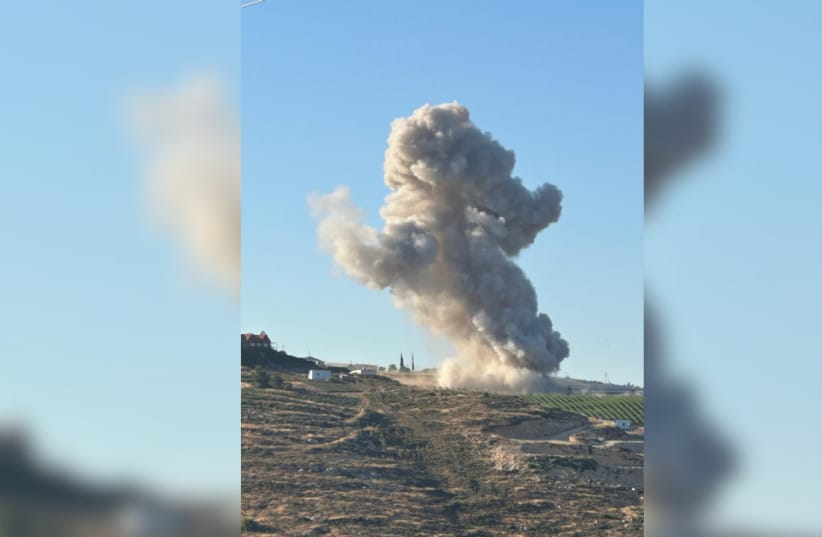
The month-long war with Iran in April gave the Islamic regime the feeling that it had won the last war. It had won against the Little and Great Satan – Israel and the US. It had gone up against the two strongest militaries and came out stronger – and now, it was the one to go on the offensive by firing at Israel first.
Israel can't turn blind eye on Iran
Unlike the rockets fired by Hamas toward southern Israeli communities prior to October 7, Israel could not turn a blind eye to Iranian missile fire. That would not only “change the equation,” but it would give Iran an even bigger prize – the sense that it could deter Israel, not the other way around.
In Operation Epic Fury/Roaring Lion it was the US and Israel that went on the offensive first. They carried out waves of intense strikes against the Islamic Republic, killing its supreme leader in the first seconds of the war.
During the war in April, the two allies (especially the Americans) used a large number of advanced interceptors to down Iranian missiles and drones. According to some reports, the Americans fired more interceptors than the Israelis.
Speaking in March at the 2025 Air and Space Forces Association (AFA) Warfare Symposium, US Air Force Lt.-Gen. Heath Collins, who serves as the Missile Defense Agency director, said that the scale of the missile attacks by Iran, even in April 2024, “was beyond what these systems were initially designed for.”
Nevertheless, he said, the “decades-long partnership with Israel has been invaluable. It took years of training. We have a test bed called the Israeli Test Bed, where we brought in the US and Israelis together to plan and execute the fight that was actually critical in the heated, very complex environment that they were seeing. We really had to train for that large volume.”
Collins made the comments prior to Operation Epic Fury/Roaring Lion when Iran fired thousands of missiles and drones toward Israel, the Gulf States, and American bases. During those attacks, costly military infrastructure was damaged or destroyed, and American troops were killed.
According to a report by the AFA news website, Iranian missile fire severely damaged the command center that has run America’s air campaigns in the Middle East for the past 20 years.
The Combined Air Operations Center (CAOC) at Al Udeid Air Base in Qatar is under Air Forces Central, the air segment of US Central Command, and it is responsible for planning and executing air operations in a complex and large theater. It includes representatives from 17 nations.
It came as no surprise to the Americans that the center was struck – Iran had targeted it in June with over a dozen missiles, shortly before the ceasefire went into effect. During the April war, personnel had been transferred to Shaw Air Force Base to run the campaign from there, and no one was hurt in the attack.
The war in April saw the Israeli and American forces operate seamlessly together. From striking deep inside Iran to intercepting missiles – it didn’t come out of the blue. The two allies have been training to intercept aerial threats for years at the Israel Test Bed (ITB) run by Elbit Systems’ Elisra. Remember that comment by Collins?
Like the CAOC, the ITB has been around for a while.
It was developed to be used – by the US Missile Defense Agency, the US Army Space and Missile Defense Command, and Israel’s Defense Ministry – as part of the US Strategic Defense Initiative.

According to the company’s website, the ITB is a comprehensive, end-to-end simulator for Theater Missile Defense. It is a fully operational system deployed and operated by the Israel Air Force (IAF) and designed to “evaluate defense architectures and systems, as well as battle management concepts, algorithms, and operational procedures. It simulates ballistic missile and rocket attacks against defended assets – and the operation of defense systems against those attacks.”
Israel, US cooperation to stop Iranian missiles
Drills between American and Israeli forces occur regularly, with troops simulating attacks by enemies, such as the Iranians or Houthis, being defended by the American Terminal High Altitude Area Defense System (THAAD), Patriot, and Aegis Missile Defense Systems, along with the Israeli Arrow, David’s Sling, and the Iron Dome.
It’s a place where troops can learn each other’s doctrine and grow personal relations – two aspects that are key to successful cooperation during war. Any successful interception that we see (or don’t) comes after years of the two forces training together, but the failures also make the strategic importance of their work clear.
This time around, there are far fewer interceptors available for the Americans. Possibly even less for the Israelis. What will make them count is the training and the technology.