
Israeli company ESC BAZ, based in Lod, has been tasked with integrating its advanced systems along Israel's borders with the Gaza Strip, Lebanon, Syria, and Egypt, as border security has become one of Israel's most challenging issues.
Recently, the National Security Council tasked ESC BAZ with developing a defense solution for the eastern border with Jordan, which faces threats from smugglers, Palestinian terrorists, and operatives linked to Iranian-backed networks.
ESC BAZ has developed, manufactured, and sold its solution to over twenty countries, including military forces, defense ministries, and infrastructure companies. This cutting-edge technology may also be integrated into IDF operations.
The system, called "Tsukit," combines the world’s most advanced surveillance tools. It operates 24/7 in all weather conditions, providing high-accuracy imagery over several kilometers from the border.
The system is linked to an artificial intelligence-based "brain" that can detect unusual occurrences, alert operators, and focus attention on potential threats. The system can also launch EVO drones from a “hive” of drones designed for various missions: gathering intelligence, investigating areas or buildings, using non-lethal methods to repel threats, deterring intruders, or executing lethal strikes (each drone is equipped with 200 grams of explosives).
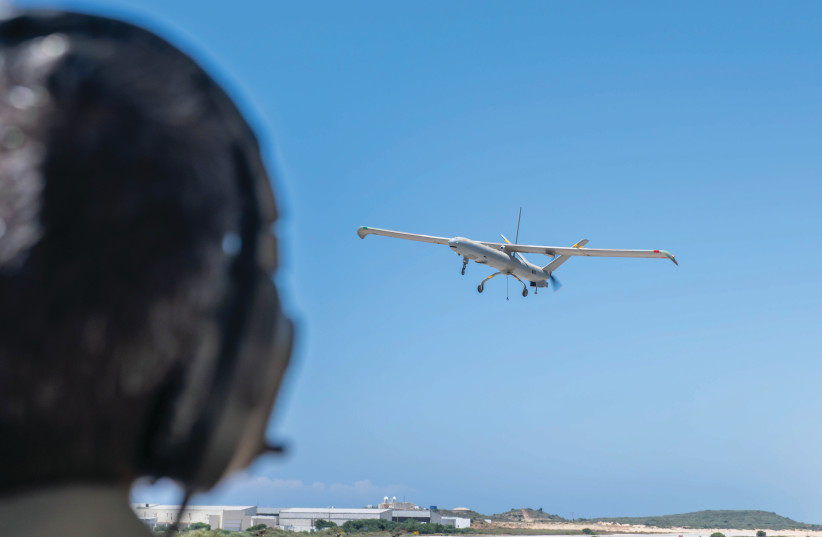
This system is specifically designed to handle scenarios like the October 7 attack, when terrorists breached the border. Its unique ability to be stationary, mobile, or easily deployable in the field significantly enhances its survivability against attacks, as seen when Hamas targeted IDF observation systems during that incident.
Enhancing border protection during war
The system was activated along Israel’s northern border during the recent conflict, in collaboration with the Northern Command. This activation dramatically upgraded surveillance capabilities in the region, even as Hezbollah terrorists targeted observation points and other key infrastructure.
The system’s versatility extends to addressing security challenges in the West Bank. For instance, the observer can identify armed terrorists preparing to attack, even when military response units are not immediately nearby. A similar incident occurred last year on the Israel-Jordan border, near Neot HaKikar, when terrorists infiltrated the border. The surveillance systems spotted them, but the nearest military unit was about 25 minutes away.
An advanced feature of the "Tsukit" system enables it to verify any device emitting a signature, including smartphones, smartwatches, radios, vehicles, and even license plates.
The system can identify individuals, determine if their movements are unusual, and assess whether they belong to the area. This technology was recently sold to the Lithuanian Defense Ministry to help protect its borders, particularly in light of the ongoing Ukraine-Russia conflict.
Cybersecurity and operational flexibility
ESC BAZ CEO Assaf Mahlab told Walla that the system is immune to cyberattacks and can effectively counter enemy tactics. It offers operators a much broader perspective than the current surveillance systems in use by the IDF, while also enabling the neutralization of threats using classified methods.