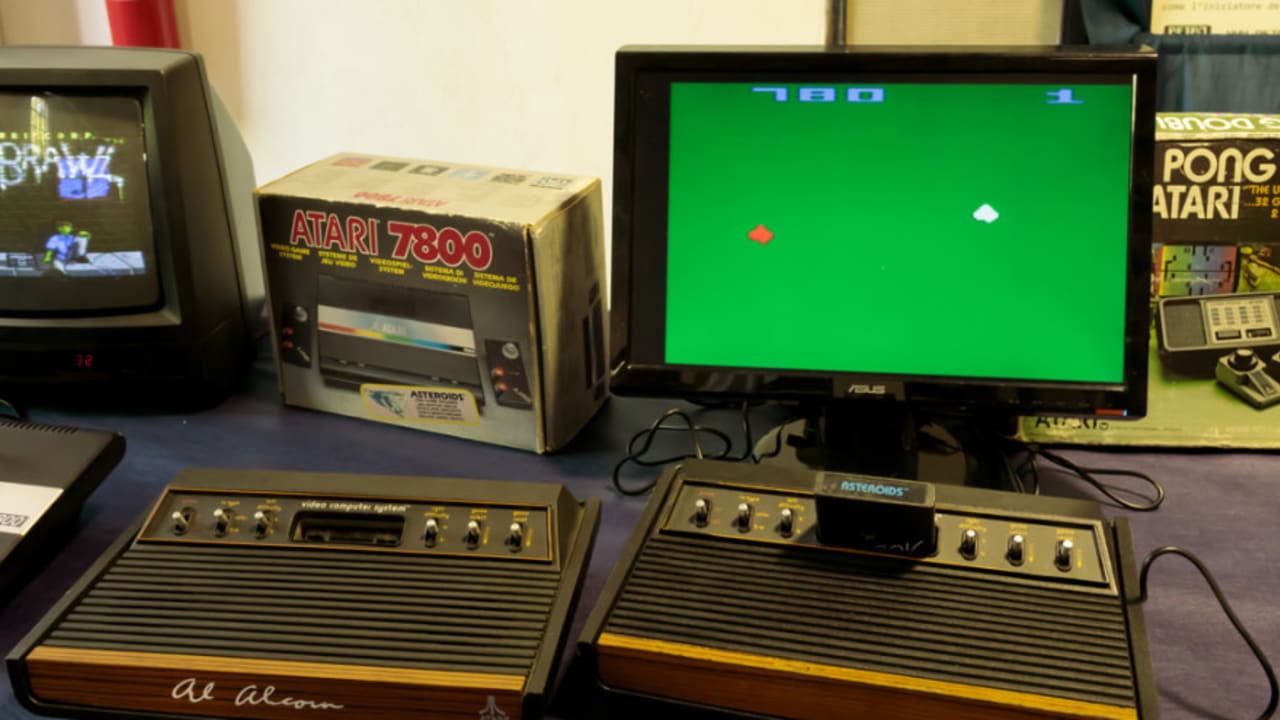
Atari’s comeback: One of the companies most closely associated with the early days of the video game industry has been trying in recent years to prove that even a brand long seen as a symbol of collapse can return to life - if it stops chasing the wrong future. Instead of competing with modern gaming giants with massive budgets, Atari has chosen to return to what it still truly owns: The collective memory of an entire generation, a historic game catalog, and a name that still evokes emotion among millions of players worldwide.
In the context of the 2026 gaming industry, Atari is not a giant. It is not Sony, not Microsoft, not Nintendo, and not Tencent. It is a much smaller, publicly traded company listed in Europe, operating in a highly competitive and fast-changing market. But precisely its relatively modest size makes its business story interesting: Instead of trying to reinvent itself as a general technology company, it is attempting to turn its past into a product. Not as a museum, but as a living business that sells games, consoles, rights, remasters, and a carefully packaged nostalgia experience.
Atari’s history begins in the early 1970s, when Nolan Bushnell and Ted Dabney founded a small company that would go on to transform global entertainment culture. The game Pong became one of the first symbols of arcade gaming, followed by hits such as Asteroids, Centipede, and Missile Command. The launch of the Atari 2600 brought video games from arcades into the home living room, and for a few years the Atari name became nearly synonymous with video games and consoles.
But rapid success also accelerated the downfall. In the early 1980s, the market became flooded with games - many of low quality - while consumer trust began to erode. The home versions of Pac-Man and E.T. became symbols of an era in which the industry moved too fast with too little oversight. In 1983, the video game market in the United States collapsed, and Atari, as one of the core players in the bubble, was severely affected. The myth of the burial in the New Mexico desert, where unsold cartridges and equipment were allegedly dumped, became a symbol of corporate hubris, later partially confirmed by an excavation carried out in 2014.
Since then, Atari has passed through different owners, transformations, and revival attempts. The French company Infogrames adopted the name, followed by years of trying to extract value through licensing, casual games, and side ventures. At various points, the brand attempted to appear modern at almost any cost: Digital currencies, blockchain initiatives, a digital casino, and even ideas for Atari-themed hotels. In hindsight, these were not stable growth engines but rather symptoms of a company searching for identity without deciding what it truly is.

The current shift is primarily associated with Wade Rosen, an entrepreneur and investor who took leadership roles within the company and has led a more focused strategy in recent years. Rosen did not acquire Atari outright in a single deal that finalized control in 2022, as some earlier formulations suggested. Rather, he was a major shareholder and led an attempt to increase his stake through a friendly takeover bid. That attempt was not completed as planned, but it signaled the direction: Rosen aimed to bring Atari back to its core - games, community, retro, and preservation.
The most significant move was a shift in priorities. Instead of positioning Atari as a crypto company, a lifestyle brand, or a general entertainment platform, the company began acquiring assets aligned with its historical identity. In 2023, Atari acquired Nightdive Studios, a studio specializing in reviving old games and adapting them to modern systems. That same year, it announced the acquisition of Digital Eclipse, one of the leading names in historical game collections and remastered editions, with expertise in presenting classic games not just as playable files, but as living archives including documentation, videos, interviews, and background materials.
These acquisitions are not just catalog additions. They change how Atari defines itself. Nightdive brings the technical ability to modernize old games and bring them to current PCs and consoles. Digital Eclipse brings deep expertise in cultural preservation and in packaging games as stories. For veteran audiences, this is the difference between an old game simply re-released on a digital store and an edition that respects its history. For younger audiences, it is a way to experience classics without feeling like they are artifacts from a technological museum.
In 2024, Atari made a particularly symbolic move by acquiring the Intellivision brand and the rights to more than 200 games. Intellivision was one of Atari’s historic rivals in the early days of home consoles. This acquisition did not turn Atari into a gaming giant, but it strengthened its position as a key player in the retro market and, more importantly, as a collector of an entire era. For a company built on nostalgia, owning a legendary rival is not just a business deal but also a powerful marketing narrative.
At the same time, Atari has returned to hardware. The Atari 2600+ and Atari 7800+ are designed to run original cartridges from the classic console era while being compatible with modern displays. This is a product clearly aimed at longtime fans rather than those seeking cutting-edge graphics or AAA open-world games. According to Rosen, this hardware line has become profitable for the company. However, it is important to remain cautious: No full sales data has been released that would confirm large-scale commercial success in the broader console market. It is more accurate to describe it as a focused, reportedly profitable product line that fits well within Atari’s retro strategy.
Spring 2026 brought two more moves that sharpen this direction. In April, the company acquired Implicit Convergence, a studio specializing in emulation and in porting legacy games to modern systems. The deal includes Syrup, an emulation engine designed to help bring 8-bit, 16-bit, and 32-bit games to new consoles. The business implication is clear: Atari now has not only catalogs and rights, but also another technological layer that allows it to re-release old games without repeatedly dealing with the technical complexity of legacy code, obsolete hardware, and outdated formats.
In May 2026, Atari announced the acquisition of rights to the first five games in the Wizardry franchise, one of the most influential role-playing series in PC gaming history. Precision is important here: Atari did not acquire the entire Wizardry franchise or all global rights to the brand. According to the company’s statement, it acquired full and exclusive rights to the first five games and their original universe. The sixth, seventh, and eighth entries are owned by Japan’s Draxom and are based on a different narrative universe. Therefore, the accurate description is that Atari acquired a foundational and highly significant part of Wizardry’s legacy, not the entire series in its broadest sense.
The numbers also present an interesting but less dramatic picture than marketing language might suggest. In its March 2026 business update, Atari projected revenues of approximately $50 million for the fiscal year ending March 31, 2026. This is significantly higher than the previous year and reflects roughly 40% growth, but it came after a downward revision from a previous forecast of about $60 million. In other words, this is strong growth, but also a company still dealing with operational uncertainty and the need to prove it can turn acquisitions into stable long-term revenue.
According to recent interviews with Rosen, the company has grown from about 20 employees a few years ago to more than 200 today. This is a significant change, especially for a brand that for years looked more like a licensing asset than an active game company. But even here, proportions matter: Much of the workforce growth comes from acquisitions of studios and companies, not purely organic expansion. The business implication is that Atari has acquired capabilities, people, and catalogs - and the real test now is whether it can integrate them into a single company with a clear strategy.
Atari’s next challenge will be proving that it is not just collecting old brands, but capable of managing them. The retro market is strong but limited. It relies on a loyal audience, collectors, older gamers, and a younger generation discovering gaming history through social media, digital stores, and remastered editions. To turn its comeback into a sustainable business story, Atari will need to maintain quality, avoid oversaturating the market, carefully choose which games to revive, and above all avoid repeating the mistake that contributed to its collapse in the early 1980s: Sacrificing consumer trust for short-term releases.
In that sense, Atari’s comeback is not a story of a company returning as an empire. It is still far from that. It is the story of a brand once considered nearly a corporate relic that has found a model suited to its limitations and strengths. The Atari of 2026 is not trying to define the future of gaming - it is repackaging its past. If it continues to do so carefully, without overpromising and without turning nostalgia into a cheap commodity, it may become one of the most interesting companies in the classic gaming market precisely because it finally understands that what was once its weakness - its long and complicated history - is now its greatest asset.