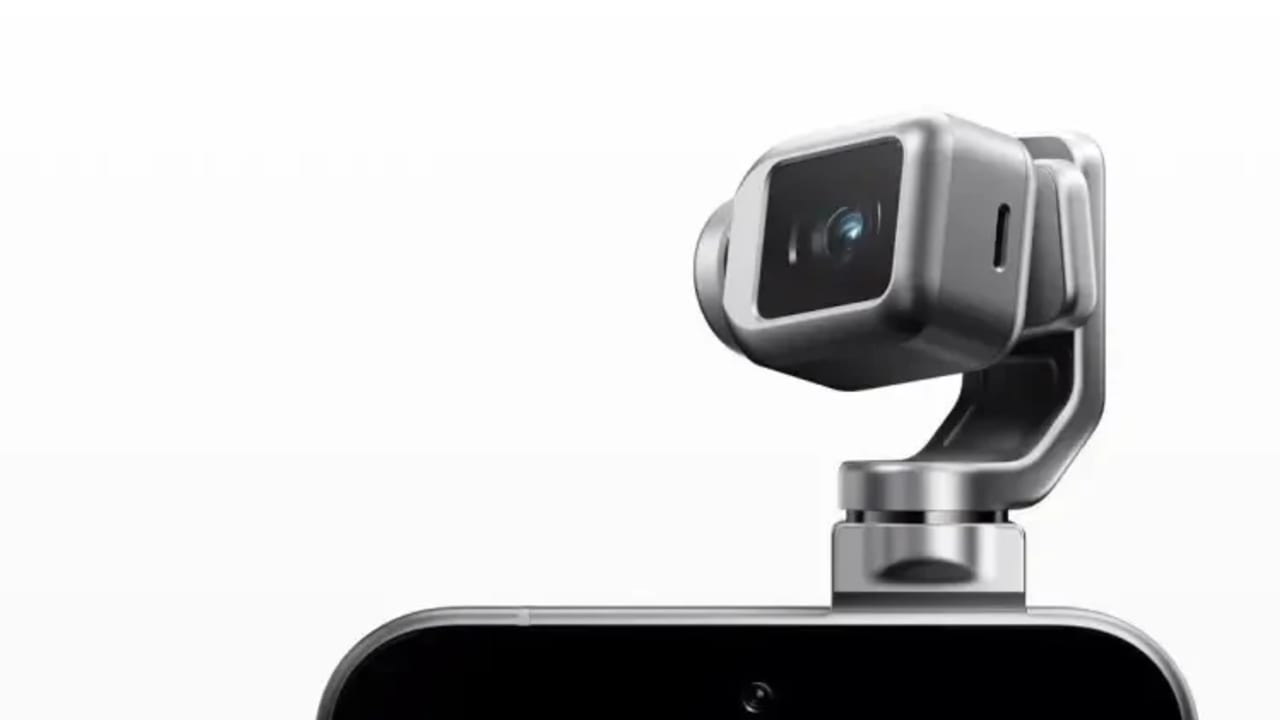
Honor announced what it calls the “Robot Phone” – a new concept smartphone featuring a smart robotic camera mounted on a gimbal that can shoot in any direction. According to the video released by the company, the device at first glance looks like a fairly thick phone, but instead of the brand logo, it bears the Greek letter Alpha – a symbol of Honor’s “Alpha Program,” aimed at redefining the company’s vision. At the center of attention is an exceptionally large camera module, divided into two parts, from which a small robotic arm carrying the main camera extends.
When the arm opens, it emits a short laugh in the video (yes, a real laugh) and presents a camera that can flip to take selfies but can also move at different angles and directions – meaning, according to Honor, it can operate independently. The concept is reminiscent of the flip camera mechanism of the 2019 Asus Zenfone 6, but this time it is far more advanced: The camera resembles a miniature version of the DJI Osmo Pocket camera, with free movement on a gimbal that allows smoother and more precise shooting.
In the teaser video, the robotic camera is shown not just as a photography tool but as an almost human-like intelligent entity – it is depicted focusing the frame on its own, gazing at stars in wonder, and even “soothing babies.” Honor claims this represents the next step in smartphone evolution, a device that not only serves as a work tool but also as an “emotional companion.” The company statement reads: “With the Robot Phone, we envision the phone of the future as more than a tool – it becomes an emotional friend that senses, adapts, and develops independently, enriching users’ lives with love, joy, and wisdom.”
The Robot Phone was revealed as a surprising announcement at the end of Honor’s official launch event for the Magic 8 flagship models, which will first launch in China this month and reach international markets by the end of the year. According to the company, more details about the concept device will be presented at the Mobile World Congress this coming spring, where a real prototype – not just a computer-generated video – may be seen for the first time.