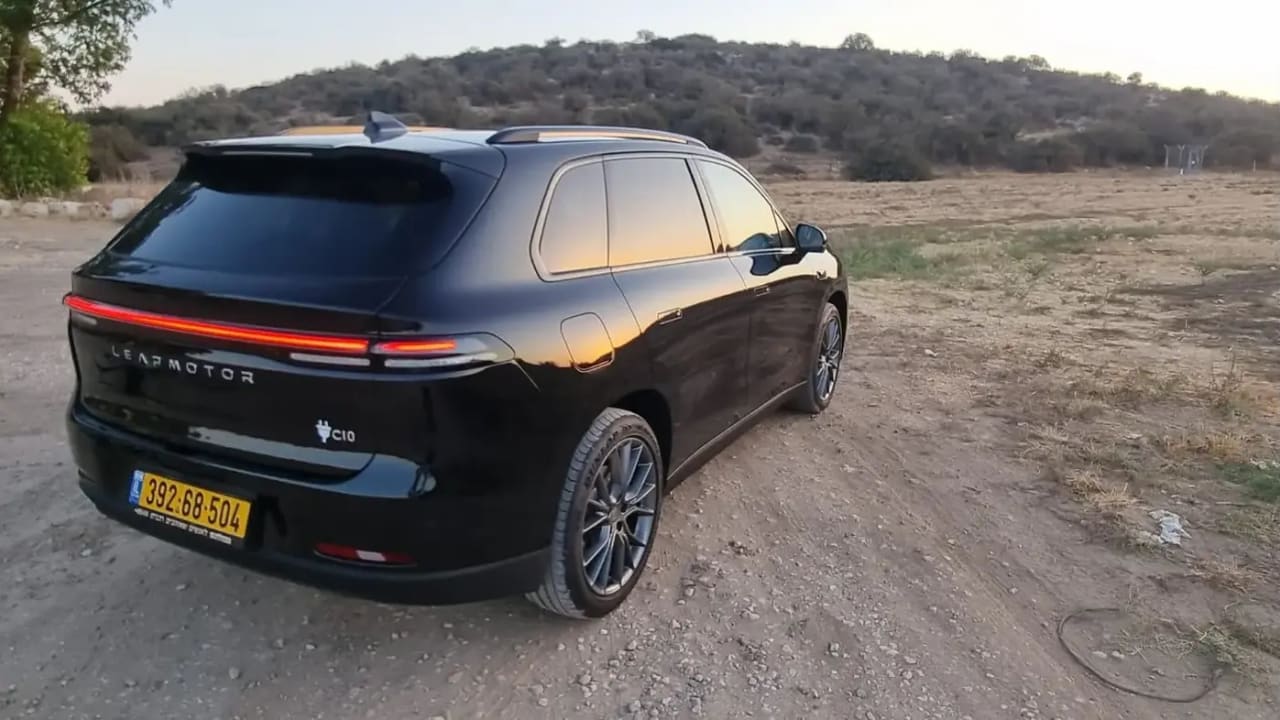
- Price (base/test car): NIS 190,000/185,000
- Competitors: JAC 7, Lynk & Co 01, BYD Seal 5
- Liked: Space, equipment, material quality, electric range
- Disliked: Ergonomics, ride comfort and handling, fuel consumption, slow charging rate, warranty
- Rating: 8/10
Israel is plugging in, but a little differently. Since the beginning of the year, 38,000 fully electric cars have hit Israeli roads, compared to 22,000 plug-in hybrids, i.e., cars that can charge from a plug and drive dozens of kilometers on electricity. During the same period last year, the gap was much wider: 49,000 electric cars versus 5,500 plug-ins.
The rise of plug-ins is one of the reasons for the decline in fully electric car sales. They allow most Israelis to drive electrically for daily commutes, errands, and school, and go on longer trips without range anxiety. Battery depleted? You get a slightly less efficient hybrid, because it carries a heavier battery than a regular hybrid, yet it’s still much more economical than non-electric gasoline vehicles.
It’s not that plug-ins haven’t sold here before; the Kia Niro PHEV and MG EHS each sold thousands in previous years. But this year, supply has surged: The Niro plug-in left the scene, the plug-in version of the EHS successor, called HS, arrived, and at the same time, JAC 7 landed here as Israel’s top-selling car, along with plug-in versions of the Chery Tiggo 7 and 8, and soon Lynk & Co 01 returning after a facelift and price reduction, Lynk 08 with an official 200 km range, the larger Tiggo 9, Omoda 7 and 9, and also the BYD Seal U and soon the new Seal 5.
All of them, by the way, are Chinese: Beijing encourages this technology for those without a permanent electric car charger, and plug-in sales in China have crossed 50% of the market. European and Korean manufacturers have their own plug-ins, and Europe’s emission regulations encourage these models, but they are much more expensive than the Chinese. So Israel sees some European luxury plug-ins, but not a single mass-market model.
In short, it’s a good time for Leapmotor to launch the C10 plug-in here. The large crossover, previously offered as a fully electric model that sold slowly due to single-phase slow charging, now comes with a gasoline-electric version that solves this drawback, at a slightly higher price: NIS 185,000 for the basic Life trim and NIS 190,000 for the well-equipped Design we drove (in electric versions, the price gap is larger: NIS 170,000 and NIS 185,000 , respectively).
A word on Leapmotor: Another Chinese electric start-up imitating Tesla, like ExPang, but one of which 21% was sold to the European-American Stellantis group (Peugeot-Citroën + Fiat and Jeep), which received global sales rights. The deal hasn’t led to Leapmotor production in Europe yet, but it boosted the brand’s sales by 91% in the first half of 2025 to 221,000 units. If you can’t beat them, buy a stake in the rival.
Design: The plug-in looks like the electric model, except for the added fuel flap. The design is somewhat generic but slightly reminiscent of the Porsche Cayenne: Respectable, solid, but not head-turning. The standout feature is the size: Identical dimensions to the electric model—4.74 meters long, 1.9 meters wide, 1.68 meters high, and a 2.825-meter wheelbase. That’s 24 cm longer than the JAC 7 and 13 cm longer in wheelbase.

Interior: No key. Entry is like a Tesla, via the manufacturer’s mobile app (which can also start the AC and seat cooling remotely, report charging status, etc.), or by tapping an NFC card to the side mirror.
The driver’s environment is identical to the electric version and, again, shows a strong Tesla influence, not for the better. Material quality is higher, but everything operates from the 14.6-inch screen, including climate control and even airflow direction. These features impress in the showroom but dangerously capture attention on the road. At least there is a separate driver display.
The only shortcoming addressed compared to the electric version is the hysterical safety warnings. They weren’t completely recalibrated, but an option was added to disable several at the start of a trip. There’s no Android Auto or Apple CarPlay, only a screen-sharing app and dongle provided by the importer, less efficient than the apps it replaces.

What’s here is plenty of space, both front and even more so in the rear. Need to transport three adults or three toddlers in car seats? This is the car. The rear floor is flat, with AC vents and charging sockets, and unlike many other Chinese cars, the seat is not too low.
Trunk: Relatively large for a Chinese car, with 435 liters in the base model and 400 in the equipped version. There is also a trunk cover, which was previously missing. No spare wheel yet.
Equipment: Two trim levels: Life (from NIS 185,000): 18-inch alloy wheels, panoramic sunroof with electric sunshade, 14.6-inch multimedia and control screen, 10.25-inch digital driver display, electrically adjustable front seats, faux leather upholstery, keyless entry and start, climate control with rear vent, and more.
Design (NIS 190,000): Adds electric tailgate, ventilated and heated front seats, 20-inch wheels, and ambient lighting. Even at the base trim, the C10 is significantly better equipped than the JAC 7 (electric front seats, panoramic roof).
Safety: The C10 received 5 out of 5 stars in the European crash test last year. It has autonomous emergency braking forward and backward, adaptive cruise control, lane-keeping and deviation correction, blind-spot monitoring, and automatic high beams.

Engine and Performance: The car has a 215 hp electric motor driving the rear wheels, and a 1,500 cc gasoline engine that charges the battery, functioning solely as a range extender and not connected to the wheels.
Although the output is identical to the electric version, the power delivery character, plus an extra ~50 kg, makes acceleration less brisk, though still good. Comfort mode saves energy, and Sport improves acceleration.
Range, Consumption, and Charging: The 28.4 kWh battery is the largest in plug-in models under NIS 200,000, promising an exceptional electric range of 145 km. In practice, we achieved ~120 km with a mix of city driving, traffic jams, and calm highway driving at 90-110 km/h. This is excellent, well beyond the daily needs of most Israelis.
Leapmotor claims 250 km/L in combined driving, which is as realistic as a vision of autonomous cars taking over the world. One reason is that, unlike modern plug-ins, the C10 lacks a hybrid mode where the car decides which engine to use for optimal consumption. When the gasoline engine activates, it’s not always quiet.
You can choose between electric mode that starts the gasoline engine after the battery drops to 25%, a mode that delays activation to 9%, and a battery preservation mode with direct charging from the gasoline engine. After battery depletion, we achieved no more than 12 km/L with the engine running.
Fast charging is possible at 65 kW, or slow at 6.6 kW, which requires about five hours to charge the large 28.4 kWh battery.

Comfort and Handling: Suspension is soft, helpful at city speeds but bouncy on uneven roads. It struggles with bigger potholes. Body roll is excessive in corners, discouraging pushing grip limits. Despite rear-wheel drive, don’t expect sporty behavior. Noise insulation is average.
Bottom Line: Creating a truly successful car isn’t easy. Although Leapmotor will only celebrate its 10th anniversary in three months, it is already outperforming older, bigger manufacturers. It’s clear why Stellantis, whose brands are over 100 years old, invested in it.
The C10 plug-in is spacious, well-equipped, high-quality, and economical if used correctly. It has a competitive price and good value. The plug-in version solves the slow charging problem of the electric version (and a new model addressing this has already launched globally). It’s a good solution for those wanting an electric car without range anxiety, able to charge daily—here, the battery will never leave you stranded. On the other hand, many plug-in owners rarely charge, and using this car as a regular hybrid yields high fuel consumption, similar to a gasoline crossover.
Ergonomics are still insufficient, safety systems need proper calibration, and a 2025 car should come with Android Auto and CarPlay, not a promise for future software updates. Warranty is shorter than most other Chinese models. This crossover is a good car, which could be excellent with a little more attention—still not too late to provide it.

Leapmotor C10 Plug-In Design: Technical Specs
- Engine: 1.5 L gasoline + electric motor, combined output 215 hp, combined torque 32.6 kg·m
- Transmission: Direct, rear-wheel drive
Performance (manufacturer):
- 0-100 km/h (seconds): 8.5
- Top speed: 170 km/h
- Electric range (manufacturer, km): 145
- Electric range (test, km): 120
- Fuel consumption hybrid mode (manufacturer, km/L): 15.6
- Fuel consumption hybrid mode (test, km/L): 12
Electric:
- Battery capacity (kWh): 28.4
- Slow charging (AC, kW): 6.6
- Fast charging (DC, kW): 65
Dimensions:
- Length (m): 4.739
- Width (m): 1.90
- Height (m): 1.68
- Wheelbase (m): 2.825
- Trunk volume (L): 400
- Weight (kg): 2,025
Safety:
- European crash test rating: 5/5 stars
- Active safety: Autonomous emergency braking, adaptive cruise control, lane keeping and deviation correction, blind-spot monitoring and collision prevention, automatic high beams
Warranty:
- 4 years or 100,000 km for the vehicle, 8 years or 160,000 km for the battery