
Gold Rush Architects: Wilson and Gundlach Rewrite the Playbook
The U.S. economy is no longer simply flirting with a traditional recession; it is showing unmistakable signs of a structural breakdown, as even the world’s top strategists scramble for new playbooks. Among the most influential voices, Mike Wilson, Chief Investment Officer of Morgan Stanley, has ignited a new debate on portfolio construction. Wilson advocates for a radical 60/20/20 approach—60% equities, 20% fixed income, and a dramatic 20% allocation to gold. In his recent commentary, Wilson argued that this new model offers a far more robust defense against inflation and central bank policy uncertainty, compared to the time-honored 60/40 split. Unsatisfied with traditional hedges, Wilson describes gold as “the anti-fragile asset to own,” a safe-haven with resilience against rising inflation and market downturns, and insists that high-quality stocks and gold together now form the strongest duo for investor protection.
The Death of the 60/40 Portfolio
For decades, the 60/40 portfolio—60% stocks and 40% bonds—set the standard in institutional investing. The premise seemed inviolable: when growth drove equities, bonds kept the balance in downturns. But as Wilson bluntly points out, this foundational principle simply no longer fits the new era of rampant inflation, fragile central banks, and declining faith in traditional safe havens like U.S. Treasuries. His endorsement of gold as a core 20% holding is a tacit admission that bonds can’t provide the diversification and stability they once did. The institutional world is now contemplating a seismic shift toward the “anti-fragile” attributes of gold, as seen by surging prices and inflows into gold investments.
Gundlach Predicts: “$4,000 Gold and 25% Allocations—Not Excessive”
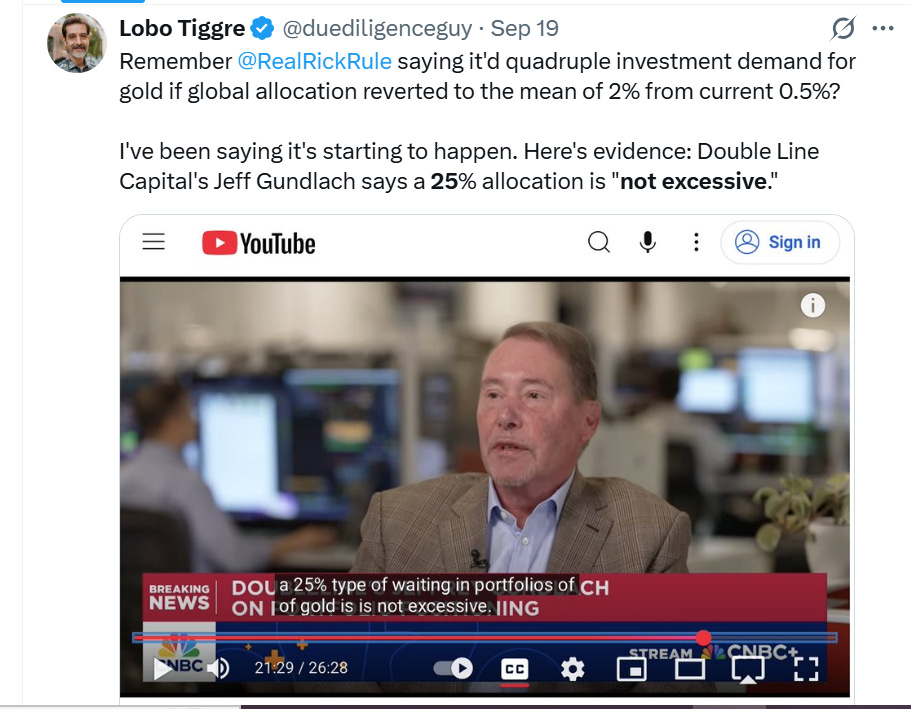
DoubleLine Capital’s Jeffrey Gundlach has added his influential voice to the gold rush. Gundlach recently forecasted that gold could hit $4,000 per ounce before year end, suggesting that even a 25% gold weighting in portfolios is not excessive in the current environment. Gundlach, known for his prescient macro calls, echoes Wilson’s conviction that traditional portfolios are dangerously outdated, and that gold must now take center stage for anyone serious about protecting wealth from inflation, policy missteps, and financial market tremors.
Overstretched Valuations, Underlying Fragility
Meanwhile, the disconnect in financial markets has never been more glaring. Microsoft’s P/E ratio stands near 38, well above its historical norm. Tesla’s is in the stratosphere at about 225, and Nvidia trades above 50—levels that in prior decades would have been regarded as warning signs of a dangerous bubble. These “magnificent seven” tech stocks drive market indices higher, yet their valuations are increasingly disconnected from earnings momentum, casting further doubt on the durability of this bull run.
Corporate America: “Layoff Tsunami” and the End of Easy Growth
The job market collapse is stark. Tech giants like Microsoft, Oracle, Google, Amazon, Shopify, Salesforce, Meta, and Intel have collectively eliminated tens of thousands of jobs in 2025 alone. Salesforce’s recent round involved nearly 4,000 roles, and this wave extends beyond tech—to energy giants like ConocoPhillips and even to consumer-facing industries. The Bureau of Labor Statistics recently revised prior job growth numbers sharply downward, revealing the true weakness beneath the surface. Only 35,000 jobs have been created per month in recent quarters, with unemployment climbing to multi-year highs. The wave of layoffs has engulfed not only white-collar workers but the entire consumer economy, as seen in Las Vegas—MGM Resorts has laid off hundreds at multiple levels, while consumer discretionary spending tumbles and broader leisure and hospitality sectors start to buckle.
Portfolio Paradigm Shift: Gold as Lifeboat
This is not merely recessionary turbulence, but a profound phase change in the economic system. Surveys already show that nearly 60% of companies anticipate further layoffs into 2026. Former pillars of prosperity—the upper-middle class and affluent households—are pulling back sharply on spending. Luxury retail, upscale travel, and the previously untouchable tech sector are all on the defensive. The sea-change is so dramatic that both institutional and retail investors are headed for safety: allocations to gold are at multi-generational highs, and market forecasters are openly talking about gold prices the likes of which haven’t been seen since the 1970s. Morgan Stanley’s Mike Wilson and DoubleLine’s Jeff Gundlach are not outliers, but bellwethers. Their calls for making gold the cornerstone of portfolio defense mark the beginning of a new investment era, where faith in the old social contract of work, growth, and asset inflation has begun to fracture—and the rush to safety is on.
Content quality approved by JPost. JPost oversees the native, paid, and sponsored content on this website and guarantees quality, relevance, and value for the audience. However, articles attributed to this byline are provided by paying advertisers and the opinions expressed in the content do not necessarily express the opinions of JPost.The sponsor retains the responsibility of this content and has the copyright of the material. For all health concerns, it is best to seek the advice of your doctor or a legal practitioner.