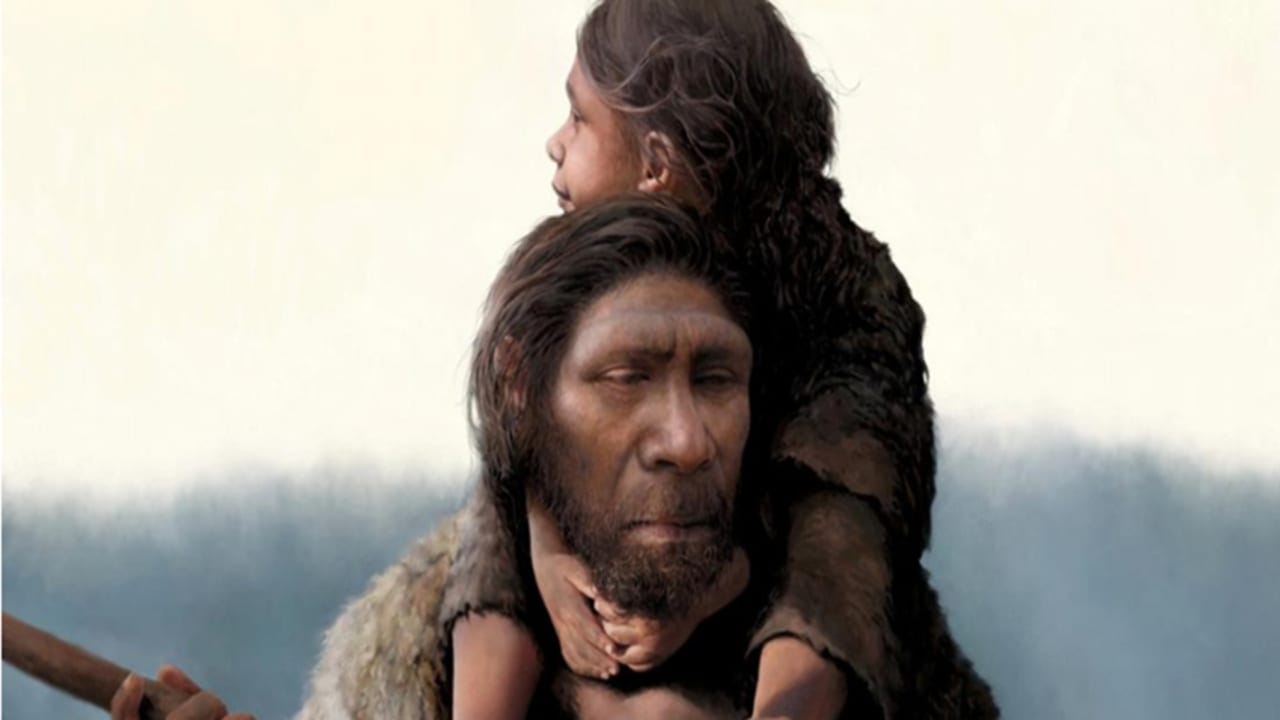
Neanderthal children developed at a much faster pace than modern humans, possibly as a way to adjust to the harsh environment of their surroundings, according to a recent study published in Current Biology.
The study analyzed the remains of a Neanderthal infant discovered during excavations in the Amud Cave in the Upper Galilee in the late 1900s, named by researchers as Amud 7, for the first time. They were found in situ in nearly 111 different fragments, tucked into a a niche in one of the cave’s walls under a red deer jaw.
According to the study, Amud 7’s remains date to approximately 51,000 and 56,000 years ago and belong to the most complete skeleton of a Neanderthal infant ever found.
However, while researchers noted that the Neanderthal features were present in the skeletal remains, it was much more difficult for them to figure out what age the child had been when they died.
When attempted to analyze Amud 7's age based on its arm and leg bones, researchers found that Amud 7 appeared to be around 13.7 months of age. But, when analyzing their age using tooth histology, the microscopic study of enamel formation in the teeth, Amud 7 appeared to be much younger, closer to six months old.

Meaning, that Amud 7's body had grown to a size typically seen in a child roughly twice its dental age.
'Rare glimpse into Neanderthal development'
Based on this, researchers found that while newborn Neanderthals and modern human newborns share similar growth in tooth formation, tooth eruption and the lengths of the arm and leg bones, Neanderthal infants had much larger skulls then humans.
Then, when they are toddlers, Neanderthals’ bodies grow at a quicker rate than their teeth, contrasting the slower and more proportionate growth of modern human babies.
It is only afterwards that Neanderthal growth evened out to match modern human children’s growth trajectories.
Neanderthals and Homo sapiens began diverging around 600,000 years ago, “evolving mostly separately in Eurasia and Africa thereafter,” according to the study,
Further, it noted that despite the divergence, there have been proven cases of interbreeding between the two species during the Middle Paleolithic era, showing that even with the division, there was still compatibility.
“This suggests an evolutionary strategy emphasizing accelerated development in the early years of life, likely advantageous in the harsh environments Neanderthals inhabited,” the study concluded.
“The remains of Amud 7 provide a rare glimpse into Neanderthal development. Its distinct morphology and growth trajectory reveal that closely related species adopted different adaptive strategies in response to evolutionary pressures.”