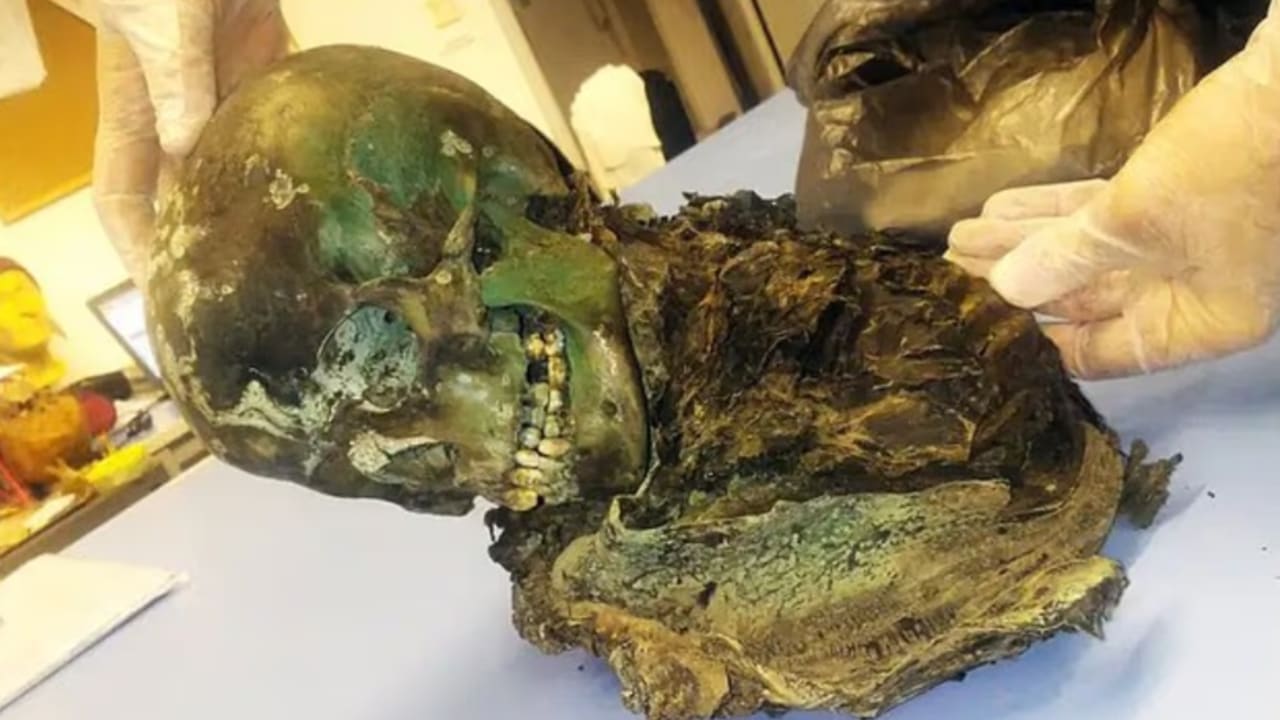
A multidisciplinary study published in Rome detailed the chain of events that turned a routine Renaissance-era burial into Bologna’s celebrated green mummy. “Ultimately, the green mummy from Bologna is the result of a unique combination of environmental factors: low temperatures in the basement, limited access to oxygen in the sarcophagus, and the biocidal action of copper ions, which together contributed to the unusual process of mummification,” wrote the study team, according to Newsam.
Conservators had puzzled over the emerald corpse since workers renovating a villa near Bologna uncovered it in 1987. The body of a boy, about 12 to 14 years old, lay in a coffin made almost entirely of copper. Laboratory tests showed that copper ions leached from the casket, replaced calcium in the skeleton, and infused skin and bone with green shades. Because copper is antimicrobial, its steady release suppressed bacterial activity, leaving hard and soft tissues largely intact and even strengthening the bone matrix.
The villa’s cellar provided low temperatures and minimal oxygen. As the coffin corroded, its base cracked, allowing bodily fluids to seep out and react with new copper compounds, which deepened the color and further slowed decay. Acids from the soft tissue also ate into the casket and produced by-products that bonded with bone. The result was a pale green patina across most of the body, sparing only the left leg; no other documented green mummy shows such intact skin.
Radiocarbon dating placed the boy’s death between 1617 and 1814 CE. Examinations revealed no signs of trauma or disease, though the lower legs were missing, likely lost when the coffin collapsed under corrosion.
“Copper not only preserves but also causes chemical transformations that uniquely preserve the body,” said Anna Maria Alabiso, lead researcher, according to Origo.
The mummy was transferred to the University of Bologna, where staff stored it at temperatures and oxygen levels similar to the original cellar. Specialists from the University of Rome Tor Vergata later conducted radiographic, histological, and trace-element studies that confirmed the absence of illness.
The study concluded that the copper coffin, the cool, oxygen-poor basement, and the corrosion products together created a natural laboratory for mummification and coloration. “Working with these unique human remains was a deeply emotional experience for me,” said Alabiso, according to Newsam.
Produced with the assistance of a news-analysis system.