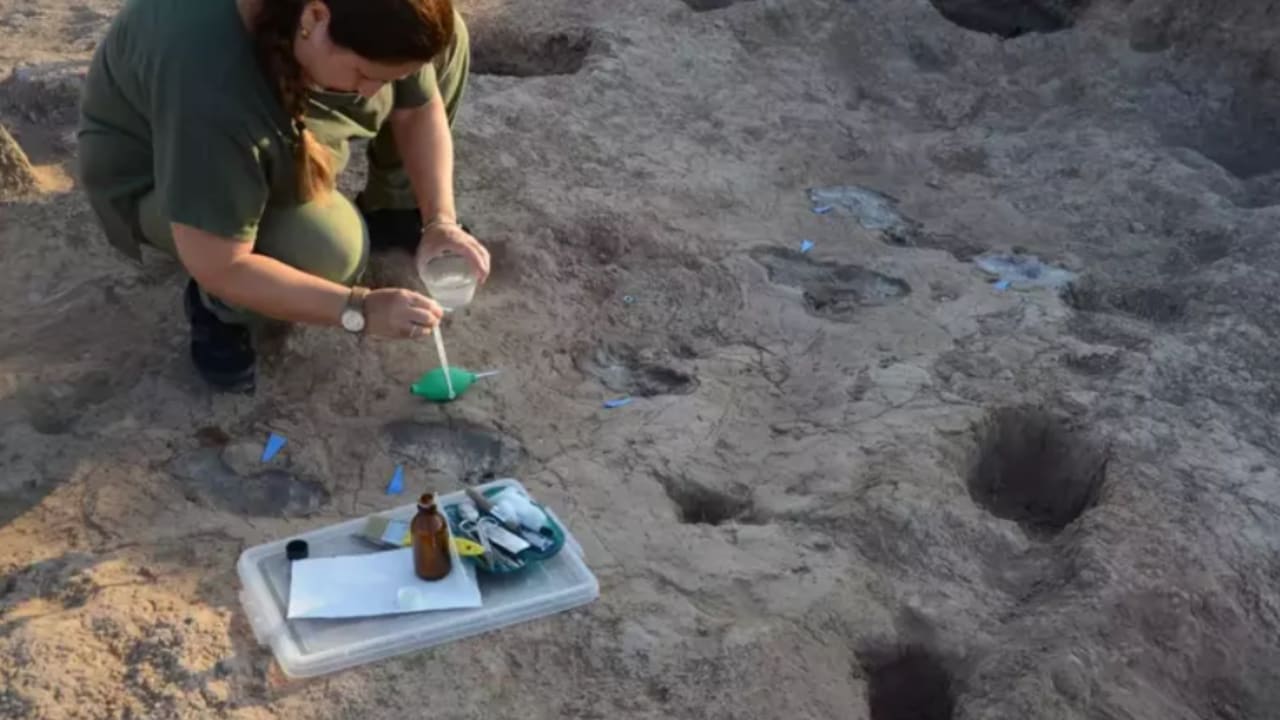
Archaeologists at Tell Kurdu Höyük mound near Reyhanlı in Turkey’s Hatay province uncovered five human footprints left in a rain-soaked surface around 5200 BCE. Turkey's Ministry of Culture and Tourism said the impressions appeared as the team dug through a sealed, water-laid layer.
"We have made a very rare discovery at the Tell Kurdu Höyük excavations in Hatay, Reyhanlı Karahüyük," said Mehmet Nuri Ersoy, Minister of Culture and Tourism, according to OdaTV. "Steps taken 7,000 years ago in Anatolia are back in the spotlight," he added later in a social-media post, reported Aydınlık.
The ministry’s briefing noted that the prints formed when several people crossed fresh mud after heavy rain; the surface then dried long enough to preserve their marks before later occupation debris buried it. Stratigraphic studies placed the layer within the Ubaid cultural horizon that linked Mesopotamia and southeastern Anatolia around 5200 BCE.
Site researchers documented three adult-sized prints and two smaller ones, using high-resolution photogrammetry. Variations in depth and spacing could, they said, shed light on movement patterns and activity areas inside the settlement.
The footprint block remained in situ under temporary cover while conservation staff prepared long-term protection and digital archiving measures, the ministry told Haberler. The Tell Kurdu Höyük work formed part of an expanding programme of state-supported excavations across Turkey.
The preparation of this article relied on a news-analysis system.