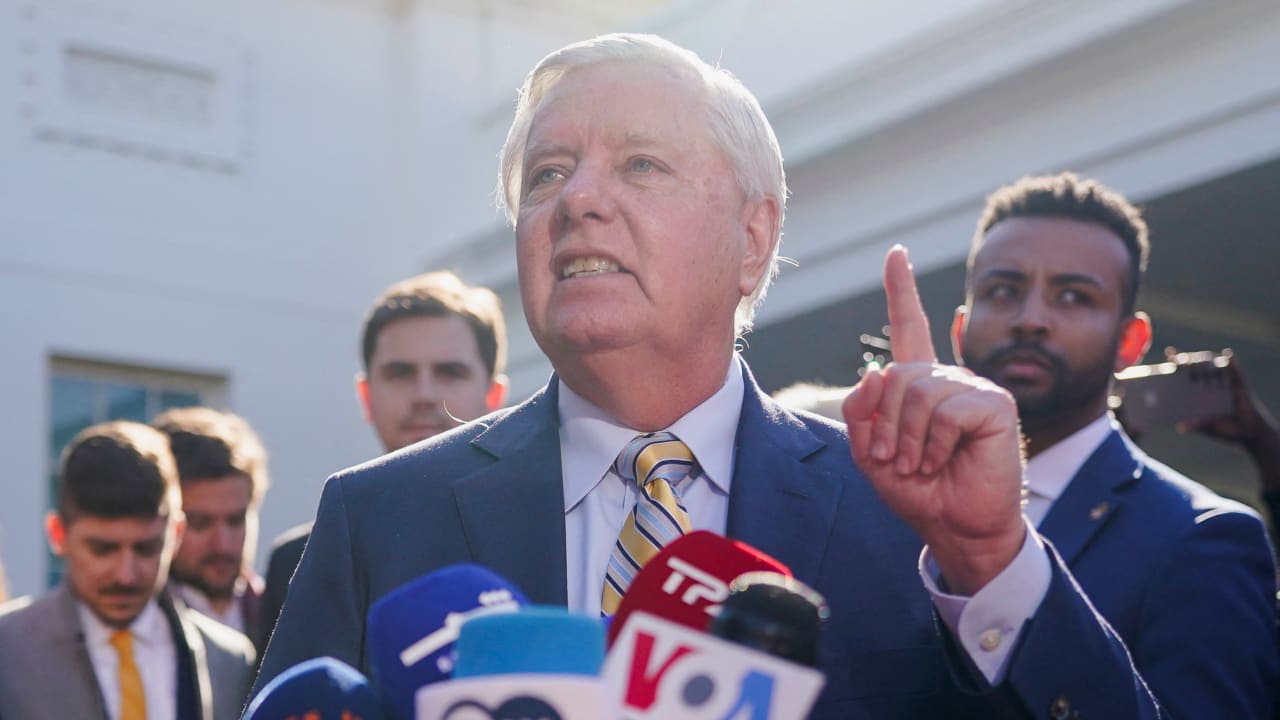
United States Senator Lindsey Graham has a message for Israelis and his own party’s skeptics: There is no sustainable future for Israel without a political horizon that separates Israelis and Palestinians into two states, once the security conditions exist.
Anything else, he warns, would either end Israel’s Jewish character or leave millions permanently disenfranchised and isolate the country.
“There is no other alternative,” the South Carolina senator told The Jerusalem Post in an interview on Friday during the Republican Jewish Coalition summit in Las Vegas. “A one-state solution would either end Israel as a Jewish state or leave millions without rights, which the world will not accept. To be pro-Israel, you need to be honest with Israel.”
Graham, one of the Senate’s most vocal hawks on Iran and a longtime supporter of Israel, said October 7 was engineered to kill the very idea of reconciliation between Israel and the Arab world and to make any talk of a Palestinian state politically impossible.
The correct response, he argued, pairs hard power with a credible political horizon: finish Hamas if it refuses to disarm, pressure Hezbollah to give up its heavy weapons, then rebuild Gaza with partners like Saudi Arabia and the United Arab Emirates under strict, measurable benchmarks and with ironclad security guarantees for Israel.

“Hamas must be gone as a governing and fighting force,” he said. “Then you put Gaza in the hands of Arabs who do not want to kill all the Jews – Saudi Arabia, the UAE, and others. They reconstruct Gaza. They change the school system so it does not glorify killing Jews. You devolve authority based on performance. If they cannot meet the metrics, they do not get the power. Meanwhile, Israel gets new security boundaries and the right to act.”
Graham’s critique of those who reject any two-state framework was unsparing, including toward parts of Israel’s right wing that still dream of sovereignty or annexation, if you will. “If you want to marginalize the Jewish state, go down that road,” he said. “It will do more damage to Israel’s future than any bomb Iran could ever build. You would lose support here in America, and you would isolate Israel from the world.”
Graham added that no administration in Washington is going to tell Arab leaders that Gaza and the West Bank will simply be handed to Israel.
“There are a billion Muslims. If you imagine a new Middle East with no Palestinians in Gaza and the West Bank, you are living in a dream world,” he said.
“Israel absolutely should insist there cannot be radical Islamic terror in the West Bank and Gaza. There will never be a Palestinian state with this crowd. But over time, with different leadership and real security arrangements, you can get to something that protects Israel and gives Palestinians a life to live for rather than a cause to die for.”
Graham addressing the Hamas problem
On Hamas, Graham rejected what he called wishful thinking about voluntary disarmament. He likened the group to a tiger that cannot change its nature. “All the evidence since the ceasefire is that they consolidate power, suppress opposition, and plan the next assault. Waiting will only make the next fight bloodier,” the Republican said. If a multilateral force does not materialize to disarm Hamas, he added, “it will fall on Israel.”
Graham placed these prescriptions inside a broader strategy to weaken Iran by removing its proxy tools. “You isolate Iran, and you remove their tools of disruption – Hamas and Hezbollah,” he said. If Hezbollah refuses to turn over heavy weapons to the Lebanese army, “you create a ground component, Israel leads, and the United States can provide air power to disarm them by force.”
He also tied Hamas’s defeat to regional normalization, arguing that progress against Iran’s proxies would make it easier to expand the Abraham Accords. He said he hopes to see a normalization deal between Israel and Saudi Arabia on the table within months, coupled with a reconstruction program in Gaza that Arab partners can publicly champion without undermining Israel’s security.
“You have to give [Saudi Crown Prince] Mohammed bin Salman a political horizon he can sell to the Arab world because it preserves dignity for Palestinians without endangering Israel,” Graham said. He predicts normalization between Israel and Saudi Arabia by May 2026.
Inside the United States, Graham dismissed the idea that anti-Israel voices on the Right are ascendant. “Seventy-five beats twenty-five,” he said, citing Republican support for recent strikes on Iran. While he acknowledged a persistent isolationist minority, he argued it is politically toxic to run against Israel in mainstream Republican politics.
“If you run for [the] Senate or the House on a platform that says supporting Israel is bad for America, that the Jews get you in trouble, you will get creamed,” he said. “It is one thing to sit on a podcast and flirt with white nationalists in a basement. It is another to try to sell that to voters in South Carolina.”
Graham credited Evangelical Christians as the anchor of the Republican Party’s support for Israel while urging pastors and politicians alike to strengthen education for younger Americans. “In parts of the media, Israel is the bad guy. In the Bible, Israel is the good guy. Education matters,” he said.
Graham’s optimism is tempered by a warning that time favors Hamas if Israel waits too long to resume operations should disarmament fail. “As this drags on, the harder it is to go back,” he said. “More civilians return, more booby traps go down, and you risk more Israeli soldiers’ lives.”
He said the region stands at an inflection point. “We live in historic times. If Hamas regenerates, good luck convincing Hezbollah to disarm. If Hamas is permanently removed and Gaza is rebuilt by partners who reject radical Islam, everything else gets easier.”
He also pushed back on fatalism about Palestinian society. “Do not tell me things cannot change,” he said. “Germany and Japan were the most radicalized places on the planet. Over the arc of time, they changed. I would never ask Israel to accept a Palestinian state that could generate another October 7. But over time, with different leadership and real security guarantees, you can have a Palestinian partner that lives in peace with Israel.”
The bottom line, in Graham’s telling, is a sequence that begins with force and ends with a political destination that preserves Israel’s Jewish and democratic character.
“Wipe out Hamas. Press Hezbollah to disarm or face consequences. Isolate Iran. Bring in Arab partners to rebuild Gaza with performance-based benchmarks. Give Israel the lines and the freedom of action it needs,” he said. “Then, keep your eyes on the horizon. If you pretend the Palestinians will vanish, or that one state is viable, you are not being honest with Israel or with yourself.
“Being pro-Israel means telling hard truths,” Graham said. “The only path that keeps Israel Jewish and democratic is a two-state framework, when the conditions are real. That is the reality friends should say out loud.”