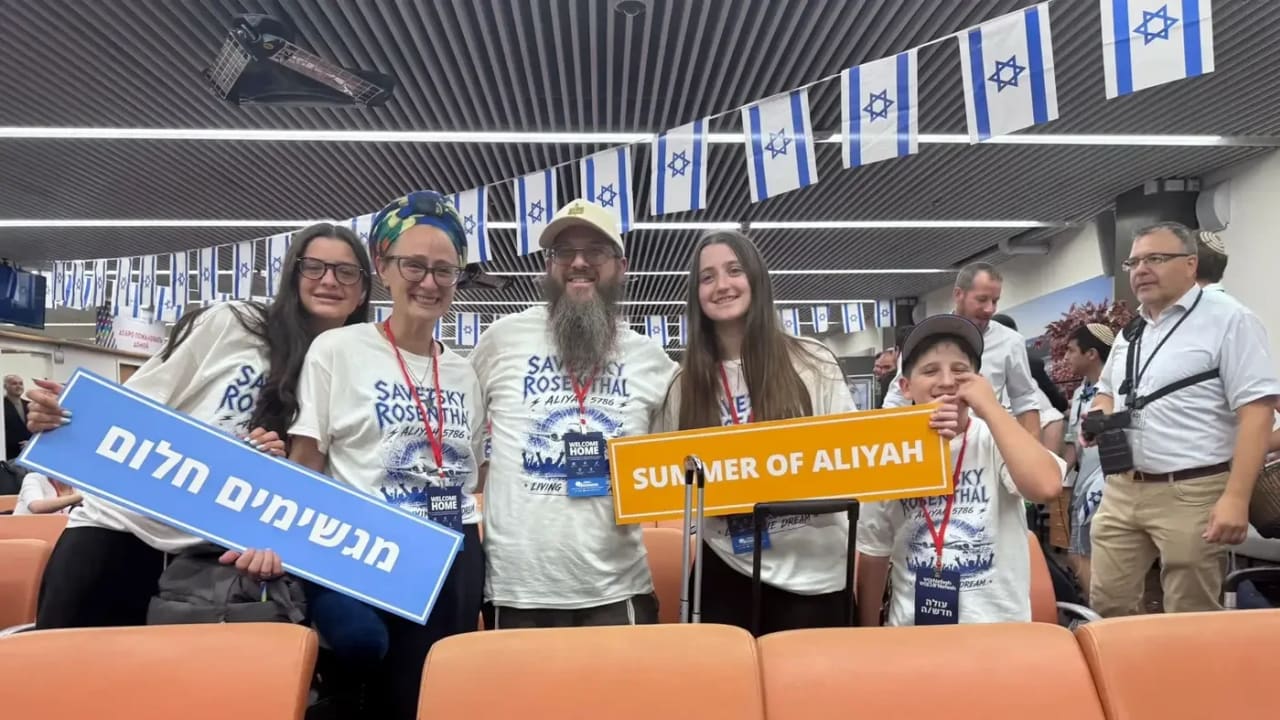
They are leaving comfortable lives, careers, and personal security for a reality of war, high costs, and uncertainty. Yet despite rising antisemitism, only a small fraction of Jews in the US and Canada are choosing to make aliyah.
Walla joined a flight from New York to Tel Aviv and met those who refuse to remain on the sidelines.
They are coming from the US and Canada not because life there has collapsed, but despite the fact that it remains comfortable, orderly, and familiar. That is precisely what makes their decision so striking: leaving behind security, language, careers, and community to make aliyah to an Israel facing prolonged war, high costs, division, and uncertainty. It is not an escape from something bad, but a conscious move toward a more demanding place because it is theirs.
Israeli stand-up comedian Yohay Sponder, who performs in English for Jewish and Israeli audiences, has captured this paradox in recent years with both humor and sharpness. In a clip that went viral, he offers a simple test of who qualifies as a Zionist: "Zionism is only if you came from somewhere better than Israel. It is not Zionism if you upgraded your life; Zionism is when you downgraded your life to help us reach the level of the country you came from. Very simple."
Last week, Walla joined several dozen Zionists of this elite variety as they traveled from New York to Tel Aviv in the middle of the seasonal peak for aliyah, just before the beginning of the school and university year.

They were not being pushed onto the plane by immediate circumstances. On the contrary, many were leaving behind full and established lives, driven by a sense of belonging that had grown stronger after the massacre and the war, as well as by antisemitism that has become increasingly visible on the streets, on campuses, and online.
"This is the last exile," 28-year-old Aaron Dahan, owner of Cafe Aharon on Manhattan's Upper East Side, told Walla two days earlier. His antisemitic employees abandoned him after October 7. "There are almost no Jews left in Europe. All the Jews left their homes and moved to Israel, except in the United States in general and New York in particular."
Dahan insisted that Walla take a copy of Jewish historian Prof. Pamela Nadell's book, Antisemitism, an American Tradition, which he prominently displays on the counter of his coffee shop.
Referring to Mayor Zohran Mamdani, whom he views as notorious, he remarked: "Thank God he was elected. If it takes this garbage antisemitic mayor to get us moving, then it is a blessing. Even my wife, who does not speak a word of
Hebrew and who, when we got married, agreed we would make aliyah only after celebrating our 75th birthdays, is already ready to leave tomorrow."
Ilana and Steven
Among the new immigrants were Ilana and Steven Snyder, both 67 and from New York State, who stood excitedly at John F. Kennedy International Airport last Wednesday, moments before boarding El Al Flight 010.
They were leaving the US, where they were born and raised and where, by their own account, life is comfortable and easy, for an apartment they had rented in Jerusalem's Arnona neighborhood.

"America is beautiful, welcoming, and comfortable, but if you are Jewish, you are still an outsider," Steven explained. "The more observant you are, the slightly harder it becomes. In Israel, religious or not religious, you are no longer a stranger. It is your country. That is something I always felt I was missing, and it is time to come home."
Ilana said a similar feeling had grown stronger for her since October 7, as it had for many other immigrants.
"We became more aware that if you wear or carry something that identifies you as Jewish, maybe you should hide it. That is a terrible feeling, and we do not want to live in an environment where you have to hide who you are," she said.
Two of their three daughters have already made aliyah, one 12 years ago and the other exactly a year ago, while their third daughter may join them next year. Their daughters were also the ones who selected their Jerusalem apartment after giving them a video tour.
Steven, an accountant, and Ilana, a baker and personal chef, hope to quickly integrate into their new lives.
"We want to integrate, to be Israelis," they said. "We do not want to be Americans living in Israel."
The flight carrying the Snyders landed Thursday morning and was one of six flights that brought about 150 immigrants from North America to Israel that day. Their flight alone carried about 40 new immigrants.
Behind those numbers was an entire system of guidance and assistance provided by Nefesh B'Nefesh, which works in partnership with the Aliyah and Integration Ministry, the Jewish Agency, KKL, and JNF-USA. Since its founding in 2002, the organization says it has helped more than 100,000 Jews from North America make aliyah.
According to Nefesh B'Nefesh, more than 2,200 new immigrants arrived from North America this summer. They included about 480 families, nearly 100 group flights from the US and Canada, and additional immigrants who obtained citizenship while already in Israel.
More than 1,100 made aliyah in August alone, a month the organization describes as one of its strongest for immigration since it was founded.
The organization sees the figures as a sign of an especially strong year. Since the beginning of 2026, about 2,700 new immigrants from North America have moved to Israel, while the forecast for the full year stands at more than 4,000. If that projection is realized, the organization says, it will be one of the strongest years for North American aliyah since its establishment.
According to Nefesh B'Nefesh, the numbers also reveal a relatively young wave of immigrants whose scale has been almost unexpected. The average age is 29.
They include about 1,100 single men and women, roughly 250 retirees, and around 700 children and teenagers who began the school year in Israel this week, including approximately 80 first graders. Another 300 young men and women are expected to join the IDF or National Service.
Among the immigrants are professionals from a wide range of fields, including doctors, nurses, teachers, lawyers, accountants, and technology workers.
Their places of origin stretch from New York, New Jersey, Florida, and California to Maryland, Illinois, Ontario, Pennsylvania, Texas, and Georgia. In Israel, they are expected to settle in Jerusalem, Beit Shemesh, Ra'anana, Modi'in Maccabim Reut, Tel Aviv, and Haifa.
About 650 are also expected to make their homes in communities in the Negev and Galilee under the Zinuk Ba'Aliyah program, a joint initiative by Nefesh B'Nefesh and KKL that encourages settlement in national priority areas.
Eleanor
Beyond the statistics, however, the real story begins when the numbers are given faces. It lies in the gap between the lives left behind and the lives these immigrants hope to build in Israel.
Eleanor Kotler, 43, from Minneapolis, is one of them. She left what she described as a dream job in design, sustainability, and inclusion at the headquarters of retail chain Target.
Kotler first came to Israel in December 2023 to volunteer and has returned repeatedly since then, as though something in the course of her life had permanently shifted.
Her moment of disillusionment came just days after the massacre, during a professional conference in California focused on equality and social justice.
"It was like an indoctrination camp for the pro-Palestinian movement," she said. "I felt like I was the only Jewish person there." A non-Jewish colleague who attended the conference with her even urged her to leave. "She said it was not safe for me as a Jewish woman."

Kotler stayed, documented what was happening, and sent the videos to Jewish organizations and the conference's sponsors. "I was completely shocked. It was my big wake-up moment."
The personal cost came quickly, too. Her public support for Israel distanced her from close friends, including some she described as being close to her "like sisters." She also came to understand that the views she had begun expressing could narrow her employment prospects.
"I knew that could happen, but ultimately I do not want to work for an organization that would be like that," she said.
Then came the love story.
During a visit to Israel last December, Kotler met Moti, 47, at the beach. Within a few months, they were engaged. She is now leaving her job, plans to live with him in Ramat Hasharon, and is preparing for a wedding at Midburn.
"Before that, I was thinking about making aliyah because I did not feel at home there," she said. "But once I met him, everything became simple, and I will always prefer a happy love story."
Nefesh B'Nefesh also became her gateway into the aliyah process. "Everyone I spoke with who had made aliyah recommended Nefesh B'Nefesh. I did not even consider any other way," she said.
For Kotler, the main advantage was knowing that someone would guide her through the bureaucracy.
"I love the idea that you have a resource you can turn to with questions throughout the process, and it simply felt very safe and very supportive," she said.
She began the process through the organization's website and had already completed her first interview by January. After Moti proposed, she accelerated her preparations and moved up the aliyah date she had initially planned for the end of the year.
Roni
Roni, a pseudonym, with her full name withheld by the editorial staff, is 18 and from Manhattan's Upper East Side. She also made aliyah alone, though under different circumstances.
She grew up in an Israeli household; her father is Israeli, and she attended the private Jewish Abraham Joshua Heschel School. Israel had always been part of her life, but she said the October 7 attack profoundly changed the way she saw it.
"Before that, Israel was the place where my father grew up and a fun place to go on vacation. After October 7, I realized these are my people, and that they are not safe now."
In the months after the attack, Roni began following events in Israel closely, attending rallies and demonstrations of support, and deepening her connection to Judaism.
A two-month stay in Israel last summer further strengthened her sense that she needed to act.
"I kept asking myself how I could help and do my part. I realized that the best way I could contribute would be to make aliyah to Israel and enlist in the army."
Her decision to leave Manhattan also stemmed from a growing feeling that New York, the city where she was born and raised, was no longer home.
She had grown tired of graffiti and stickers carrying harsh anti-Israel messages and calling for a free Palestine, which appeared repeatedly on bus seats, traffic light poles, and road signs across the city.
At a pro-Palestinian demonstration, Roni and a friend stood holding an Israeli flag. The two were surrounded and shouted at.
"I saw how much hatred there is there," she said. "It made New York feel even less like my home. I felt hated by many of the people around me."
The contrast between New York and Israel became even clearer during her visit to the country. Against the alienation she felt in her hometown, she found a sense of belonging, warmth, and community in Israel.
"In Israel, I felt love from everyone, something I can no longer say about New York."
The anti-Israel hostility, she said, did not weaken her Zionist feelings. It had the opposite effect, prompting her to learn more about Israel and deepening her connection to the country.
Roni will begin a six-month pre-military preparatory program through Kol Ami in Kiryat Ye'arim. She is then expected to enlist through Garin Tzabar, hoping to serve in a combat position.
She said her family "completely" supports her decision to make aliyah and enlist.
As an American football player, she has already contacted the coach of Israel's national team and hopes to train with the team and perhaps eventually join it.
Her main concern is being far from her family, particularly her younger sister.
"I know it will be difficult and there will be days when I ask myself why I did this. But I believe the purpose and the fulfillment I will feel will make it all worthwhile," she said firmly.
Chava and Akiva
For Chava and Akiva Lessin, the decision followed a different path. It was less about romantic love and more about a family and religious commitment.
The couple, aged 46 and 47, are moving from Virginia to Modi'in with their three children, aged 12, 10, and two.
For Akiva, aliyah is explicitly a religious and ideological decision. In his view, Judaism and Zionism cannot be separated.
"Anyone who studies Torah understands that a Jew should make aliyah to the Land of Israel. And yes, not everyone can, there are obstacles."
Those obstacles delayed their plans for years.
Akiva fell in love with Israel at 18, when he arrived at the Ohr Somayach yeshiva after becoming religious. Chava developed her connection to the country in her 20s while studying at Neve Yerushalayim.

Their aspiration to make aliyah was repeatedly postponed, however, because of the demands of careers and family. Akiva believed he first needed to establish himself financially. He built a successful technology company and eventually sold it to an international firm.
The move also presented a delicate challenge for the family. Their children had never visited Israel and did not know what to expect, so the parents chose Modi'in in part because its English-speaking community could ease their transition.
"October 7 shattered the bubble of inner calm in which I had lived when it came to being Jewish and the world's acceptance of Jews," Chava said.
"I found myself repeatedly defending Israel on social media, to friends and family. It was difficult, but at the same time my love for Israel and my determination to defend it also became stronger. I realized that for me, being Jewish means that I must live in Israel."
For Akiva, Judaism is not simply a religion that his family practices, but an entire life they build. In the Land of Israel, he said, faith, family, community, language, history, and Jewish responsibility come together.
The family is deeply grateful for the life they had in the US and for the values it gave them, including freedom, self-determination, and personal responsibility.
Akiva stressed that Jews had been welcomed in America from its earliest days in an unprecedented way. The family is now choosing, "with courage and hope," to join the next chapter of the Jewish people in Israel.
Akiva describes aliyah as a "sacred adventure" and an act of faith and hope.
"We are choosing not to make comfort the only measure of a good life," he said.
Their children are also central to the decision. Chava and Akiva want them to grow up somewhere Judaism is not merely a private belief, but something lived through language, the calendar, culture, and the shared responsibility of the Jewish people.
Akiva praised the assistance provided by Nefesh B'Nefesh, saying that without it the family would not have seriously considered making aliyah. Chava has followed the organization's work for years and becomes emotional whenever she sees immigrant families arriving at their new homes.
They are well aware of the cost of the move: helping three children adjust to new schools, the Hebrew language, and a different culture; rebuilding their professional and community lives; and facing the economic uncertainty that comes with starting over.
They are also saying goodbye to a beloved community in Richmond, Virginia, where they lived for years.
"We have concerns, but we have no doubts," Akiva concluded. "We are not making aliyah because we think life in Israel will be easier, but because we believe this is where God wants us to live and grow."
Leah
Also on the flight was Leah Shusterman, 27, from Indianapolis, who made aliyah alone.
She, too, says without hesitation that October 7 was the turning point. The rise in antisemitism in the US since then has only strengthened her Jewish identity, and she is no longer willing to hide it.
"On the contrary," she said, pointing to the pendants with Jewish motifs she wears around her neck.
Shusterman is the daughter of Freidel and Mendel Shusterman, Chabad emissaries in Indianapolis, Indiana. She knows her parents will miss her, but during earlier visits to Israel, she came to understand that "Israel is home."

Zionism 2026
"The historic wave of aliyah we are experiencing this summer is the most moving testament to the resilience of the Jewish people and to the deep connection between North American Jewry and the State of Israel," said Rabbi Yehoshua Fass, co-founder and CEO of Nefesh B'Nefesh.
The organization has made changing the rules of the game its mission and, according to Fass, has helped about 100,000 immigrants from North America and the UK move to Israel since its establishment in 2002 by removing professional, logistical, bureaucratic, and financial obstacles.
It has also maintained a retention rate of more than 90%, compared with approximately 50% to 60% before the organization was founded.
"The fact that thousands of families and young people are choosing to relocate their lives and build their futures here, precisely at this time, is a Zionist shot of energy and an enormous engine of growth for Israeli society and the economy."
Yet it is here, alongside these personal stories, that the harder question emerges.
Despite the moving stories and the work of organizations driven by a deep sense of mission, the broader demographic picture of aliyah to Israel remains troubling.
Much of the hope rests on the roughly seven million Jews living in the US and Canada. Yet total aliyah to Israel fell from a peak of about 75,000 immigrants in 2022 to only around 22,000 in 2025. At the same time, more than 150,000 Israelis left the country between October 7, 2023, and the end of 2025.
In other words, aliyah from North America is providing Israel with remarkable stories of belonging and love, but it has yet to alter the larger picture. Israel's migration balance remains worryingly negative.
Compared with the years before October 7, the number of immigrants arriving from North America has remained stable at best, rising only from about 3,700 in 2002 to roughly 3,920 in 2025.
Their share of total aliyah has increased because immigration from other parts of the world has fallen significantly. In absolute terms, however, the numbers remain far below the hoped-for potential.
Even Nefesh B'Nefesh's forecast of more than 4,000 immigrants in 2026 represents only a tiny fraction of the total Jewish population of North America, roughly one immigrant for every 1,750 Jews, or just 0.057%.
At that rate, it would take 2,000 years to bring them all back.
Israel, of course, hopes that more Jews will be willing to leave America for Israel, and to do so in significant numbers. But despite rising antisemitism, high costs, and the need for heavy security to maintain communal Jewish life in America, for now, that is not happening.